 •
Rating:
•
Rating:
THE REVIEW
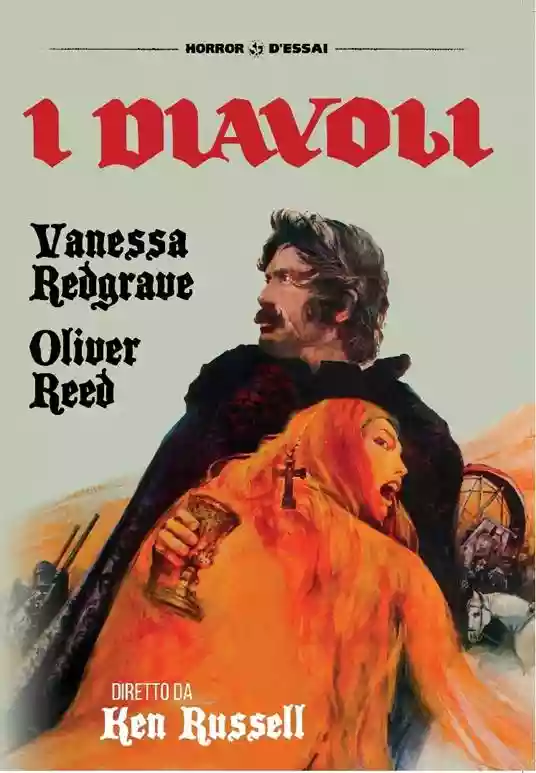
THE DEVILS — KEN RUSSELL
First of all, I want to thank the editorial team for giving me this space. It's a space that, let me say it straight away with utmost transparency, I will use with extreme caution. With extreme, I would say, responsibility. Because one can talk about The Devils by Ken Russell — of course, we are adults, this is a serious website, we have values — but it must be done properly. It must be done with full awareness. It must be done knowing that certain images, certain content, certain — how shall I put it — thematic nuances require an appropriate frame. This review aims to be that frame. I hope I'm up to the task. I hope, above all, that the reader — whom I greet with sincere affection and esteem — will wish to accompany me on this journey, with a confidence I will strive to deserve, word by word.
That being said. Let's begin.
THE PLOT — I’LL JUST BARELY TOUCH IT, I SWEAR
There’s a priest. There’s a nun. There’s a novice in the review room on the Site. They never actually meet each other, which does not prevent things from happening that — how shall I put it — I would prefer not to have to describe in detail on this site, not out of personal censorship, let me be clear, but out of respect for the context and the sensibilities of the readership, which are diverse and deserve protection. There is power. There is the church. There is the state. It ends badly for those who did not deserve such an end. Oliver Reed. Vanessa Redgrave. Derek Jarman for production design. The story is true, documented, historically verified — I stress this because it seems important, at this moment, to emphasize it.
THE CENSORSHIPS — IF YOU WILL ALLOW ME, ONE BY ONE
And here’s the point. The delicate point. The point that — and here I ask the reader for a small act of trust in me, which I will reciprocate with the utmost objectivity — I cannot avoid addressing, even though I know that addressing it exposes me. Exposes me to what, exactly, I cannot precisely say. But it exposes me. I feel it. I feel it and I proceed all the same, because it is right to do so, because it is necessary, because someone must do it and that someone, today, is me. With all the weight that entails.
1. The "Walpurgis Nun" scene — cut by Warner Bros., 1971. There is a scene. In this scene, things happen that Warner Bros., in 1971, deemed not for distribution. I won’t go into details — I’m not the right person at the right time, it’s not the place, it’s not the moment, it’s perhaps not even the right website, but here I am anyway — and I’ll just say that Russell was not consulted. The director was not consulted about his own film. I note this without comment, because anyone in my position would make the comment and I don't need to add anything. You’ve already understood. I know you’ve already understood.
2. The British ban on the uncut version.
The British Board of Film Classification intervened with mandatory cuts that I would describe — and here I choose my words with great, great care — as numerous. Plentiful. Enthusiastic, almost. Russell protested for thirty years. The BBFC did not seem particularly troubled by this protest, which tells us something, even if I'm not here to say what it tells us. You’re grown-ups. You already know what it tells us.
3. The seizure in Italy.
The Italian magistracy seized the film for blasphemy against the Catholic religion. A trial followed. Years followed. A version circulated within the country that was, if I may be permitted this very delicate observation, a film different from the film. I’ll add nothing more. I cannot add anything more. Not on this website. Not today. Perhaps not ever, frankly.
4. The ban in Catholic countries.
Francoist Spain, Portugal, France, Latin America. Forbidden, mutilated, redistributed in unrecognizable forms. I would never dare — let me make that clear — to establish causal links between the nature of the content and the geography of the censorship. That would not be correct. That would not be balanced. Above all, that would not be prudent. I’ll leave it at that and let the reader, in their wisdom, establish what connections seem appropriate. If they seem appropriate. Which could be many.
5. The disappearance from the BBC.
Aired once, in 1979. Then never again. The BBC did not explain. Did not explain for years. Did not explain with a consistency which, if I may, is almost admirable in its steadfastness. I’m not insinuating anything. I simply register it. I’m the one who registers, with the calm of someone who has nothing to fear and therefore is very much afraid.
6. The Warner block on home video. Warner Bros. systematically blocked every attempt at complete release for decades. Official reasons were never made clear. Unofficial ones — and here I lower my voice, metaphorically, because this is a serious site and not a place for speculation — I leave entirely to the reader, to whom I’m very fond and in whom I place total, unconditional trust. Total. Unconditional.
7. The Director’s Cut — Russell dies waiting.
In 2002, the BFI presented a more complete version in select theaters. Russell died in 2011 without ever seeing a full distribution. I report this fact without irony, without comment, without any inflection in my voice. I report it flatly, neutrally, clinically. Because irony here would be too easy. And I am not here to do the easy thing. I am here to do the right thing, which is much harder and probably less read.
8. The "lost" reels. Rumor had it — still has it — that some reels of the original negative were deliberately damaged. I don’t know if it’s true. I cannot know if it’s true. I am not in a position to know if it’s true, and even if I were, I’m not sure this would be the place to say so. Still, I’m telling you all the same, sotto voce, in passing, like someone mentioning something without really wanting to mention it. Did you hear? Good. Let’s move on.
9. The 2012 restoration — for the chosen few. Art house theaters. Festivals. Academic contexts. The general audience — the ones who pay, the ones who deserve it, the ones who in my opinion should really be the true recipients of art — had no access. That’s a choice. Someone made that choice. Someone with a name and a registered address made that choice. I don’t give names because I don’t know them and I don’t want to appear to have a grudge, no, I hold no grudge against anyone. There.
10. Streaming — the definitive absence. It’s not on Netflix. It’s not on Amazon. It’s nowhere. Warner holds the rights and manages them in the only way that, fifty years on, still makes sense: keeping the film away from the eyes of those who might watch it, think about it and — perish the thought — ask questions. This is not my conclusion. It’s a statement of fact. A statement I make with my heart in my hand, my eyes downcast, and full awareness that I’m saying something perhaps I shouldn’t. I said it anyway. Forgive me. Or don’t.
I don't want to seem biased. Truly. I mean it; I very much mean it, not to seem biased on this website that I value and have only recently begun to frequent, but with pleasure and with the hope that it will continue to host me after this review, which is not entirely certain, I know, and that knowledge has accompanied me since I began writing to this point, which is nearly the end, and from which I will not turn back.
The film that demonstrates with the most surgical precision how religious power and political power are interchangeable is also the film that these powers would strive, longer, more methodically, and more creatively, to erase. This might be a coincidence. It's probably a coincidence. It’s almost certainly a coincidence.
Thank you for making it to the end. Thank you for your trust. Thank you for your patience.
The film is still Unfindable in its complete version.
Loading comments slowly
Summary by Bot
The review examines Ken Russell's 'The Devils,' highlighting its controversial subject matter and bold cinematic style. The reviewer gives a moderate score, acknowledging the film's artistic ambition and provocative themes. The review recognizes both the film's strengths and flaws, with a focus on its lasting cultural impact. Religious elements and censorship issues are discussed as central points. Overall, the film is seen as notable yet polarizing.
Ken Russell
Ken Russell (1927–2011) was a British film director known for flamboyant, controversial, and visually bold cinema, including The Devils, Tommy, and Women in Love.02 Reviews
Other reviews
By Fidia
"A true masterpiece that simply has the merit of telling a true story in the best possible way."
"The merit of The Devils is precisely that it spares the viewer nothing of the clerical contradictions."
