
 •
Rating:
•
Rating:
THE REVIEW
The paradox begins with the opening credits, even before the images appear: you are the master of yourself, but you won't even have time to decide when to take a piss.
Maloney lays out to Ricky Turner the right formula to frame the job.
Maloney is the head of the transport company to which Ricky applies for a job.
He's a bastard and he's not ashamed to admit it.
He is the prototype of the technological slave driver.
You're with us, but you're not one of us.
You're the entrepreneur of yourself, but the scanner for the packages will be your God, always able to tell you where, how, and when.
The world is a vampire that no longer does you the courtesy of wrapping you in a cape before biting, and Ricky can only accept.
In the evening, returning to Debbie, Ricky tells her about the new job and how he can get the money that will allow him to undertake it.
She, a mother and home care assistant, who can't say no to anyone, will sell her car in the hope of picking up the thread of an interrupted dream, the purchase of a house.
What follows is the story of their family and their navigating through the uncertainties of an entirely ordinary life.
The political theme in this Loach remains almost in the background.
You read it if you have the lenses for it.
It's a deduction through the everyday lives of his characters.
The delivery time of a package that becomes more important than a man's time.
The technology that increasingly appears indispensable yet not too subtly guides and controls us.
A new form of slavery for which there seems to be no remedy.
What remains of the fight is entrusted to the memory of the black and white photos of the old lady assisted by Debbie.
Loach's disenchanted denunciation halts at the declaration of a state of affairs.
There remain people, with their emotions, complications, life's misadventures, but also the stubborn desire for a moment of peace and joy.
And there are passages of intense delicacy.
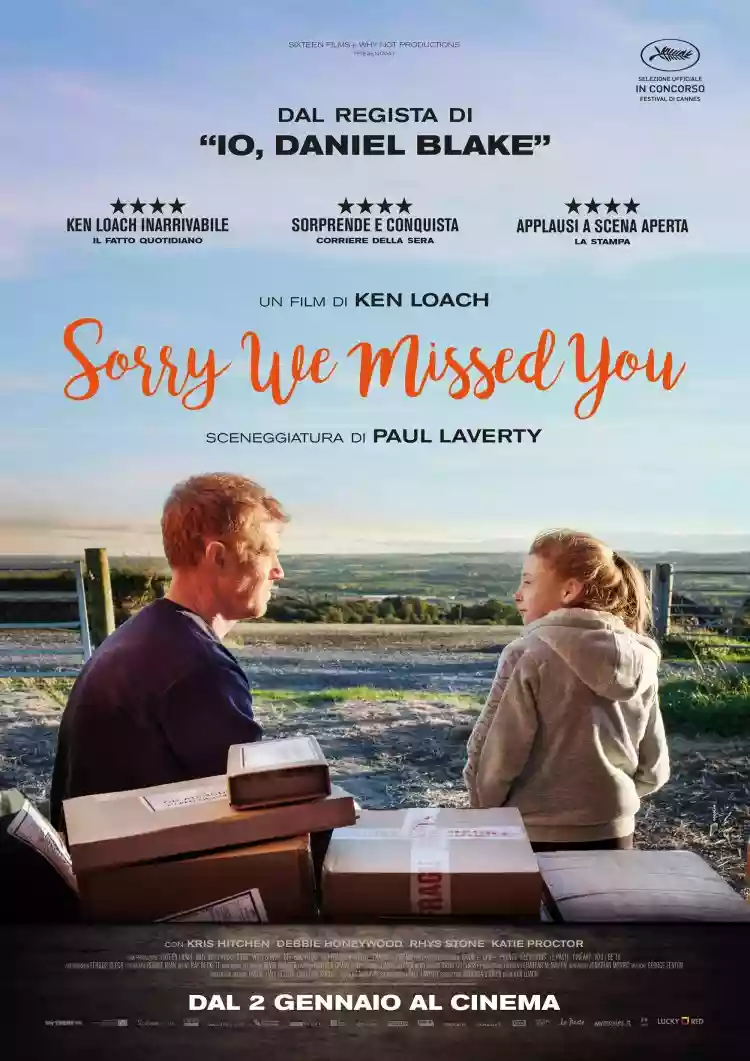
Liza accompanies her father to work, scolding him indulgently for his absent-mindedness.
Their sandwich consumed in the back of the van in front of a sunny landscape, indifferent to the scanner thundering the end of the break.
There's Seb's adolescence, the human variable that causes turmoil in the time of Debbie and Ricky, measured to the second.
He is exactly aware of what he doesn't want, without yet knowing what he desires.
Loach narrates his shyness, cleverness, urges, oppositions.
Like his saying that the person he cares for is just a friend because he doesn't yet know how to name a feeling.
Loach knows the phenomenology of adolescence well and shows it as it manifests.
And everything, in this probably unique Loach, comes without any artifice, without any star in their umpteenth masterful performance, illuminated only by a wise, profound simplicity.
Loading comments slowly
Summary by Bot
Ken Loach’s Sorry We Missed You is a powerful social drama exposing the harsh realities of the gig economy and technological labor control. The film depicts a delivery driver’s struggle and his family’s endurance. Loach’s nuanced storytelling highlights everyday life challenges with deep emotional sensitivity. Its political critique is subtle but clear. The performances and narrative simplicity enhance its impact.
Ken Loach
British film director known for social‑realist, politically engaged dramas. He won the Palme d’Or at Cannes for The Wind That Shakes the Barley (2006) and I, Daniel Blake (2016).10 Reviews
Other reviews
By ilfreddo
There is no humanity or dignity in this surviving.
Loach gives us a devastating finale with a silence that knocks us to the ground, leaving us bleeding and breathless.
