 •
Rating:
•
Rating:
THE REVIEW
”I know I am imperfect, and it is this imperfection that makes me want to improve. If I became perfect, and were no longer vulnerable, maybe I wouldn't experience the same emotional shock that makes me feel the need to write music.”
This, ladies and gentlemen, is Kate Bush. A bold child prodigy, revealed in the candid and magical splendor of her 16 years, who bloomed and appeared extraordinarily to the very fortunate David Gilmour, who became her patron and will always have the honor of having gifted the world the talents of this extraordinary artist, a being so deeply human in her shocking sensitivity and so distant from any possible analysis and rational cataloging. A nymph, a goddess from another dimension (despite a given birth date, July 30, 1958, a little over a month younger than my mother, which would make sense if time existed: but in this review, time is unnecessary) lost in a land populated by shadows, fairies, graceful white horses, and mysterious faceless men.
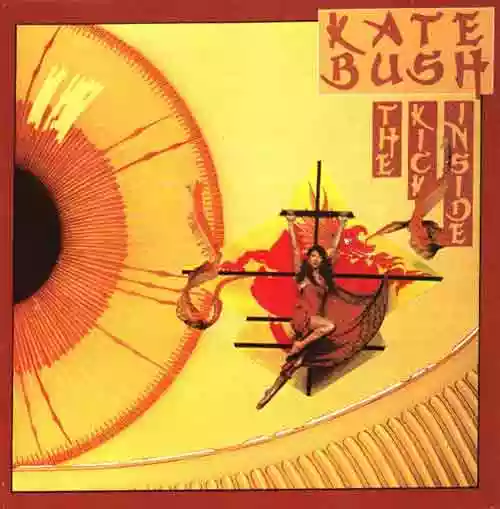
Kate Bush had composed the songs of this vinyl miracle in perfect solitude, happily trapped in a sort of enchanted glass bell, within which a small part of her innate talents (composer, dancer, author, musician) served the whims of a mad child-woman full of mischievous innocence, sensuality, recklessness, enchantment, and lust. Energy. Something too great for poor mortals: it was brutally clear that she was an extraordinary creature that had somehow landed in earthly life, strong in her gypsy soul, lived through her thousand vocal registers, her thousand eternities. A phenomenon. “The Kick Inside” is the enchantment, the spell of a nomadic princess who has gone beyond languages, genders, and “earthly” musical conventions, yet deeply attached to her uprooted roots, in love with a humanity lost in literature, arts, and song. Poetry. How much femininity is there in her that is not found in most of the muses that have brightened and will brighten the irreversible course of our lives, how much astonishment in benefiting from this angelic demon now mother, now tender girl, now untamed shrew, now butterfly… an iron Venus, therefore divine and imperious in her poignant frailty. Impossible to find her a contemporary, criminal to attempt to align her with any other model: in the art of Kate Bush, the notes, the musical genres, the literary quotes, references to distant lands, and romantic and impetuous sunsets mean nothing, they are simply the frame of a sweet orgasmic lament in which one can truly touch with hand that inner limbo of a geisha suspended between total chastity and unbridled libertinism. The torment and the ecstasy.
But Kate cannot recount her ecstasy, she is not home. Lost in a blissful confusion, she lives it through the modulations of her voice first aborted, then hinted at, then mistreated and released, through a fantastic worldly ritual, of an initiation celebrated in garments of veil with giant fuchsia blooms and in the sound of the nightingales' singing. The Divine leads me to the sweet and disturbing incipit of Moving, between Macbethian echoes and enchanted nocturnal suggestions, invites me not to be afraid to feel her in the dark, to let my battered spirit dance; the location does not matter, and now I venture to find her in a Berlin bar (The Saxophone Song) unaware of the stars building towers on the vowels, to know that I had everything of her even though unaware and undeserving of the poetry I may have bestowed upon her. The lights in the room go out at the bloom of Strange Phenomena, and I struggle to understand by drawing hypothetical meanings: but these are not songs, they are dreams and nightmares chasing each other through the gestures of a priestess so sweet and terrible in her insecurity, crossing my hearing and instinct in a mystical and painful embrace. It can be punk, reggae, or progressive. It can be a symphonic blues in which I see from very far away the images of Carole King and Joni Mitchell, but it's like entering a road where one crosses instead of meeting.
There's a hole in the sky with a big pupil in Kite calling me, inviting me to come up and become a kite on a diamond night, a diamond kite: and she's there, and we don't know if we want to stay above the moon anymore, but now I, too, no longer know how to descend, now that I’ve finally known her. And I feel bad because I know I can't be The Man With The Child In His Eyes while Kate wonders why she's told her love won’t last forever, and why she feels she must remain in this desert without the Tartars, in this valley of tears dried by her arcane whisper. I hear her voice and seek her presence while I get lost in the misty northern moor, perceive the call of Kate/Cathy returned to her Wuthering Heights, disturbed by the resignation of having to live inside a cruel illusion, though fantastically comforted by the words of my beloved that seem to want to tear apart Emily Brontë's masterpiece. But what does it matter! Even if for a few minutes, I am your Heathcliff. Or your James and The Cold Gun while suddenly you spit your poison in my face, and slap me reminding me that I’m fleeing from reality, and that paradise is nowhere else but where we have been destined, while in the chaos of my emotions I seem to hear Pink Floyd's Animals accompanying your melody kissed by the stars, now that you, from tender lover, have become so mean, and I from passionate Heathcliff become an unworthy James of you.
What a fool. But in Feel It I feel captured and swept away again by you, wicked and delightful enchantress, when you give me back the keys to the game and to my apartment, I imagine possessing you while your stockings slide on the floor, feel my warm hand caressing you and you ask me to continue to move, synchronizing time in a glorious union. It could be love or just lust, we don't ask because it’s fun, and wonderful. Oh, To Be In Love! Peter Gabriel can wait. But how did I get here? You could have been anyone's dream, and now that everything seems to have become so unreal, the colors played by your piano seem more vivid now, and every word of yours is new to my ears, fearing slipping into tomorrow too quickly because yesterday is always too sweet to forget. Yet Schopenhauer said it, the lovers' sigh is the sigh of the species. L’Amour Looks Something Like You, Kate, while I enter with you into the boudoir before morning comes too soon, stupid, old moon. But it's you who resembles an angel dressed in lace with eyes rocking in wine, and you sail in my thoughts giving me chills when you sing about wanting to be touched by me, in search of that sensation of sticky love inside. You overwhelm me in the acme of eros, in the elusive orgasm, with my sperm and your honey settling on pink skin. Cigarette. You talk to me about Them Heavy People, those wonderful teachers who opened doors you thought closed forever, read you Gurdjieff and Jesus, almost killed you! But what a wonderful feeling. You who love the whirling dances of the Dervishes, love the beauty of rare innocence, just now that I cannot believe you different from a fairy, tell me I don’t need crystal balls because we are the humans who work miracles, and each of us has an inner Eden. Because it is in Room For The Life that Kate proudly professes her being a woman, claims it in a strong and human dimension, and overwhelms me with her contagious passion, strong and gentle at the same time, and one never feels so enchanted by the impetuosity of her touch of pure femininity when she sings “We were made strong because we are women”.
A strong woman. Yet I should have realized by this point that my dream is ending and I am headed for a cruel awakening when in The Kick Inside Kate appears in a sad and twilight music and speaks to me lowering the veil, and I already know she has now decided to leave me behind. No longer a lover, nor muse, but a sister, and I must lose her like an arrow shot into the murderous storm, because I know that when I read her letter, once I come to, she will already be well. And she will return home, but not before the sun and moon meet on that hill down there…
Loading comments slowly
Summary by Bot
This review celebrates Kate Bush's debut album 'The Kick Inside' as a magical and timeless work of art. It highlights her unique sensitivity, vocal range, and poetic songwriting. The album transcends genres and conventional analysis, capturing a blend of innocence, passion, and mysticism. The reviewer deeply connects to the music, praising its emotional depth and artistic power. Ultimately, 'The Kick Inside' is seen as a singular, enchanting masterpiece.
Kate Bush
Kate Bush is a British singer-songwriter and musician known for distinctive vocals, literary storytelling, and ambitious studio experimentation across art-pop.14 Reviews
