
 •
Rating:
•
Rating:
THE REVIEW
The most important turning point in Kate Bush's career is perhaps represented by her collaboration on Peter Gabriel's pivotal third album. Thanks to that encounter, Kate decided to have greater control over the recording of her albums and managed to co-produce the album "Never For Ever" (1980), a transitional record between the child prodigy Kate of the late '70s and the uncontested lady of sophisticated pop in the following decades.
Buoyed by the feedback received ("Never For Ever" was the first album by a female English artist to reach number one in the UK), Kate decided to completely produce the next album on her own, leading to what is perhaps her masterpiece, "The Dreaming" (1982), a gem of bizarre creativity where dreams, visions, nightmares, psychoses, and passions intertwine in complex and daring plots, never giving the listener a break.
The album left both critics and audiences bewildered; the eccentric nymphet from the first three albums had disappeared, taking with her the kind of songs that could make a nation sing along, like "Wuthering Heights" or "Babooshka," and for the first time in her career, Kate found herself experiencing failure.
In hindsight, the importance of this album is clear, not only for Bush's career (in a certain sense, the much-celebrated "Hounds Of Love" can be seen as a more "civilized" version of "The Dreaming") but also for many artists who would continue its dialogue in the following decades, notably Bjork, whose experiments (vocal and otherwise) owe much to this album.
It is hard to point out specific songs as they all deserve applause.
The album opens with the relentless thirst for knowledge of "Sat In Your Lap" ("Some say that knowledge is something sat in your lap / Some say that knowledge is something that you’ll never have") and continues with the story in a heavy "cockney" accent of a bank robbery in "There Goes A Tenner." "Pull Out The Pin" sees Kate in the role of a Vietcong torn between the survival instinct urging him to kill the American soldier in front of him and the awareness that he is just a normal human being like himself ("Just one thing in it / Me or him / And I love life!"). "Suspended In Gaffa" is a wonderful psychotic waltz with a cryptic text (even in the title!), while "The Dreaming" criticizes the white man's treatment of the Australian Aborigines. It's in this track that Gabriel's influence is most visible; the intricate rhythmic section and ethnic arrangement (featuring Rolf Harris's didgeridoo) closely resemble certain atmospheres of the colleague's fourth work, released in the same year.
In "Night Of The Swallow," Kate plays two roles: in the verses, she is the wife of a smuggler who tries with every plea and threat to stop him from taking flight, while in the choruses, the husband responds; his voice, like his plane, soars to dizzying heights supported by an effective Irish arrangement.
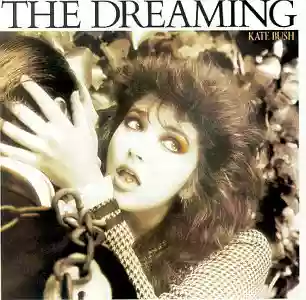
"Houdini" is divided between two separate temporal planes; on one side, there's the magician's wife who, after his death, participates in séances to disprove the self-proclaimed mediums who claim to be in contact with her husband. On the other, there’s the harrowing reconstruction of one of Houdini's breathtaking (in every sense!) exploits. A small curiosity: the album cover is inspired by this very track, showing a highly coiffed Kate-as-Mrs. Houdini about to pass the key to the chains imprisoning her husband through a kiss.
The gem of the record, however, comes only at the end, "Get Out Of My House" plunges the listener into a nightmare of distortions, agonized screams, and pounding rhythms that concludes with Bush transformed into a braying donkey (!!!), an absolute visionary masterpiece of production and vocal interpretation.
Overall, a surely difficult album where Bush courageously imposed no limits on herself and for the first (and perhaps only) time fully exploited the enormous potential of her voice and let her producer's imagination run wild, creating ten complex, powerful, and unforgettable tracks. To be rediscovered.
Loading comments slowly
Summary by Bot
The Dreaming marks a pivotal moment in Kate Bush's career as her first fully self-produced album, showcasing her bold creativity and vocal mastery. The album blends surreal themes and complex arrangements, challenging listeners while influencing future artists like Bjork. Despite initial mixed reactions, it’s now celebrated as a visionary and daring masterpiece.Tracklist Lyrics Videos
Kate Bush
Kate Bush is a British singer-songwriter and musician known for distinctive vocals, literary storytelling, and ambitious studio experimentation across art-pop.14 Reviews
