
 •
Rating:
•
Rating:
THE REVIEW
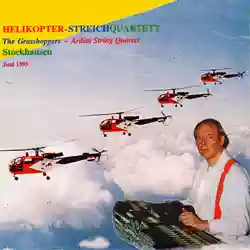
Get four helicopters, this time: complete with a pilot. Add four musicians, a string quartet to be exact: first violin, second violin, viola, and cello. Finally, four sound technicians: each of whom will have to operate a small mixer. Once the twelve humans are gathered, send them on the helicopters, make them take off, and when they are flying over your heads, it means the music of "Helikopter-Streichquartett" has started.
Too complicated? Don't worry: Karlheinz Stockhausen has already thought of it, as he wrote the music for this quartet between 1992 and 1993, destined to be part of the opera "Wednesday from Light" within the grand cycle dedicated to the days of the week. And he also thought of you, Stockhausen, you in the audience, who sit comfortably in the concert hall watching four columns of television monitors (one for each musician) and listening to the sound coming from four groups of speakers (one for each musician): images and sounds broadcast by cameras and microphones installed in the helicopters, transmitting the video and audio signals to the ground.
And since all this apparatus was dreamed up (literally) by Stockhausen, someone who was familiar with technical matters, you can be sure that down there everything is seen and heard perfectly: as happened to the audience in Amsterdam on June 26, 1995, at the first performance of this rather peculiar string quartet.
But how do the musicians, poor things, hear each other and play in sync if they are flying solo in the air? Simple, they wear a pair of headphones through which a guide voice counts the beats of the score while impulses mark the accents of each measure: all with a margin of error of a tenth of a second; additionally, through the headphones, each musician hears the others thanks to the intervention of the four sound technicians who mix guide voice, impulses, sounds, and the noise of the helicopters (also amplified with an external microphone).
This, folks, is the music of "Helikopter-Streichquartett": a tense sonic continuum that lasts about half an hour in which the helicopters are treated as percussion instruments (thanks to the noise/sound of the blades and rotors) and the four string instruments imitate the helicopters by playing in tremolo an intricate web of ascending and descending glissandi. The reference recording edition is that of Stockhausen-Verlag: a double CD featuring the recording of the world premiere in Amsterdam with an introduction in English by Stockhausen himself (7 minutes) and final comments with pilots, musicians, and audience at the end of the performance (14 minutes); in addition to the studio recorded version, with 3 additional minutes of music composed by Stockhausen after the first performance and included as the finale in the definitive version of the quartet.
A quartet born from a dream, as mentioned, after Stockhausen initially refused the commission he received to write a traditional quartet. Yet another demonstration of the fact that no one like him has been able to transform dreams, even the most extreme ones, into reality.
Loading comments slowly
Summary by Bot
Stockhausen's Helicopter String Quartet is an innovative and complex musical work requiring four musicians to perform live from separate helicopters. The audience experiences a unique audio-visual event via screens and speakers as the helicopters become part of the percussion ensemble. This piece challenges traditional music formats by blending technology, sound, and aerial performance into a tense, intricate half-hour composition.
Karlheinz Stockhausen
Karlheinz Stockhausen (1928–2007) was a German composer widely recognized as a key figure in post-war avant-garde and electronic music, known for pioneering studio techniques, spatialized sound, and large-scale works including the opera cycle Licht.17 Reviews
