
 •
Rating:
•
Rating:
THE REVIEW
Birmingham, 1976.
A group of young workers decides to emerge from the darkness of the British working class, and to do so, they record for a small label, Gull, an album where they unleash all their dreams and frustrations, far removed from the budding punk scene, and instead marking their difference, drawing inspiration from greats like Dylan and Hendrix. The guys won't be rewarded for their success in the slightest and will break their contract with the label, backed by a major (Columbia/CBS) that recognizes their talent and wants them in their stable.
Told this way, it sounds like the screenplay of a movie. In fact, it's much more: it's the first cry of heavy metal, a genre destined to experience moments of great glory and immortal vigor.
Our (Rob Halford, vocals; K.K. Downing, guitar; Glenn Tipton, guitar; Ian Hill, bass) first exclude the inept Alan Moore, responsible for the crimes committed on drums on the previous "Sad Wings Of Destiny"; then they place behind the drums a certain Simon Phillips (later Toto, Oldfield, Beck, Brian Eno, Jagger, The Who, Pete Townshend, Michael Schenker Group): finally, they entrust themselves to a producer, proposed by the new label, with some experience (the Roger Glover of Deep Purple, to be precise).
It is rare in the world for such a fortunate combination of factors to be created. The talent of the Priest (young, yes, but already very experienced) with Glover's knowledge, Phillips' stellar skill, the resources of CBS: success was bound to come.
And indeed it does. Upon the album's release, Sin After Sin reaches the 23rd position in the UK, and sells reasonably well throughout the Anglo-Saxon orbit. But it does more: it creates a myth. These are the years of change for the Priest: they begin with the all-leather and studs look, cloned for decades by thousands of other bands.
A small clarification: in 1977 the height of fidelity was the turntable (as it is today, after all), and albums were recorded for them. If you really want to hear how it sounded back then, put on the record, it's a different story. You will find it at relatively accessible prices at well-stocked markets. You'll just need to play it and compare it with other productions of the time to understand what it meant to play metal in '77.
“Sinner” is fast hard rock, but complex enough to highlight the influence of British progressive rock. The guitar work is superb, both in the accompaniment and the central solo, even more emphasized live. The sound is clearly influenced by Glover, and this is a good thing in the evolution of the Priest sound; our heroes immediately prove to be dark and sharp like never before, never neglecting a love for melody that makes them, overall, accessible and elegant. The almost seven minutes of “Sinner” flow fast and powerful, without a moment of slack, and lead us to a cover of Joan Baez, “Diamonds And Rust”, excellently reinterpreted, which will also achieve great commercial success. “Starbreaker”, which follows, reaffirms the canon of the English quartet: grit, heavy riffs, sharp solos and central exchanges, unmistakable screaming. A remarkable piece, which live – unfortunately for a few years – reveals unheard-of power, driven by an always over-the-top Halford.
The whole album, despite the dark and angry passages, is imbued with a visionary and dreamy romanticism. So it is not surprising to find a ballad like “Last Rose Of Summer”, quite banal and '70s to be honest, nor the opening of “Let Us Prey/Call For The Priest”, very British, which for a moment deceives you into thinking you've put on a Queen record before overwhelming you with its frantic rhythm, a clear source of inspiration for the nascent Motorhead. “Raw Deal” starts as a nice Sabbath-style mid-tempo, heavy and melancholic, then accelerates in the final part and reveals its more explicitly metal soul; “Here Come The Tears”, a new poignant and desperate ballad. But it's with “Dissident Aggressor”, the final track, that the Priest return to strike. What to say about this piece that hasn't already been said by History? A crescendo of drums and distortion culminating in a terrifying scream, then proceeding with a heavy riff and a layer of percussion as usual fast, angry, and sophisticated, for the purely “metal” piece in the sense that the word still holds today. Try comparing the original, perhaps live, with the Slayer cover from '88...
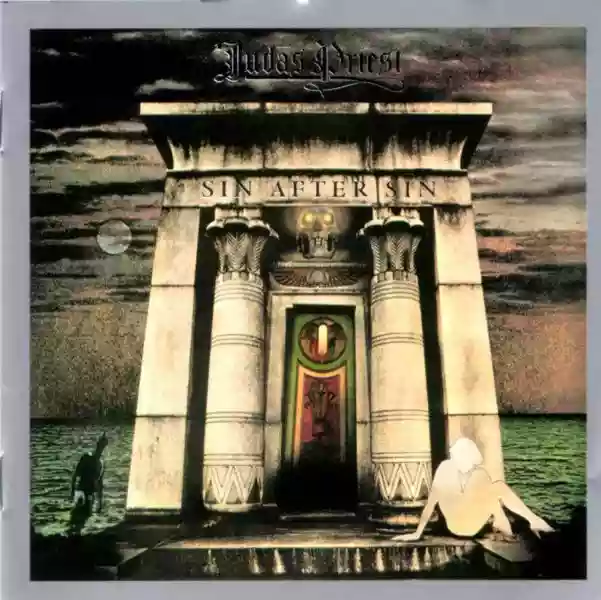
Sin After Sin is not the masterpiece of Judas Priest, nor of metal in general. It is not the most brilliant and innovative album from the English midlands. It is not packed with legendary tracks like the previous “Sad Wings Of Destiny”, nor does it have the charisma of the subsequent “Stained Class”. It is, simply and grandly, a brick of that temple we faithful call Metal and that, with prophetic inspiration, is depicted on the album cover. A brick of a movement that for at least another twenty years will have much to say to music and the entire world, laid by those who did not just design that temple but built it.
Loading comments slowly
Summary by Bot
Judas Priest’s 1977 album Sin After Sin stands as a foundational pillar in heavy metal history. Produced by Roger Glover and featuring the stellar drumming of Simon Phillips, it showcases the band’s blend of hard rock, progressive influences, and powerful metal sound. The review highlights standout tracks like 'Sinner,' 'Diamonds and Rust,' and 'Dissident Aggressor,' praising their musical complexity and lasting influence. Though not the band’s most famous album, it remains an essential brick in the metal movement.Tracklist Lyrics Videos
Judas Priest
Formed in Birmingham in 1969, Judas Priest are among the pioneers of heavy metal, known for twin-guitar attack and Rob Halford's high vocals. Their career spans classic studio albums and acclaimed live records.49 Reviews
