
 •
Rating:
•
Rating:
THE REVIEW
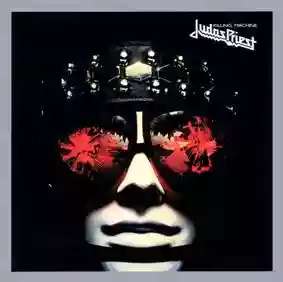
The 1978 was a particularly significant year for the career of Judas Priest, as the Birmingham group, after the somewhat unconvincing offering in the album 'Sin after Sin', released, within a few months of each other, two excellent albums such as 'Stained Class' and 'Killing Machine' ('Hell Bent for Leather' in the American edition), often considered by many as the cornerstones on which the future NWOBHM would be based.
Let's focus, on this occasion, on 'Killing Machine'. The album begins with the powerful Delivering the Goods, marked by Rob Halford's aggressive vocals, in continuous alternation of highs and lows, and the guitars of Glenn Tipton and K.K. Downing: A piece with a cohesive structure that has the continuous sonic wall created by the group as its distinctive feature. The following track, Rock Forever, is characterized by a hard rock guitar riff, well supported by Ian Hill's bass and Les Binks' excellent drumming, in his last appearance on record with the group: the piece is catchy, with a pop-like structure, and Halford alternates his proverbial highs with almost spoken parts. Evening Star is a soft/hard track that, in the typical style of Judas Priest, echoes the teachings of the early Led Zeppelin, with an easily memorable melody suitable for radio audiences, whom the Priest never despised; the central solo is also excellent, with the two lead guitars alternating with each other.
Harder territories, close to the sounds of the contemporary 'Stained Class', are explored by Hell Bent for Leather, with a very tight rhythm section and unusually low vocals, where Halford showcases great versatility and dramatic ability. Take on the World, almost the Priest's answer to Queen's We will Rock, is a track explicitly intended for live performances, with an alternation of solo voice and choirs, supported by an almost martial drumbeat, allowing listeners to identify with the singer and follow the band. The following songs form the heart of the album, which, far from showing any drop in tension, demonstrates its qualitative peak here: Burnin' Up, introduced by some sinister synthesizers, benefits from a series of supersonic riffs that explode in the pressing chorus, with Halford in splendid form: the central break is excellent, where the rhythms seem to slow down, the drums continuously vary the rhythms, and the singer lingers in his atypical spoken parts until the central solo. The Green Manalishi (originally included only in the American vinyl but now present in the CD edition), a Fleetwood Mac cover, denounces the group's influences and at the same time reveals the Priest's discontinuity from tradition: hard blues is revisited with an essential technique, where no note is wasted, and, above all, with a new attitude, not found in other bands of the '70s: a concise and complacent expository violence, with an almost kitsch and aestheticizing trait, unlike the punk nihilism emerging in those years, it is already heading towards the hedonism of the '80s, of which the Priest will be heralds in the hard and metal domain.
The following Killing Machine reprises the dynamics of Burnin' Up, with Halford's almost gasping singing and the guitars executing tight lines: a very brief break introduces the central solo, with markedly heavy evolution. Runnin' Wild is a fast ride in purely heavy metal territories, a forerunner of many Iron Maiden pieces, though less pompous and intricate, and close to Motörhead, although played and executed with more class (but less brutality) than Ian "Lemmy" Kilmister's band. Before the Dawn is an acoustic ballad, with a melancholic flavor, where Halford's singing is particularly mournful: the melody and the composure with which the group, accustomed to other sounds, accompanies the lead voice without unnecessary burdens that sometimes afflict similar pieces is splendid, and the central guitar solo is excellent, in tune with the spleen felt when listening to the song. The concluding Evil Fantasies is a syncopated hard/heavy track, with a particularly intense central theme, where the group portrays at the peak of form the latent violence typical of the album and the themes covered in the lyrics.
The CD edition, besides offering a live version of Riding on the Wind, also presents an unreleased studio track, Fight for Your Life, which is nothing less than a primitive version of Rock Hard Ride Free, contained in the subsequent 'Defenders of the Faith' (1984): a splendid piece, inexplicably excluded from the album, far superior to the version made in the '80s (with a different chorus), which marks particularly sharply the crossover practiced in the '70s by the Priest: hard & heavy united in the same song, a bridge between past and future.
In conclusion, it is an excellent effort: different from 'Stained Class', perhaps less uniform and more open to contamination between genres, 'Killing Machine' is an album recommended for all those who love hard rock, where the feeling within the group emerges much more than in the more refined (and artificial) subsequent productions.
Loading comments slowly
Summary by Bot
Judas Priest's 1978 album Killing Machine (Hell Bent for Leather in the US) is celebrated as a landmark in hard rock and early NWOBHM. The review highlights the band's strong performance, especially Rob Halford's versatile vocals and the tight guitar work by Glenn Tipton and K.K. Downing. Songs range from aggressive rockers to melodic ballads, showing the group’s dynamic range. The album's influence on metal's future and its bridging of past and future sounds are emphasized. Overall, it's a highly recommended classic for hard rock fans.Tracklist Lyrics Videos
Judas Priest
Formed in Birmingham in 1969, Judas Priest are among the pioneers of heavy metal, known for twin-guitar attack and Rob Halford's high vocals. Their career spans classic studio albums and acclaimed live records.49 Reviews
