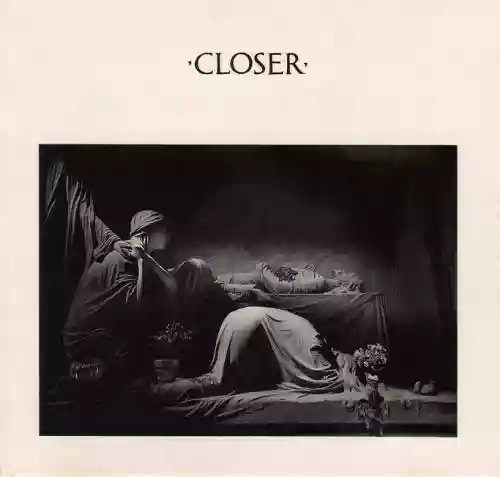

 •
Rating:
•
Rating:
THE REVIEW
DISTRACTIONS FOR THE TROOP
(Re-listening to Closer, before going out to see Control)
(“I was well aware, while we were composing it (from November '78 to November '79) that the music transcended the composition—and the composers. It was as if, no matter how much we tried to be original, we were somehow responsible for the re-assembly of something that already existed in a collective unconscious—grasping fragments from the ether instinctively, and using our art to put them in the 'right' order...”—S. Moxham, Young Marble Giants, 1993).
At its best moments, Joy Division, which indeed consists of four elements, sounds like four distinct pieces, separated by a great void (or, since it's about sounds, by a great silence): like four slashes on a canvas by Lucio Fontana. Slashes, because the sounds of what is ironically called Joy Division evoke sensations that from a tactile or visual point of view are adequately described by the ideas of wound, breakage. (Ironically, because, as everyone knows, Joy Division was, at least according to legend, the battalion of prostitutes attached to each German division in '39-'45, tasked, of course, with keeping the troops' morale high. In a recent film that talks about the Division, for choosing this name, a journalist accuses Steve Coogan, or Tony Wilson, owner of their label, of subliminal Nazism, and Tony Wilson gets angry, as if! we also have a band called Durruti Column! so are we fascists or communists? have you ever heard of Dadaism? situationism?, not even he, probably, knowing very well what he was talking about).
To achieve this outcome Joy Division used, at least concerning string instruments (electric guitar and bass guitar), sounds that had become trendy during its peak period, with the advent, due to the energy and economic crisis of the seventies, the ebb of the illusions that flourished in the previous decade and other contingencies (Margaret Thatcher, etc.), of the so-called nihilistic dadaist fashion punk.
Deep and distorted bass, distorted and compressed guitar like the noise of jackhammers under the bedroom window that explodes suddenly in the morning silence and forces you to wake up. As mentioned, however, and here is the other fundamental ingredient of Joy Division's music, its four distinct sounds, when combined, do not form a compact wall that fills the room and heads and makes you jump, etc., but remain separated like four planes crossing a deep blue sky leaving four different trails, or four ships in the ocean, four individual entities in a sea of silence. Joy Division's sound was not the product of a plan. They were too young to realize what they were doing. I never forgot a statement by Joy Division's guitarist from an old interview: it seemed to us that we were not composing our songs; our music was in the air we breathed; we were merely conduits, executors. Yet no other contemporary so-called punk band sounded like this. Nor, on the other hand, does it make sense to count Joy Division among the groups belonging to the "movement." In addition, indeed, to the already mentioned bass and guitar, Joy Division included a drum kit, analog, and played normally, but which the visionary producer Martin Hannett managed to make sound exactly like an industrial machine (The Atrocity Exhibition), and the cavernous voice of the only member of Joy Division I will name: Ian Curtis.
Lyric, restless personality, etc., Ian Curtis had bent Joy Division to his personal needs (the music that the guitarist seemed not to compose but to breathe probably, just as unconsciously, emanated from him). Ian Curtis cared to express in song form his anger at the limitations of the human condition. Not because he was philosophically aware of it; as for any poet, his need to articulate was physiological rather than intellectual. Ian Curtis knew punk through the Sex Pistols, the Clash, spontaneous groups that added new words to the vocabulary of popular music. Some of them (Sid Vicious) died and were victims more of historical and social circumstances than themselves. Their anger was more than anything adolescent, ready to dissipate with the growth of age and belly. Ian Curtis's despair, on the other hand, does not belong to any particular era. It is the intuition of man's absolute helplessness in the face of the laws of life, death, the gods, and fate. And the inability to accept it, Prometheus who wants nevertheless to steal the fire, etc. (Ian Curtis suffered from epilepsy, like many greats who believed they could become gods). Ian Curtis, to explain the despair arising from the consciousness of this paradox (a consciousness not given to many, not wanted by anyone, but impossible to refuse if received) was given punk, and Ian Curtis used punk, or made Joy Division use it. In another era he might have used another language, but certain of his verses, where his tragedy and hybris are more clearly articulated, might have been born identical. If only I could show you the beauty, those things I cannot describe... instead pleasures, ephemeral distractions: is this my splendid prize? (A Means to an End) and the funeral procession seen passing by the Eternal: we go on, the cries are over, the living naïvely shake off the idea of death... I instead want to scream, in the face of their futility, ephemeral as clouds drifting by in the sky.
When he finally hanged himself, refusing to accept the fragility of his condition, his humanity, death was for Ian Curtis the only logical conclusion. New Order was not comparable to Joy Division, and Joy Division has become eternal: four slashes on an empty canvas, four slaps on the face of God.
Loading comments slowly
Summary by Bot
This review explores Joy Division's 'Closer' as a transcendent post-punk album that combines distinct musical elements into a haunting and timeless experience. It credits Ian Curtis’s profound lyrics and Martin Hannett's innovative production for shaping the band's signature sound. The album embodies themes of despair, human fragility, and existential struggle. Ultimately, 'Closer' is portrayed as an eternal work that diverges from typical punk bands and resonates beyond its era.Tracklist Lyrics Videos
Joy Division
Joy Division were an English post-punk band formed in the late 1970s (Ian Curtis, Bernard Sumner, Peter Hook, Stephen Morris). They released two studio albums, Unknown Pleasures (1979) and Closer (1980). After the suicide of lead singer Ian Curtis in May 1980 the remaining members later formed New Order.43 Reviews
Other reviews
By TenshiSell
Ian Curtis was about to become a living legend. He lucidly chose to limit himself to being a legend.
You collapse to the ground, a scream frees you from a burden.
By Mr.Moustache
It is 1980. Punk is dying and with it the little good music ... when suddenly, in less than a year, an album is about to change the course of contemporary music forever.
The glacial beauty of the album is indisputable due to the ruthless sincerity it suggests.
By andrea biacca
"Closer" is a journey made of nightmares, sadness, physical and mental stimulations; the musical transposition of the agony of the most charismatic leader rock has ever had: Ian Curtis.
All we have left is to listen to this musical masterpiece and appreciate its excellent craftsmanship, both in terms of lyrics and harmonies.
By COX
Closer is the testament in which Curtis invites us to explore the roots of his illness and his apathy towards life.
Joy Division has the power to tear you apart, to gradually consume you with their melody that backs you against the wall and forces you to face reality for what it is.
By darkfall
‘Closer’ is a truly difficult album to classify, but probably not to understand... I personally prefer to classify it as dark, just dark and nothing more.
‘The Eternal’ is a funeral march, accompanying Ian Curtis on his last journey... the heart is now definitively burned but the soul is still here.
