
 •
Rating:
•
Rating: THE REVIEW
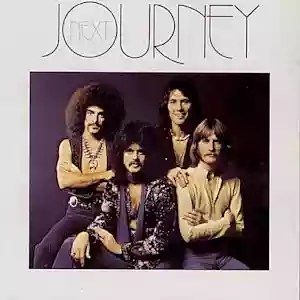
Third studio effort for Journey and the third competent, yet mediocre remix of ideas and themes in melodic hard rock, with a progressive/fusion aftertaste. The band reappears for the last time as a quartet, this time also trying to assess who has the most effective lead vocals: so far, keyboardist Gregg Rolie had sung everything, thanks to his credentials with Santana (his is the voice on timeless tracks like "Black Magic Woman" and "Oye Como Va"), but at this point, they also try an alternative, having guitarist Neal Schon sing some songs, who meanwhile has taken intense lessons to improve. His vocal delivery is less powerful, but more pleasant and extended compared to his colleague; however, we are far from a standard that could genuinely make Journey excel in melodic rock.
A step forward is made (in the sense that it is episodic, not generalized) in the improvement process of sounds and production, but especially in the consistency and synthesis of the arrangements. Rolie almost entirely refrains from those whirling monophonic synthesizer solos, which are so inexpressive; his partner Schon tries on some occasions to restrain the guitar solos to normal lengths, canonical for hard rock that wants to cloak itself in pop accessibility and to interest many more people than usual musicians or aspiring ones and virtuosity fanatics.
This time it starts with a clear ballad, titled "Spaceman": a choice that is, in hindsight, almost symbolic... the group doesn't know it yet, but in their future, there will be an industrial quantity of slow songs. Schon's guitar chooses notes with care and economy, instantly becoming much more fascinating than when he lets loose on long runs up and down the neck. Ross Valory proves to be an excellent bassist once again, but the rhythm section continues having some flaws: here, for example, Aynsley Dunbar is too rigid on the hi-hat... Despite his noble pedigree (Mayall, Zappa, Bowie, and Reed up to that point, then Jefferson Starship and Whitesnake among many others in his post-Journey future), I have many reservations about this globe-trotting English drummer... and I am not alone, as some time later, new singer Steve Perry will convince the band and management to kick him out, complaining of a lack of groove in his style. True!
Very good is the following "People", the best of the batch, structured on a deep, elegant, and effective offbeat guitar arpeggio entrusted to Schon's neither-good-nor-bad vocals. In the third episode "I Would Find You", unfortunately, the minimoog howls again, albeit only for an intro, plunging Journey back into progressive and fusion genres, which, understood, are excellent genres, but played by others. The same thing happens more or less in the instrumental placed towards the end "Nickel and Dime"... these are the last psychedelic and somewhat snobbish flickers of a band that will instead distinguish itself in the rest of its career for a distinct pandering nature and popular accessibility, also suitable for tacky and sweetened tastes, all fortunately associated with exceptional melodic, instrumental, and vocal exploits, as well as an undeniable stylistic peculiarity that will proclaim them recognized leaders.
The rest of this album does not, however, foreshadow all this and continues to offer little more than thunderous jam sessions filled with rapidly successive guitar notes, predictable and scholastic singing parts, unnatural and forced energy. We are on the eve of a necessary turning point, the most important in their career because there would not have been a commercial chance for a fourth album structured in this manner.
The subsequent "Infinity" will, however, be a work of a very different kind... but I will not write about it, because someone has already done so here previously, instead moving on to some of the following episodes, those not yet covered by anyone.
Loading comments slowly
Summary by Bot
Journey's third album 'Next' shows moments of progress but largely remains a mediocre blend of melodic hard rock with progressive and fusion influences. Vocal duties are split between Gregg Rolie and Neal Schon, with mixed success. The production and arrangements improve sporadically, though some instrumental excesses and rigid drumming detract. The album foreshadows the band's need for a new direction, which would come with their next release.Tracklist Lyrics Videos
Journey
Journey is an American rock band associated with AOR/arena rock, widely known for its 1980s commercial peak and big radio staples such as “Don’t Stop Believin’,” “Open Arms,” and “Separate Ways (Worlds Apart).” Reviews highlight key lineup eras (Steve Perry, Neal Schon, Jonathan Cain, Ross Valory, Steve Smith) and emphasize the band’s shift from earlier prog/jazz-rock leanings to a more melodic, chart-focused sound.12 Reviews
