
 •
Rating:
•
Rating:
THE REVIEW
It's incredible how humans are capable of forgetting and discarding even the most beautiful things.
Joni Mitchell has been and still is a great artist, although not many are willing to acknowledge it, whether due to musical ignorance or simply for the sake of stubbornness. In the late sixties and seventies, Mitchell gifted the world with some of that generation's fundamental works while simultaneously distancing herself from the image of the eternal hippie. It was right after 1972, following a streak of five folk albums including the confessional masterpiece Blue, that Joni Mitchell veered towards something different, perhaps dangerous. The pivotal album is Court and Spark, a perfect blend of folk, pop, and jazz. But the true revolution comes shortly after, in 1975.
With The Hissing of Summer Lawns, Joni Mitchell embarks on a journey, often a solitary one, that would lead her to encounter some of the sacred monsters of jazz. A journey that would make her lose much of her devoted fan base and gain the antipathy of critics.
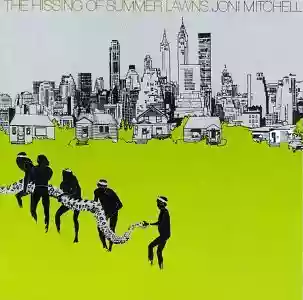
The album cannot be understood nor appreciated without considering Mitchell's own words noted in the booklet: "This is a total work, conceived graphically, musically, lyrically and accidentally as a whole." It is therefore a total work involving graphics, music, words, and fate, which must be taken as an indivisible whole. This is why, rather than starting with the songs, it's best to begin with the cover, the artwork (which with modern CDs, unfortunately, has been significantly reduced).
Literally, The Hissing of Summer Lawns means The Hissing of Summer Lawns. A colorful and evocative expression, which gains even more strength with the cover: a group of stylized black figures (presumably nude) drag a giant snake across a field of tall grass, with the city looming behind them, its suburban houses in the foreground and skyscrapers in the back. Modernity and progress versus the wild and primitive. The album starts with cheer and lightness with In France They Kiss on Main Street, recalling youthful loves, ballrooms, jukeboxes, and love made on the backseat of a car.
The album then moves on to The Jungle Line, which delivers the first heavy blow to the listener. The sound is primitive (this is the first song to use sampling techniques) thanks to the drums of Burundi natives, yet the atmosphere is futuristic, almost sci-fi. It speaks of the famous demarcation line separating the jungle, the savage, from progress. The song "slithers" like a snake, unfolds, and Mitchell's voice, almost in a trance, definitely hallucinatory, enchants both the ear and the mind.
The blend of folk and jazz is now evident. The tracks are elusive, the melodic line becomes at times evanescent, Mitchell's voice turns husky or whispers. Masterful tracks such as Edith and the Kingpin, Don't Interrupt the Sorrow, and Shades of Scarlett Conquering (where Mitchell, with a few simple words, champions womanhood more than any feminist movement) pass by. But the most striking example of this splendid musical encounter is not The Jungle Line, but the title track. The Hissing of Summer Lawns has a lazy sound like a Californian summer afternoon. The bass line becomes constant and repetitive, while flurries of flugelhorn and flute sway between Mitchell's abstract and surreal words. The sensation is like swimming freely in a pool under the blazing sun. You can actually hear the lawn hissing in the heat, that snake slithering towards us from beyond the line separating us from the dark jungle. These are purely jazzy sensations conveyed through a musical structure that is almost free and not contained within a precise framework. It's obvious that this is not pure jazz, not even remotely, just a quick incursion that nonetheless bestows enormous elegance and sentiment upon the entire work.
Analyzing song by song would take us down a path too fraught with difficulties. Fully understanding Joni Mitchell's tracks is a pleasant endeavor because they are pure poetry, and like the latter, they are loaded with symbols, metaphors, and expressions known only to the author.
If musically The Hissing of Summer Lawns represents the tearing down of a wall separating two distant genres like folk-pop and jazz, it delivers a fierce social critique in its verses. Hypocrisy, ambition, exploitation, male chauvinism, money, and religion are recurring themes in this album.
In 1975, it was difficult for critics and fans to accept such a complex and intricate work, being accustomed as they were to the melancholic Joni Mitchell depicting tormented love and the broken dreams of the pacifist generation with skillful phrases. With The Hissing of Summer Lawns, Mitchell turns her investigative and analytical gaze outward, towards society, uncovering its evils and ugliness. She herself transitions from being the blonde girl with a guitar and ukulele to a sophisticated woman who would soon devote herself entirely to jazz. It was only towards the end of the 1980s that the fickle music industry brushed off this hidden gem of North American music, giving it back the life that had been denied it in the 1970s.
Loading comments slowly
Summary by Bot
Joni Mitchell’s 1975 album The Hissing of Summer Lawns marks a bold fusion of folk and jazz, moving beyond her previous acoustic style. The album features complex social critiques and poetic lyrics wrapped in innovative, genre-blurring music. Initially misunderstood by critics and fans, it has since gained recognition as a sophisticated and elegant work. Its artistic cover and use of sampling highlight its unique character.Tracklist Lyrics Videos
Joni Mitchell
Canadian singer-songwriter, guitarist and painter, widely influential from the late 1960s onward. Known for intimate songwriting (Blue), jazz-inflected work (Hejira, Mingus), distinctive open-guitar tunings and painted album covers.28 Reviews
