
 •
Rating:
•
Rating:
THE REVIEW
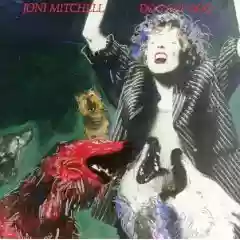
"Dog Eat Dog". Dog eat dog. Perfect expression to represent the eighties. An increasingly aggressive international policy, the rise of neoliberalism, rampant consumerism. Elsewhere, however, there are the Third World, flies on the eyes of starving children, burning oil wells, attacks, and weak alliances. The music becomes plastic, boosted by synthesizers, vocoders, and prefab sounds. The innocence that had already begun to fade in the seventies is now definitively lost in a whirlpool of latex, teased hairstyles, and carnival makeup.
It's 1985 and Joni is going through a rough patch. You can imagine her in her living room, chain-smoking, swearing, and crashing things. The eighties really aren't for her, an ecological and sentimental poetess, in a time when love is the last thing on people's minds and the ozone hole hasn't yet been heard of. Between medical misadventures and various frustrations, Joni decides to work to pour out her feelings. What emerges from this process are a series of rather aggressive texts, so direct as to border on brazenness. In Joni Mitchell's discography, "Dog Eat Dog" is considered the most detested album both by fans and critics. Some who have listened to it wonder, “Is this really Joni?”. Yes, it's her. Like everyone in that period, even the Lady fell into the electronic trap, obtaining a result barely acceptable. The power of Mitchell's music lies in being out of the laws of time."Dog Eat Dog", instead, at times appears embarrassingly dated and not up to Joni's very high standards. If you manage to bypass the cold barrier of electronic sound and reach directly to the heart of the compositions, you will discover remarkable gems ("The Three Great Stimulants", "Ethiopia", "Dog Eat Dog") and equally as many banalities ("Lucky Girl", "Shiny Toys"). However, it is wrong, as many unfortunately do, to discard it completely.
In the crosshairs of Mitchell's fiery pen are many targets, including TV evangelists, the Church, Reaganites, individuals suffering from consumerist fever, bigots, and so on. Like with "The Hissing of Summer Lawns", the album opens with an out-of-context song, in its own way calm (Good Friends, in collaboration with Michael McDonald) whose purpose is perhaps to introduce us to Joni's new sound shift. It promptly resumes with the first vitriolic song, "Fiction". This syncopated track, loaded with sound effects and distorted guitars, shows us the discontent for the rules of the capitalist world (Buy me! Watch me! Listen to me!), but it focuses mainly on the frustration for unreal models and the unnatural life rhythms that this system imposes on us. The chorus is a long list of everything false circulating around. It then moves to "The Three Great Stimulants" which offers a clear example of why not to discard this record. The song is the best of the album and is built on a repetitive base that has the strange power to transport us into a dimension of distress and obsession, while Joni sings about how we never tire of wars, how we've become sad automatons, and the probable fate of the Earth. Once again, we must acknowledge the foresight of this artist (While madmen sit up building bombs / And making laws and bars / They’re gonna slam free choice behind us). Tax Free is instead a liberating snarl against religious preachers: “Fuck it! / Tonight I'll dance / With the drag queens and the punks / Let the rhythm free me from this vile hypocrite / We are not damned angels / And he is not a heaven-sent messenger.” Until 1985, no one had ever heard the elegant Lady of the Canyon utter expressions like fuck it! This indicates her anger and what a vent music represents for her.
"Dog Eat Dog" is certainly not one of the best albums of Joni's long career, but in my opinion, not even the worst. Only three years later, "Chalk Mark in a Rainstorm" would see the light, an unlikely jumble of collaborations always marked by a synthesized sound that doesn't suit Mitchell's sensitivity and style. "Dog Eat Dog" has the merit of containing some of the most biting and sharp texts of the Canadian poetess. In conclusion, this is an album worth revisiting, if not out of curiosity, at least to recognize its few but very valid merits and also to observe how, in one of the dark moments of her career, Joni Mitchell managed to maintain her critical spirit intact.
Loading comments slowly
Summary by Bot
Dog Eat Dog captures Joni Mitchell's struggle adapting to the 1980s musical landscape, mixing sharp social critiques with synth-heavy production. While often seen as one of her weaker albums, it contains standout tracks with powerful lyrics. The album reflects a turbulent period both personally and culturally, offering a raw but imperfect listening experience. Fans and critics remain divided, but the album deserves a fresh look for its unique merits.Tracklist Lyrics Videos
Joni Mitchell
Canadian singer-songwriter, guitarist and painter, widely influential from the late 1960s onward. Known for intimate songwriting (Blue), jazz-inflected work (Hejira, Mingus), distinctive open-guitar tunings and painted album covers.28 Reviews
