 •
Rating:
•
Rating:
THE REVIEW
"Blue songs are like tattoos"
Joni had just finished whispering in the title track of that small, mighty poetic testament that was "Blue" (1971); an epochal record, a prelude to a series of musical endeavors all born under the sign of confessional autobiography, culminating in 1976 with the marvelous allegory of self-escape in "Hejira." Sad, melancholic, indelible like tattoos, Joni's songs; but just like them, they are travel companions and of self-awareness - "We're only particles of change, I know, I know / Orbiting around the sun / But how can I have that point of view / When I'm always bound and tied to someone"
("Hejira") - which is also solace, consolation.
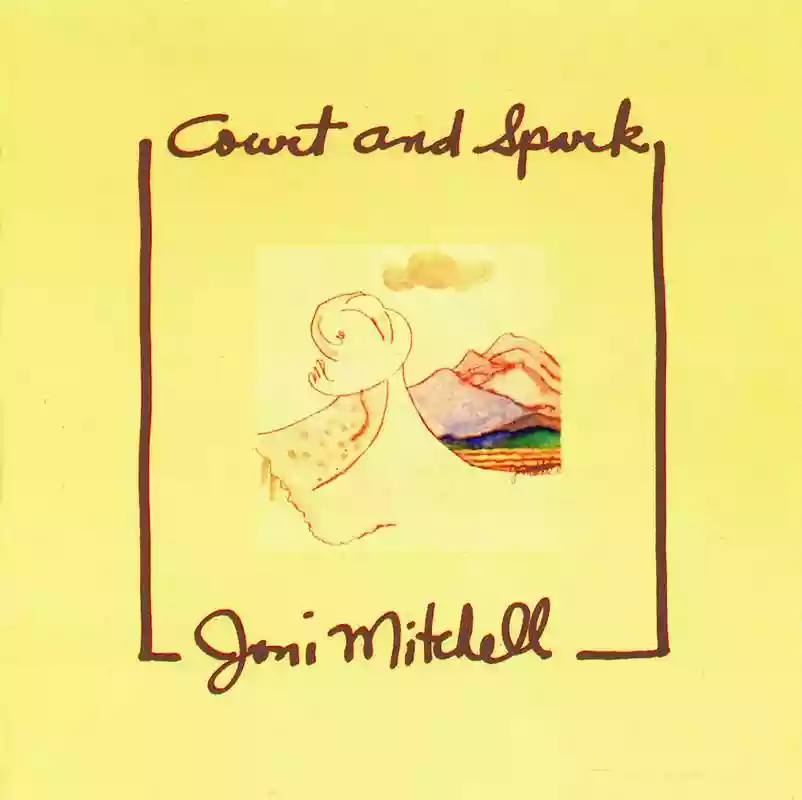
The poetic hallmark of this journey in search of a deeper self is, for Joni, the painful confrontation with the inevitable ups and downs of emotional relationships, a "high and low" explored with sweet melancholy in the grooves of "Court And Spark." And it might not be a coincidence that this was also her most commercially successful album; Joni manages in one fell swoop to revolutionize her sound, turning it towards the liberating spirals of a jazz-rock that would soon set a new standard, while maintaining intact and vividly poignant, thematically, the dissection of everything that love gives and immediately takes away ("Pleasure moves on too early / And trouble leaves too slow"
, "Down To You").
In reality, a taste of the new style - which increasingly distances the author of "A Case Of You" from her folk-rock roots - had already made an appearance in the creases of the previous effort, that marvelous junction which is "For The Roses"; there, in the conclusion of "Blonde In The Bleachers", the band accompanying her indulged in 'free' passages that certainly would not look out of place in an imagined medley with the new "Car On A Hill". And what can be said about the voice of the Canadian lady? Beyond the more evident, yet not self-indulgent, displays of skill (the rendition of "Twisted" is a small preview of the "Mingus" project), how is it possible not to be drawn in by certain almost Beatles-like modulations (try, and you'll believe, the line "Love is gone / Written on your spirit this sad song"
, again in "Down To You"), or by the sensual and languid high notes of "Same Situation" and "Help Me"?
Even though, in the end, perhaps it is the apparent melodic linearity of a "People's Parties" - almost a canvas in which the introverted Joni sketches one by one her fragilities in the confrontation with a world puffed up with appearances - that does not betray the expectations of those who pursue an artist of heart and mind.
Loading comments slowly
Summary by Bot
Court And Spark marked a significant evolution for Joni Mitchell, merging her confessional songwriting with jazz-rock innovation. The album explores the highs and lows of love with poetic depth and vocal mastery. It stands as one of her most commercially successful works while maintaining artistic integrity. The review highlights the album's thematic richness and musical sophistication.Tracklist Lyrics Videos
Joni Mitchell
Canadian singer-songwriter, guitarist and painter, widely influential from the late 1960s onward. Known for intimate songwriting (Blue), jazz-inflected work (Hejira, Mingus), distinctive open-guitar tunings and painted album covers.28 Reviews
