
 •
Rating:
•
Rating:
THE REVIEW
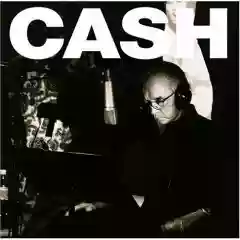
AMERICAN V: A HUNDRED HIGHWAYS
or "Poetics of Solitude"
Johnny Cash.
Johnny Cash and his voice.
Johnny Cash and his guitar.
Johnny Cash and his songs.
That even if they aren't his, are his nonetheless.
Is this what will remain in the end? A handful of bitter reflections will remain, this mumbled melancholy will remain, these piano embroideries, these arpeggios, the hinted violin, the brushed organ will remain. Yes, and not only: the echo of the prisoners’ laughter at Folsom will remain, his way of holding the guitar and moving in front of the microphone, his dark voice intertwined with the crystalline one of June Carter. Those devilish and precise rhythms like thunder will remain, the soft duet with Bob Dylan will remain, all the murderers, the lovers, the desperate and condemned rednecks will remain. That memory of the old West will remain, like in "My Name is Nobody".
The Man in Black... listening to these hundred highways I prefer to think of a tired, embittered man. A man too lonely, for some months now. The anger has faded, even the anguish, the black suit is in a drawer covered with dust. Has the past perhaps completely abandoned this gentleman? Or is it always terribly close? Is it like a ghost, that you see from the corner of your eye, and when you turn, it’s no longer there?
Don’t expect to hear something absolutely new. When you approach a work by Cash you know it’s about epic: the formulas repeat relentlessly, perhaps not always convincing. Epic of the anti-hero, typically twentieth-century! Technically the disc is not as supreme and varied as the previous one, it’s not a majestic artistic testament. That it had to be the last one, however, Cash knew, and perhaps for this reason, he finally takes the path of emptiness. He completely abandons the sumptuous strokes that distinguished some ballads of "The Man Comes Around". He lets the covers flow under his fingers, dries the arrangements; the rhythm, even the most inexorable, as in "Like the 309" (the last song written by the artist) and in the dirty "God's Gonna Cut You Down", slows down, losing a bit of the incisiveness of other works with Rubin.
But I am not here to talk about technical merits, innovations, or other useless musical issues. That’s not the point, and the American singer suggests it by focusing on the man, on his weakness. Down to the bone of autobiography, sincere and fragile concessions. Poetics of solitude. In "Further Up On The Road" I imagine him sitting in front of the window, looking outside, it’s a sunny day. "Rose of my Heart": he turns, looks at a photo of his wife. The furrowed face. Ancient and faithful wisdom. "I Came To Believe". A prayer with a muddled voice. Useless medicines on the bedside table. "On The Evening Train". He lies down on the bed, the sheets are white. There’s a half too empty. The evening train whistles just outside the Nashville station. His eyelids lower slowly. Wandering serenity. "A Legend In My Time". "If loneliness meant worldwide fame, then everyone would know my name. I would be a legend of my time."
An era irrevocably ended: that of Johnny Cash, of his dusty memories, of his guitar, of his songs, of his way of approaching the microphone, of his voice.
"If you could read my mind, love,
What a tale my thoughts could tell.
Just like an old time movie,
'Bout a ghost from a wishing well.
In a castle dark or a fortress strong,
With chains upon my feet.
You know that ghost is me.
And I will never be set free
As long as I'm a ghost that you can't see."
Loading comments slowly
Summary by Bot
The review captures the deep melancholia and poetic solitude of Johnny Cash's American V: A Hundred Highways. It highlights the stripped-down arrangements, the autobiographical nature of the songs, and Cash's embodied presence through voice and guitar. Though not as technically innovative as previous works, the album stands as a sincere and fragile farewell. The reviewer emphasizes Cash’s humanity and legacy over musical novelty.Tracklist Lyrics Videos
Johnny Cash
Johnny Cash (1932–2003) was an American singer-songwriter known as the “Man in Black,” celebrated for a deep baritone voice, stark storytelling, and songs about prisoners, outsiders, faith, and redemption. His late-career American Recordings with producer Rick Rubin sparked a major resurgence and introduced him to new audiences through sparse arrangements and transformative covers.20 Reviews
