
 •
Rating:
•
Rating:
THE REVIEW
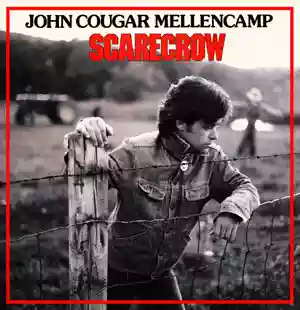
United States of America, 1985. A mature and conscious John Cougar Mellencamp observes the fertile fields of the Midwest hardened by the absurd socio-economic policy choices of the Reagan administration. On the cover, a stark black and white image seems borrowed from an old frame of the film by John Ford "The Grapes of Wrath," derived from the novel of the same name by John Steinbeck and from which, ten years later, a poetic Bruce Springsteen will draw inspiration to write Tom Joad. That image of a Cougar, no longer the "American Fool", but pierced in his deepest democratic ideals, recalls the serious, stern, and suspicious expression of Bob Dylan on the cover of his third album "The Times They Are A-Changin'."
In "Scarecrow", John Mellencamp becomes the bard of the other America: the rural, agricultural one, that of small workers exploited and strangled by the economic interests of the big lobbies. The most direct example to follow is that of Woody Guthrie but this time, the instrument of protest and condemnation is not an old guitar but the inimitable power unleashed by the band of Little Bastard, capable of exalting the realism of the author's lyrics with an energetic, granite, rough, and vital sound. It is easy to love this album and the spontaneous and direct way it speaks of family, friendship, roots, tradition, rights. Listening to classic tracks like "Small Town", "Minutes To Memories", "Rain On The Scarecrow", "Rumbleseat" one can think of being able to transform rock 'n' roll into a high tool of social involvement with which to express political ideals. John Cougar excellently synthesizes and winks at the style lesson learned from various Bruce Springsteen, Tom Petty, Bob Seger, Steve Earle.
The engaging and direct sound instead, has a purely 1970s Rolling Stones matrix and is fundamental to the work's economy. Just listen to "Lonely Ol' Night" to realize this. Mike Wanchic and Larry Crane, the two guitarists, play as if they had listened to "Exile On Main Street" a million times and they play with mastery. The rhythm section, with the great Kenny Aronoff on drums and Toby Myers on bass, is precise and dry. Even Rickie Lee Jones is on board and offers an exciting duet with her lived-in voice in the intense ballad "Between A Laugh And A Tear." So, when at the end of the journey the guitar riffs fade, the snare stops and the ground is left with only betrayed and shattered dreams, John Mellencamp does not lose heart and puts all the possibility of expression back into the hands of the old and sincere rock 'n' roll pronouncing it letter by letter in the final anthem "R.O.C.K. In The U.S.A."
Loading comments slowly
Summary by Bot
John Cougar Mellencamp’s 1985 album Scarecrow delves deeply into the struggles of rural America during the Reagan era with mature, politically aware lyrics. The album uses gritty, classic rock sounds inspired by the Rolling Stones and social protest traditions from Woody Guthrie to Bruce Springsteen. Standout tracks like "Small Town" and "R.O.C.K. In The U.S.A." showcase both social critique and energetic rock performance. Mellencamp's band Little Bastard delivers precise, vibrant musicianship, creating a compelling rock narrative of working-class resilience and heartbreak.Tracklist Lyrics Videos
John Mellencamp
John Mellencamp is an American singer-songwriter known for heartland and roots rock, with songs often focused on small-town life and social themes. He rose to mainstream success in the early 1980s (notably with American Fool) and later released acclaimed albums including Scarecrow and roots-oriented projects such as Trouble No More.17 Reviews
