
 •
Rating:
•
Rating:
THE REVIEW
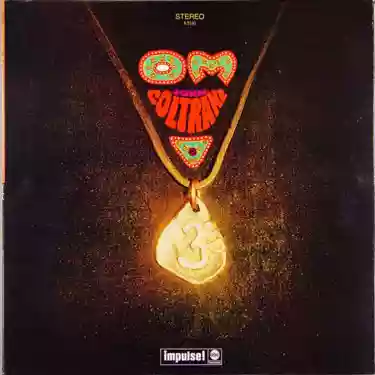
Pure madness.. this might be the first statement that comes to mind once you place "Om" by Coltrane on the turntable, a pivotal work with undeniable historical and artistic value in the entire and controversial musical journey of the saxophonist.
The search and desire to reach a spiritual ascetic message, these are the motivations that lead Coltrane to a drastic change in his way of conceiving music, in his approach to the instrument, in the style undertaken that completely abandons any reference to tradition and embraces Free-jazz infusing it with African sounds but also mystical and arcane sounds.. The holy Hindu mantra par excellence, to which Coltrane dedicates this collective delirium, is the basis and crux upon which the entire session unfolds.. the piece opens with African percussion accompanying a collectively recited prayer, which will end with the invocation repeated more and more solemnly until almost shouted of the word Om; to the invocation of the Om join the saxophones of Pharoa Sanders and John Coltrane.. cacophonic and distorted they start the session.. a kaleidoscopic cauldron of screeches, dissonances, and distortions. The furious and inhuman solos of the wind instruments are accompanied by the faithful Jimmy Garrison on bass, Elvin Jones on drums, and McCoy Tyner on piano, engaged in laying down the appropriate and emblematic sound carpet on which the free digressions of the soloists slip away., the ethnic sounds emitted by Joe Brazil's flute, the bleating of sheep, the invocation of the Om that mid-track is heard again in the background.. then reaching peace once again, again the collective recitation and the final invocation of the Om..
If with "A Supreme Love" John Coltrane translated into music his experience linked to faith and spirituality while remaining faithful to the modal style of which he was an undisputed master, "Om" as well as and primarily "Ascension", are important because they put an end to an era to start drastically another; the advent of Free music in the saxophonist's career does not seem to know half measures, his spiritual research continues by temporarily setting aside the unparalleled lyricism of his sax, instead becoming strong, especially in this session, of a cosmic aggressive and noisy free jazz that manages to excel and be engaging having on its side the experience and mastery of a giant of contemporary music...
Enjoy listening
Loading comments slowly
Summary by Bot
John Coltrane's Om is a pivotal album marking his shift to free jazz infused with spirituality and African influences. Featuring intense, dissonant solos, and collaborative jazz mastery, it challenges traditional forms and embraces cosmic themes. The album is both aggressive and engaging, representing a key point in Coltrane's spiritual and artistic evolution.
John Coltrane
John William Coltrane (1926–1967) was an American jazz saxophonist and composer, a major figure in 20th-century jazz who helped pioneer modal jazz and later free jazz. He is known for his intense improvisations, 'sheets of sound' technique, and landmark recordings on Atlantic and Impulse! Records.38 Reviews
