
 •
Rating:
•
Rating: This blond (now gray-haired) guitarist, quite famous but never enough for his merits, was born in 1948 as Joseph Fidler in Wichita, Kansas, in the middle of the pneumatic nowhere of the United States. He lost his father at only two years old and was adopted by his mother's new husband, whose last name is, in fact, Walsh.
He grows up and learns to make music first in New York and then in Ohio, where Mr. Walsh's job relocations take him. Barely twenty, he achieves his first tangible successes between ’68 and ’71 as guitarist and keyboardist of the James Gang, a band also never quite recognized enough for their merits, especially in our parts.
He bolts from the James Gang after four albums, preferring to team up with a guy he met during college years, who also had much bigger ideas about what to do in life than just being an English teacher. He is Italian-American and also goes by the nickname Joe, but his last name is Vitale: their partnership will last forever. As a first stop, the two young partners and friends end up in Colorado, setting up a brand-new quartet called Barnstorm, which in 1972 releases its self-titled debut album.
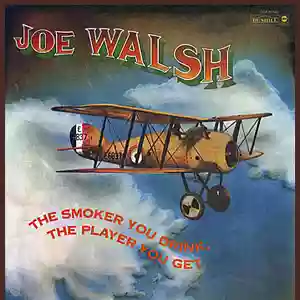
The record label, however, insists that Walsh make music under his own name, and so here comes his first solo work, dated 1973. The title is stunning! A somewhat convoluted way to say “The more you drink and smoke, the better you play”… Very telling of his personal, strong tendency to get high: Walsh is, in fact, one of those many musicians who miraculously managed to reach old age despite a long season of excess and abuse involving little powders and bottles.
Joe’s solo career starts off with a bang because the episode that opens this album is certainly among his most celebrated and well-known: it’s titled "Rocky Mountain Way," and it’s a generous and perfect five minutes of boogie rock with variations. Walsh’s talent is displayed here in multifaceted ways: there’s the simple and thrilling rock’n’roll riff, the sly and musical slide guitar, his distinctive, sharp, irony-laden voice, and, above all, the long interlude featuring the seminal guitar solo filtered through a device called a talk box.
This gadget, invented in the sixties, makes its high-profile rock debut precisely in this song, but historically its real fame would come shortly after, when Peter Frampton would make Walsh’s insight his own and immortalize the sound of the talk box in his splendid "Do You Feel Like We Do," closing the hugely successful album “Frampton Comes Alive.” Not a big loss for Walsh, who, when all is said and done, would enjoy a much richer and longer career than the excellent Frampton.
For those curious about how the heck this talk box works: a foot pedal reroutes the guitar signal, sending it not to the big amp but to a special amplifier with a small speaker, enclosed in a box placed at the guitarist’s feet. From here, a rubber tube runs up the mic stand and ends beside the microphone. At this point, you just need to put your mouth at the end of the tube and play something on the guitar. The “resonance chamber” formed by the box, tube, and oral cavity can then be modified simply by moving your mouth, even speaking or singing with the tube in your mouth. The microphone nearby picks everything up and the result is precisely what you hear in "Rocky Mountain Way", as well as in Frampton’s records, or, if you wish, in David Gilmour’s work on "Pigs" from Pink Floyd’s album “Animals,” and elsewhere—the list is long.
This opening song of the album, and thus of Walsh's entire solo career, inevitably overshadows the rest of the record, which still features strong moments like the heart-wrenching "Wolf," gloriously shifting from a minor key in the verses to a major key in the choruses; and then the steelydan-like instrumental "Midnight Moodies," as well as the masterful piano ballad "Dreams," which deftly oscillates between passages that are at times epic, other times jazzy, and further on even Beatles-esque.
"Happy Ways" has a strong Caribbean flavor, in that tex/mex/Cuban style of Stephen Stills. "Meadows" is joyfully introduced by a highly… alcoholic moment from Joe, before returning to the norm of a very melodic ballad, maybe arranged in a slightly cumbersome way…
The blond from Kansas allows his friend Vitale and even his bassist to compose and sing some of the songs… All in all, “The Smoker…” is still a Barnstorm record and not a solo Walsh effort after all—a musician who, by the way, has always felt more at home within a band than alone, and his career proves it.
But above all, Joe shows here once again, and always, what an eclectic musician he is… There really is a bit of everything on this album, but it’s always been that way, even with the James Gang, and it will be until today. He simply loves, and creates, good music of any genre, from the slowest to the fastest, from the saddest to the cheekiest. He is a great one.
Tracklist
Loading comments slowly
