
 •
Rating:
•
Rating:
THE REVIEW
The Joe Meek Case (who is Joe Meek and why is it so important to talk about him?)
Piece 1: Humphrey Lyttelton.
One shouldn’t get distracted when a new record is about to be released. But Humphrey was calm, he was a well-known jazz musician, and Parlophone had entrusted the production of that EP’s four tracks to Denis Preston, a capable man, an innovator in many ways, but solid and recognized. So Preston took the tapes to the IBC studios (the most advanced of the day, in England) and everything was going smoothly.
The only hitch was that, when it was time to record the fourth – and final – take of the EP, the saxophonist had fled for other, imaginary commitments. But good old Humphrey didn’t lose heart and improvised, right there on the spot, a trumpet tune accompanied by bass, drums, and piano. He called it “Bad Penny Blues” and, having entrusted the recording to Preston, he left. Preston – as we said – did his job, left the tapes at the studios, and left as well.
The problem was that the guy who had to put it all together was an odd young man: slicked-back hair, prominent chin, and perpetual dark glasses. He was really strange – as we will see – our Joe Meek.
And he had strange ideas.
So, the good Joe decided to do things his way: he raised the volume of the drums in a way that had never been done before. Then, since he liked that piano riff, he boldly put it front and center and finally left the leader’s trumpet in the background. Almost hidden.
Something unheard of before.
In fact, when Humphrey heard it, he got angry, but Allen Stagg, the powerful head of Joe, got even angrier.
But it was too late: “Bad Penny Blues” had already been released.
But the crazy thing was that it soared to the top of the charts. It was the first British jazz piece ever to enter the top 20. Granting Humphrey immortality. (And that piano riff to the Beatles for “Lady Madonna”).
It was 1956, and Joe had just invented acid jazz.
Yes, but Stagg didn’t like that guy: he was strange and did strange things. Like shaking stones in a box to mimic the soldiers' march and then putting some odd fading effects on Anne Shelton’s “Lay Down Your Arms” (another UK no.1 towards the end of 1956), and all that echo and reverb he loved to use, those microphones he insisted on placing stuck to the instruments, and a bunch of other oddities that poor Stagg had never seen before.
That Joe Meek has to go.
Piece 2: 304 Holloway Road.
And Joe leaves.
Because Joe isn’t an easy guy, he has a bad character. Actually, he’s quite out of his mind.
And he has secrets. Unspeakable secrets.
So, our Joe rents a three-story apartment on Holloway Road in Islington and here he founds RGM Sound (from Robert George Meek, his real name).
It’s 1960, and Joe has just invented Indie music.
And so many people arrive at Joe’s place, there on Holloway Road.
Youngsters like Jimmy Page, a very young Ritchie Blackmore, Ray Davies, Alvin Lee, Steve Howe, Gene Vincent, a 17-year-old kid named Rod Stewart, the future Status Quo, Tom Jones, a little band of kids who call themselves Kon-Rads (their singer is a certain David Robert Jones. A guy who, a few years later, will fall to earth with spiders from Mars), a 16-year-old named Mark Feld who will later call himself Marc Bolan. And others.
Many others.
But he kicks most of them out or treats them badly (his dislike for Tom Jones is legendary). Legend has it that he refused to produce tapes of certain new bands that approached him: certain Beatles and, it seems, also certain Rolling Stones.
He only had eyes for “his” Tornados and for that hunk of a bassist, Heinz Burt. The blond one.
In the end, Joe didn't understand much about music. And he couldn’t play a single instrument.
But musicians flock there because that place is a kind of Disneyland of music: strange contraptions, microphones around the rooms, musicians placed on the stairs, in the bathroom, in the kitchen, and Joe: Joe orchestrating it all and “playing” his tapes and his contraptions in real-time, along with others as if they were musical instruments.
They are musical instruments.
Joe invented the role of record producer. Joe understood that the recording studio could be part of the creative process and a place of wonders far before (and better) than Phil Spector, George Martin, Brian Wilson, and all the others that come to mind.
It’s just that few know it.
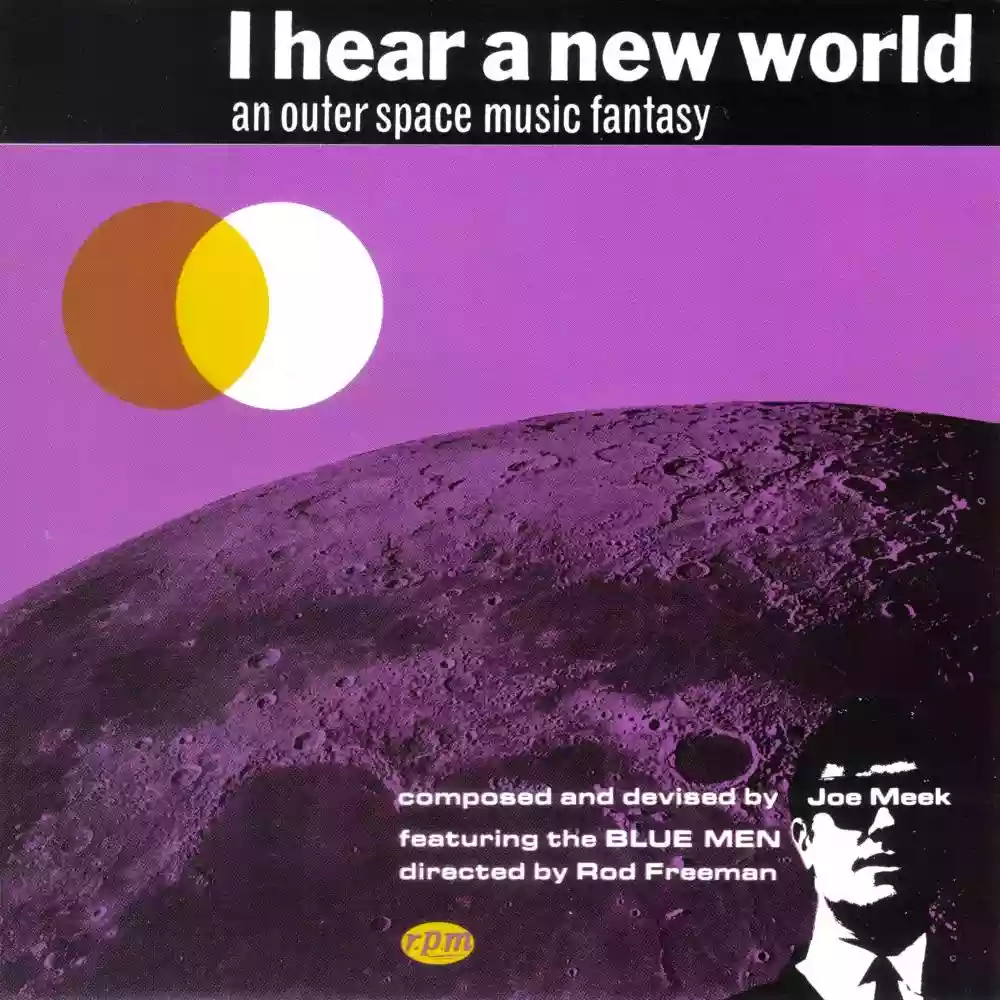
Piece 3: “I Hear A New World”
Joe doesn’t know how to play, but his head is full of music.
And also full of other things. For example, aliens.
Joe knew about the existence of aliens. He knew it since he was a radar technician for the Royal Air Force.
He heard them.
So he decided to let others hear what he heard: he would make a record of music that describes those worlds and alien lives.
It’s 1959, and Joe has just invented the concept album.
But he doesn’t know how to play. So he calls a certain Rod Freeman, leader of the Blue Men, a group that played skiffle music, and gives him tapes: essentially, “meowed” melodies to vocally reproduce the sounds he had in mind. Freeman and the members of his band struggle to give form to those absurd sounds.
And then, on those notes, he arrives and goes wild: he produces an extraordinary assortment of sounds taken from everyday life, like running water, bubbles created with straws, milk bottles hit with spoons, teeth of a comb slid on the edge of an ashtray, short-circuited circuits, spring toys, toilet flushes, steel rods slammed together, heavy breathing near the microphone, clattering cutlery, radio interference. And trade tricks, like reverb, echo, tape manipulation (backwards, in loop, sped up, slowed down). And he records everything in stereophony: it’s one of the first times.
Others will record blender solos and jackhammers, but no one will use noise like Joe.
What is it? Imagine the Residents playing skiffle, or better: imagine that under the eyeball masks in tails there are Carl Stalling, Dick Dale, and Syd Barrett.
Or imagine the soundtrack of “Plan 9 from outer space” played by Renaldo and The Loaf.
It’s Space music, interior Space. Absurd nursery rhymes, cartoon marches, accelerated little voices, untuned pianos. An episode of “The Jetsons”.
The “cosmic couriers” before – long before – krautrock.
It’s 1960, and Joe has just invented psychedelia.
No one would dream of publishing such stuff today, let alone in 1960! In fact, Joe only releases four pieces in the form of an EP, titled “I Hear A New World part.1”, for Triumph Records, which he had founded a few years earlier with William Barrington-Coupe. Then Triumph goes bust, but it doesn’t matter: now there’s RGM! Now Joe is free to publish whatever he likes….
In fact, the record will not be released. You’ll have to wait until 1991, thanks to RPM and the “Incredible Strange Music” trend. Then it will be reissued several times.
Afterward, if you want, get the various collections dedicated to our Joe, like “Portrait Of A Genius”, or “It's Hard To Believe It: The Amazing World Of Joe Meek” (to name a few of the best). But the first record to have to know him is “I Heard A New World”.
Piece 4: Johnny, don’t forget me.
But RGM is a serious thing: he’s there to produce hits, not to play the mad genius!
And the hits come: “Angela Jones” by Michael Cox, “Have I the Right?” by The Honeycombs, “Tribute to Buddy Holly” by Mike Berry.
But the right song is written by his friend Geoff Goddard: it’s “Johnny Remember Me”, and it’s a murder ballad. The story of a certain Johnny and his girlfriend who committed suicide and calls him in the dark not to be forgotten.
Geoff also finds the right guy to sing it. It’s John Leyton, a fairly well-known singer and actor. Then they take the Outlaws as session musicians and a very young Charles Blackwell for the arrangement.
Joe places Leyton in a room with a screen behind, the rhythm section nearby. The violins on the stairs, the backing singers end up near the bathroom, and the brass downstairs. And him, Joe, next door, “playing” his machines like any other musical instrument.
What comes out is an inextricable tangle of sounds, where you can’t understand who or what is being played. Twenty years later, a certain Brian Eno will do the same thing with Roxy Music. (Do you know what I mean?)
But the stroke of genius is taking Lissa Gray, who is the voice of the girlfriend who committed suicide, and locking her in the bathroom to use the toilet’s reverb! What comes out is an unforgettable voice from the afterlife.
Only Joe could create that voice because Joe knew what dead people’s voices sounded like. He had heard them and still heard them (as he listened to the voices of aliens). At night he would go to cemeteries to record the voices of the dead and talk to them.
Or with cats.
Because the spirits, sometimes, speak through cats.
He often spoke with the spirit of Buddy Holly. But we’ll talk about that later.
By the way: “Johnny Remember Me” – of course – shoots up to no.1 in the charts, despite the BBC boycott.
Piece 5: Engineer Giovanni and family and Mrs. Thatcher.
In the spring of 1973, the average TV viewer who waited for “Carosello” to end could witness a sketch titled “The Figures Speak”, in which RAI showed a quick overview of the successes achieved in terms of production, audience, and approval ratings in the previous year.
The musical background accompanying the program was credited to a certain “Engineer Giovanni and family”. But, in reality, that music was an arrangement of “Telstar” by Joe Meek and "his" Tornados. And that engineer Giovanni was Piero Umiliani.
Meek had even reached “mamma” RAI. And that piece wasn’t just any piece: it was Meek’s greatest success and one of the best-selling singles in history.
“Telstar” was indeed a hit: no.1 in the USA! The first English single ever to reach no.1 in the States.
The “British Invasion” before the “British Invasion. Before the Beatles on Ed Sullivan, before the Rolling Stones.
Many will cover “Telstar”, not just Piero Umiliani. In Italy, for example, Caterina Valente adds lyrics to it (telestar tell him I'm here and I'm just waiting for him... ) and releases it with a dreadful orchestral arrangement.
To fuel the myth, there was also the enigma of how the sound that opens and closes the piece was made, so much so that Meek himself had fun challenging acquaintances to solve the mystery.
Even Mrs. Thatcher, years later, in an interview, will say that “Telstar” has always been one of her favorite songs.
An immense success, which would last much longer than the communication satellite that inspired Joe that tune he hummed to “his” Heinz.
All good? No: “Telstar” is the beginning of the end.
Piece 6: The Marches of Austerlitz.
The Telstar satellite was lost, less than a year after its launch, among the Van Allen belts.
Joe, instead, gets lost in courts. Because a certain Jean Ledrut sued him for plagiarism: he claimed that “Telstar” was copied from his “Marche D’Austerlitz” composed for the soundtrack of the 1960 film “Austerlitz”.
Moral: Joe doesn’t see a penny from the royalties, which are blocked by the court until the case is resolved.
Joe starts to lose his mind. But that will be only the first blow.
Things really start to go wrong.
Piece 7: Bernard Oliver, Violet Shenton, and Patrick “Pink”.
Bernard Oliver was only 17 when his body was found dismembered and locked in two suitcases.
Bernard was gay, and investigators naturally assumed his killer was too.
Now, you can talk with aliens and cats, roam around cemeteries to record the voices of the deceased, and spend your time chatting with Buddy Holly’s ghost but, in 1967’s England, you cannot – just cannot – be gay.
In 1967, in England, being gay is a crime.
Joe had tried to hide his nature, but soon enough, they caught him: “obscene acts”. He was marked. He was on record.
And he knew Bernard. So he got involved in investigations and went completely off the rails.
He convinces himself he is being spied on; his house is filled with hidden microphones. Record companies steal his ideas. That Phil Spector steals his ideas. The "Wall of Sound"! But Joe invented the "Tone Deaf"! The police spy on him, they want to frame him, and that Violet Shannon (his landlady) is a police spy.
Joe shuts himself in the house, but he isn’t safe at home. His paranoia explodes, and amphetamines don’t help improve the situation.
Yet he still manages to deliver strokes of genius: “Have I right” by the Honeycombs still hits no.1 in 1964, and then “I Lost My Heart At The Fairground”, “The Spy”, “Order Of The Keys”, “Powercut”, “Merry Go Round”, “Go On Then”. All pieces, memorable in their way. But by now, the record producer of the future is that damn Phil Spector.
But Joe still has time to score another first.
The Tornados (his Tornados) reform, and with Joe, they record “You Come Here Often?”. Apparently an innocuous lounge tune. Instead, at one point, the music lowers, and you hear a conversation, banal but allusive, clearly allusive: it’s the first openly gay piece released by a major (Columbia) in history.
But Music doesn’t save him.
His entire life seems to point in one direction: from his mother dressing him as a girl (but is it true?), to his father traumatized by the war, from the first manipulated tapes already as a child to Doris Day's “Secret Love” sung by his sister-in-law (his first recording), from the RAF to the IBC and then there on Holloway Road where he had “heard a new world.”
It’s February 3, 1967. Patrick Pink (actually Robbie Duke, his new assistant and – perhaps – lover, since Heinz had left, taken back by his wife. Joe had decided that he should be called Patrick Pink, and so it was) knows it’s a special day: the anniversary of Buddy Holly’s death. Joe started early with the amphetamines, so when Violet comes to ask for the rent money, Patrick gets worried. He is right: Joe gets mad, starts shouting despite Violet’s calm and gentle manners. Then he takes the gun.
The gun Heinz had left him.
And all that Music flies out of his head and spreads over the walls of his house and on poor Violet’s corpse.
Epilogue:
Three weeks later, the court ruled that the copyright for “Telstar” belonged to Joe Meek.
On July 21, 1967, the British Parliament passed the so-called “Sexual Offences Act 1967”, the law that definitively decriminalized homosexuality in England.
Bernard Oliver’s murderer was never found
Somewhere there must be the so-called “Tea Chest Tapes”, the over 4000 hours of recordings found in his apartment after his death, containing among other things pieces by very young David Bowie, Jimmy Page, Ritchie Blackmore, and Screaming Lord Sutch. Will someone publish them?
In 2009 a special award was instituted dedicated to innovation in music production bearing his name (The Joe Meek Award for Innovation in Production), won in 2009 by Brian Eno and in 2010 by Chris Blackwell.
In 2014, he was named by NME “the greatest producer of all time.”
Too late.
Violet is buried somewhere in Islington. She was a good person. She loved plants. She died the same day as Buddy Holly.
But she had barely heard of Buddy Holly.
Loading comments slowly
Summary by Bot
This review delves into Joe Meek's revolutionary work as a music producer, highlighting his pioneering techniques and landmark album 'I Hear a New World.' It explores his influence on psychedelic and indie music, his eccentric personality, and the tragic circumstances surrounding his life and death. The review also places Joe Meek's achievements within the broader context of 1950s-60s British music history.Tracklist Videos
02 Orbit Around the Moon (02:49)
03 Entry of the Globboths (03:09)
04 The Bublight (02:43)
05 March of the Driblots (02:07)
06 Love Dance of the Sardos (02:33)
07 Glob Waterfall (03:15)
08 Magnetic Field (03:10)
09 Valley of the Sardos (02:50)
10 Driblots Space Boat (02:16)
11 Disc Dance of the Globboths (02:15)
12 Valley of No Return (03:07)
13 Monologue 1 (05:49)
14 Monologue 2 (04:43)
15 Monologue 3 (10:08)
16 Monologue 4 (11:08)
Joe Meek
Joe Meek (Robert George Meek, 1929–1967) was a pioneering British record producer and recording engineer. He ran an independent studio at 304 Holloway Road, London, crafting innovative hits like Telstar (The Tornados), Johnny Remember Me (John Leyton), and Have I the Right? (The Honeycombs), and the experimental I Hear a New World. He died in 1967 in a murder-suicide.01 Reviews
