
 •
Rating:
•
Rating:
THE REVIEW
As has recently happened to several other musical legends of the seventies, Joe Cocker passed away at the threshold of old age without managing to cross it, and perhaps enjoy it; excessive drinking and repeated intake of other unhealthy substances finally took their toll at the age of seventy, after all not too few given the subject. On the other hand, heavily drugged and notorious drinkers like Keith Richards, Eric Clapton, Jimmy Page, Pete Townshend, and many others are instead succeeding in the difficult task of becoming truly old... so good for them and peace to the soul of poor Joe.
It can be said that Cocker owes most of his fame and success essentially to his contributions to a couple of epochal films (participations lasting no more than ten to twelve minutes in total!), namely “9½ Weeks” and “Woodstock”. Regarding the first film, it refers obviously to the pulsating cover of Randy Newman's “You Can Leave Your Hat On”, enjoyable at full volume on the soundtrack in the scene featuring Kim Basinger stripping for the exclusive benefit of her boyfriend Rourke, in a fairly soft sexy situation, but still epoch-making.
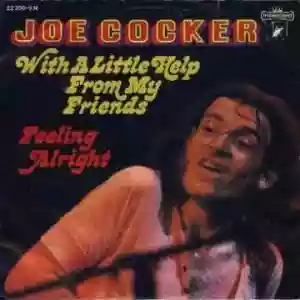
The second magical and immensely fortunate moment for Cocker not only involves music but also sees his person physically present: I am referring even more intuitively to his participation in the 1969 Woodstock Festival and the inclusion in the eponymous film of his remarkable Beatles cover performance. The studio version of the cover had been released a few months earlier on an eponymously titled album, ultimately his recording debut. The original brilliant McCartney nursery rhyme, entrusted to the modest but friendly voice of its drummer Ringo, had undergone a decisively effective restyling, with the rhythm changed from 4/4 to 3/4 to serve as a rhythmic base for a rock blues arrangement that featured Jimmy Page's guitar soaring, at the time involved in one of his last stints as a studio musician before assembling Led Zeppelin and moving on to much bigger things. Another instrument in the forefront of the arrangement is the Hammond organ operated by Tommy Eyre, immediately memorable in the long, ascending initial arpeggio and then constantly important throughout the piece. Ultimately decisive is the role given to the three black backing vocalists, capable of injecting the power and evocativeness of gospel into the hard rock blues base, excellently driven by Procol Harum's excellent drummer B.J. Wilson.
Biographies state that the ambitious Page seized this common session opportunity for Cocker's record to ask the same Wilson if he was interested in forming a band with him, bassist and multi-instrumentalist John Paul Jones, and Keith Reid on vocals... History had it that Wilson declined and, regarding the singer, Reid also eventually backed out, while recommending Page contact a guy from around Birmingham named Robert Plant who, upon learning that the drummer position was still vacant, brought along his neighbor and close friend John Bonham...
Returning to Cocker and this epochal reinterpretation of the Beatles song, it remains one of the best examples of added value given to someone else's song: the truly heartfelt performance of the Sheffield singer, the wise and powerful transformation of the original pop ditty into something authentically intense and engaging, the impeccable arrangement, and the beautiful voices answering the titular man's vigorous raspiness (by the way: in my opinion, at Woodstock, producer Kramer had the choruses redone in the studio, discarding the tracks that captured the two Grease Band guys at the microphone: in the soundtrack those voices sound too clean, powerful, precise, effective, and... feminine considering the situation, the live capturing techniques of that time, their... faces!), all contribute to making this track epochal and, for once, to defraud the Beatles of historical memory regarding their creation. Indeed, in the American Hall of Glory, they included this version, not the one from Sgt. Pepper, rightly so.
Loading comments slowly
Summary by Bot
This review highlights Joe Cocker's transformative and passionate cover of the Beatles' 'With A Little Help From My Friends,' which became iconic through his Woodstock performance. It praises the arrangement involving notable musicians like Jimmy Page and the gospel-influenced backing vocals, emphasizing the track's lasting impact. The review reflects on Cocker's troubled life but focuses mainly on his musical achievements.Tracklist Lyrics Videos
Joe Cocker
Joe Cocker (Joe Robert Cocker, born May 20, 1944, Sheffield) was an English singer known for a gritty, emotional voice and for reworking cover songs into distinctive soul/blues-rock performances. He broke through with his Beatles cover “With a Little Help from My Friends,” appeared at Woodstock in 1969, and later had major hits including “You Can Leave Your Hat On” and “Unchain My Heart.” He died in 2014.19 Reviews
Other reviews
By joejoeblues
"Joe Cocker secured participation in the Woodstock Festival in August 1969 where his live set proved to be among the most memorable and intense."
"A record to own, calmly included among the 10 most important and influential albums of the Woodstock generation."
