
 •
Rating:
•
Rating:
THE REVIEW
Every ten years a flower is born, sometimes a few more. We're talking about female singer-songwriters, just to clarify ideas and narrow the field.
Well, the 1980s saw the blooming, it's quite the case to say, of the fairytale-like Kate Bush, unsurprisingly discovered and projected onto international stages by Gilmour; the '90s were the bakers of delightful fragrances like Bjork and the early Tori Amos; could the new millennium be the springboard (or rather, the catapult) for Newsom, another terrifying creature with a voice as dangerous as a siren's song?
Of course, yes, otherwise this preamble would make no sense.
Let's be clear: these names mentioned are not the only stars that sparkle in the firmament of singer-songwriters or, more simply, "beautiful voices." There would also be the very young Anja Plaschg (alias Soap&Skin) or the vocal magic of Elizabeth Fraser (Cocteau Twins) or even the splendid Jesy Fortino (alias Tiny Vipers). But for us, for me, at least for now, I am only interested in talking about the talented American harpist and singer-songwriter: Joanna Newsom. I will say it again: Joanna Newsom. Carve her name well into your mind, it’s truly worth it.
She is also quite pretty, let's not deny it. But her beauty, combined with her voice, evokes "only" adoration. Nothing more appropriate in the presence of this goddess of song.
Okay okay now I'll talk about the album, as long as I am not called sexist.
"Ys" is one of the best albums of the new millennium, that should be enough for you.
I don't care if there are thousands of other genres, thousands of other bands, thousands of other artists.
Oh no, that’s not enough for you? Bastards. But in the end, you're right.
Well, this piece of art consists of only five tracks, yes few, but each more beautiful than the last and all vocally and orchestrally incomparable.
"Emily" breaks the ice, or rather, the world: behind an orchestral structure that simply follows all the thematic (musical and lyrical) variations of Newsom, her voice emerges like a leopardine broom flower, so angelic and yet so rooted to the earth, with a more human tone, we would say imperfect but precisely for this more unique and rare. The track is distinguished by numerous and unpredictable vocal changes, as well as symphonic, ranging from lullabies to introverted laments of the artist transitioning to her sudden guttural screams.
Her's is a voice capable of transitioning from the most ethereal high notes to the deepest, most intimate stretches. Not least is the harp: the only instrument capable of reflecting her voice, paradoxically, "without going out of tune."
What happens meanwhile inside of us? An emotional storm that drains us of all strength.
Then comes "Monkey & Bear", a folk ballad (as the whole album is folk) that directly transports us into a medieval-like fairy tale: a story of an impossible love between a monkey and a bear, here transformed into absolute and perfect reality.
Here, this is precisely Newsom's distinctive trait: her songs are not merely songs, they are stories narrated with the passion and emotion of a medieval minstrel.
The instrumental backbone in this case reveals an underlying linearity absolutely not simplistic, as might be easily assumed; a scenography without acid colors or flourishes of any sort in a film that is already in itself intricate.
Next is "Sawdust & Diamonds".
A veil falls on the orchestra. Not a violin out of place, no viola, no mandolin. Their silence is filled with reverence and sanctity. A private dialogue is taking place between Newsom and her harp, played like a piano. The voice, in this case, takes on the guise of an intense and sweet recitation, extremely warm in verbal expression.
It's time for "Only Skin", my personal gem of the entire album.
As in "Emily", the melody forms by disintegrating and rebuilding itself each time in what seems like a hall of mirrors made of braking and wild vocal accelerations.
Gradually, an impressive variety of instruments takes shape and substance: from violin to flute and accordion, finally arriving at banjo and percussion.
Precisely the end, the duet with Bill Callahan that highlights their respective timbral differences and throat distances, closing the track in a sharp crescendo (of hers) full of pathos and harmony. Their voices are two butterflies chasing each other in a field of daisies.
Chilling.
Finally "Cosmia", the last, fantastic folkloric journey at the heart of the narrative-formed track.
Simply exceptional is the instrumental jolt halfway through the song, among vocal flights, frantic sprints with the harp, and sustained rhythms of the accordion and other orchestra instruments.
Yet another, redundant, confirmation of this extraordinary Californian folk singer’s theatrical and narrative capabilities.
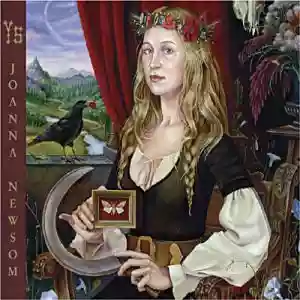
What remains at the end of this journey? The gaze of Newsom herself who from the cover seems to observe us with the indecipherability and enigma of an anachronistic storyteller.
Loading comments slowly
Summary by Bot
The review praises Joanna Newsom's album 'Ys' as one of the best folk albums of the new millennium. Each of its five tracks is celebrated for its unique orchestration and vocal performance. The review highlights Newsom's storytelling ability, her rare and emotive voice, and the album's rich instrumental textures. Special mention is given to the track 'Only Skin' featuring Bill Callahan. Overall, the album is depicted as a beautiful and emotionally powerful journey.Tracklist Lyrics Videos
Joanna Newsom
Joanna Newsom is an American singer-songwriter and harpist known for intricate compositions, literary lyrics, and a distinctive vocal style. Acclaimed albums include The Milk-Eyed Mender (2004), Ys (2006), Have One on Me (2010), and Divers (2015). Her work blends indie folk and chamber textures, with notable collaborations on Ys and expansive song forms throughout her catalog.07 Reviews
Other reviews
By godbowl
Joanna knows how to express herself through these long monologues of the soul, a soul... of a "little child" with purity and visions of curiosity.
After listening to "Ys" just one more time, its controversial nature becomes a virtue, the virtue of the artwork of a very young artist who has a lot of new things to say.
