
 •
Rating:
•
Rating:
THE REVIEW
I love Joan Baez, so much, and I believe that her persona has never been thoroughly explored and examined as she deserves: when talking about this extraordinary artist, people often stop at a few essential traits that are now decidedly stereotypical. How many beautiful records, how many nuances, how many different feelings this wonderful woman has given me: the doleful and austere allure of "Vol. 2," the auteur folk of "Farewell, Angelina," the rustic simplicity of "One Day At A Time," the pride and hope of "Gracias A La Vida," the vivid brilliance of "Diamonds And Rust," the lush overflow of images and sensations of "Gulf Winds," the unfinished masterpiece "Blowin' Away" and the last, most precious twist, "Gone From Danger;" however, in her vast discography, there is one moment that further emerges and stands out; 1971, Joan Baez's farewell to the historic Vanguard Records, the label that had launched her star into orbit.
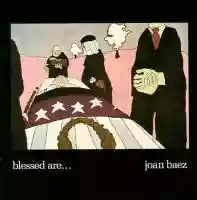
"Blessed Are..." is an overflowing double album, probably the most ambitious project of her entire career, representing the definitive crowning of a period of great change for the Latin-American singer. A bit of history: having definitively archived the era of pure folksinger with the overall disappointing tribute to Bob Dylan "Any Day Now" from 1968, Joanie completely changes direction, turns to country, and after a scholarly and utterly negligible "David's Album," hits the mark with the excellent "One Day At A Time," where, for the first time, she presents herself as a songwriter with the beautiful "Sweet Sir Galahad" and "David's Song." "Blessed Are..." comes across as an almost encyclopedic album, a summary of what Joan Baez had been up to that point: country, folk, rock, pop, and gospel meet and follow each other harmoniously, the Joan Baez interpreter takes by the hand and walks alongside the Joan Baez songwriter.
Among the countless interpretations with which the album is steeped, a choral and captivating "The Night They Drove Old Dixie Down" stands out, destined to become a mainstay of Joan Baez's repertoire, frequently performed in concert, and a tribute to the Rolling Stones with the spirited "The Salt Of The Earth", which fits Joanie like a glove both musically and textually. It should not be forgotten that "Blessed Are..." was recorded in Nashville, and thus country dominates the scene for much of the album, from a great classic like "Help Me Make It Through The Night" by Kris Kristofferson to the lighthearted and festive "The Brand New Tennessee Waltz", veering towards gospel nuances with "Heaven Help Us All" and the fun "Put Your Hand In The Hand". Among the most notable and remarkable interpretations are a bitter "Lincoln Freed Me Today", which portrays the sad disenchantment of an old ex-slave after only an apparent liberation, and "Deportee" by Woody Guthrie, a vibrant protest song in which Joanie once again sings of the racism and falsehoods of that great nation called the United States of America, and on a more intimate and personal level, the sweet folk ballad "Angeline" by Mickey Newbury and a wonderful and passionate bolero like "Maria Dolores".
After the taste in the previous album, in "Blessed Are..." for the first time can you accurately evaluate Joan Baez as a singer-songwriter who, as I have said before, for me is the best Joan Baez, the most important, the one I feel most connected and close to, and the original compositions are closely tied to the folk dimension of "Blessed Are...," Joanie expresses her creativity accompanying herself with the acoustic guitar, and always hits the mark with sweet and reflective ballads, characterized by very "plain" sounds but refined and tastefully arranged, such as the smooth, velvety, and consoling title track, where the glorified are the defeated, the humble, the marginalized, or the bittersweet and shaded country of "Outside The Nashville City Limits", the enchanting neoclassicism of "Milanese Waltz/Marie Flore", where a brief childhood friendship is evoked and especially songs veiled with melancholy and kindness, I think of the brief and poignant serenade of "When Time Is Stolen" and the dreamy "Gabriel And Me", songs in which you can hear Joan Baez's voice in all its enchantment, expressing itself over her beautiful melodies, further amplifying its charm.
However, beyond the sweetness, there are also darker shadows in "Blessed Are...," shadows that inspire Joanie to create two of the finest pieces in her songwriting repertoire, "Last, Lonely And Wretched" is a sparse and essential ballad: just guitar and voice, like in the beginning, and it is a song that ties a knot in your throat, heart-wrenching, of a sadness that almost inspires tears, and finally the wonderful "Three Horses", musically similar to the previous one but more expansive, disorienting and dreamlike, elevated by a visionary text of pure poetry, that unfolds in three verses dedicated respectively to the past, present, and future, words filled with allegories and reflections, the best ever written by Joan Baez. With such masterpieces in its tracklist, "Blessed Are..." is a product of the highest quality, which, despite being a double album, presents very few fillers and weak points; Joan Baez as an interpreter is, as always, excellent, four full saddles, the songwriter is simply wonderful, songs of a beauty and disarming simplicity, emotions, sighs, and reflections, and it is thus right and proper to reward such an important album with the highest marks, Joan Baez has never soared so high, not even in "Gulf Winds" and "Blowin' Away" that I personally adore, not even in the bestseller "Diamonds And Rust."
Loading comments slowly
Summary by Bot
The review praises Joan Baez's 1971 double album 'Blessed Are...' as her most ambitious and accomplished work. It highlights the album's eclectic mix of folk, country, rock, and gospel, along with Baez's maturity as a singer-songwriter. Key tracks and the emotional depth of the songwriting are emphasized. The album stands out as a crowning achievement in her career, combining personal reflection with powerful social commentary.Tracklist Lyrics Videos
03 The Salt of the Earth (03:25)
04 Three Horses (07:06)
06 Last, Lonely and Wretched (03:46)
07 Lincoln Freed Me Today (The Slave) (03:24)
08 Outside the Nashville City Limits (03:25)
09 San Francisco Mabel Joy (04:27)
10 When Time Is Stolen (03:02)
11 Heaven Help Us All (03:36)
12 Angeline (03:40)
13 Help Me Make It Through the Night (03:02)
15 Put Your Hand in the Hand (03:24)
16 Gabriel and Me (03:31)
17 Milanese Waltz / Marie Flore (05:59)
18 The Hitchhiker's Song (04:23)
19 The 33rd of August (03:46)
20 Fifteen Months (04:29)
Joan Baez
American folk singer, songwriter, and activist whose career rose after the 1959 Newport Folk Festival. A leading voice of the 1960s civil-rights and anti-war movements, renowned for her crystalline soprano and interpretations alongside originals such as Diamonds & Rust.08 Reviews
