
 •
Rating:
•
Rating:
THE REVIEW
With a very brief but explosive career in the world of rock, Jimi Hendrix must be placed among the inspirational figures of the psychedelic scene of those years. He had many traits: the revolutionary innovations he gradually introduced to music, the unmatched guitar virtuosity, the pyrotechnic shows, the irresistible erotic-lysergic impulses emanated on stage during live performances, his warm, deep, black blues voice.
From adolescence, he felt a connection to music genres like blues and rock&roll, which led him to work his way up around America, accompanying more or less famous musicians, until in 1966 he met former Animals member Chas Chandler who brought him to London, where this black guitarist immediately managed to capture attention. He formed his own band, a classic guitar-bass (Noel Redding) - drums (Mitch Mitchell) ensemble, which took on a historic and legendary name: "Experience." They released a series of essential singles for understanding and approaching psychedelic rock.
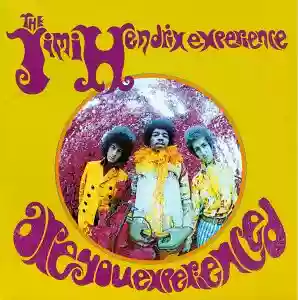
In this first 1967 album, Hendrix combines all '60s trends, rock-blues-pop-soul, adding abundant strokes of psychedelic color diluted by his revolutionary guitar art, partly inspired by English masters (Jeff Beck, Pete Townshend), but pushed beyond limits by an unorthodox technique that abuses feedback and distortion, achieving an unimaginable and shocking sound impact for the time. With this debut, one of the most formidable in rock, we are drawn for the first time into a psychedelic scene in its most carnal, visceral, and incandescent interpretation.
Immediate, revolutionary music, made up of pulsating acidic veins and piercing guitar outbursts, of a pure psychedelic frenzy emanating from "Purple Haze," "Foxy Lady," "Manic Depression," enriched by the distorted blues of "Red House" or "Hey Joe," the sci-fi experiments in "Third Stone from the Sun," only softened by the more ecstatic tones of "The Wind Cries Mary."
This album was just the first act of a rapidly evolving career but already achieved, with some of Hendrix's most important pieces and a second-place position on the UK charts, behind the Beatles' Sgt. Pepper.
Conclusions? Perhaps some might criticize Hendrix's lack of approach to more extended lysergic compositions, to a less direct mantra, akin to other "acid" groups of the time (the Grateful Dead, Jefferson Airplane with After Bathing at Baxter's, the Pink Floyd, and the Velvet Underground across the ocean), but be sure of one thing: if this Genius had lived a bit longer, he surely would have given us many more emotions, and considering his adaptability to various genres, he would have undoubtedly become the greatest, not just as a guitarist. Unfortunately, his "fast" living took him too soon from a world he felt was his, but from which he tried to escape.
Rumor has it that before his death he had decided to join ELP, I don't even dare to think about how many masterpieces they could have gifted us together. Just try to imagine the magnitude of the loss of Jimi for the history of music, or put on "Hey Joe" and travel together with your beloved Jimi.
Loading comments slowly
Summary by Bot
Jimi Hendrix’s debut album ‘Are You Experienced?’ is a landmark in psychedelic rock, blending blues, rock, and pop with revolutionary guitar techniques. This work showcases Hendrix's unmatched virtuosity and stage charisma. Despite a brief career, Hendrix left a profound legacy. The album includes iconic tracks like 'Purple Haze' and 'Hey Joe,' marking a major influence in 1960s music. Though short-lived, his impact remains powerful and transformative.Tracklist Lyrics Videos
Jimi Hendrix
James Marshall "Jimi" Hendrix (born Johnny Allen Hendrix, November 27, 1942, Seattle — died September 18, 1970, London) was an American guitarist, singer and songwriter known for revolutionary electric-guitar techniques, blues roots and pivotal psychedelic rock recordings.27 Reviews
Other reviews
By Elfo1
Are You Experienced? encapsulates an important chapter in Hendrix’s musical career.
Jimi significantly influenced what would become the electric sound of the ’70s by blending blues sounds with distortions.
