
 •
Rating:
•
Rating:
THE REVIEW
There comes a point in every artist's career when their repertoire literally risks playing out of their ears. Undoubtedly, it is difficult to please both the general fans, who ultimately always want the classic four or five hits (people who get excited over Aqualung, Thick as A Brick, Boureé, and Living In The Past) and the more ardent fans, who expect the proverbial "nuggets" and "gems" scattered here and there in the vast repertoire, if not even the more "new" material, given that the aforementioned classics have already been well assimilated for quite some time.
Fact is, for the reasons mentioned above, Jethro Tull embarked on a world tour that was different from the usual ones, partly due to the pressure from the public demanding a Jethro conversion to the "Unplugged" trend launched in the early '90s by MTV, which was a way of reinterpreting their repertoires live in an acoustic style. And that's what they did. This fact implied a strong change in 1992, not only from the point of view of the arrangements but also in the lineup, albeit temporarily. The keyboardist Andy Giddings, who had recently joined Jethro Tull during the recordings of "Catfish Rising" (1991), was kindly invited to stay home for the duration of the tour, while drummer Doane Perry requested a break to attend to his extra-Tullian business. Thus, Dave Mattacks, who had been the drummer for Fairport Convention introduced by then-bassist Dave Pegg, was engaged behind the drums. Gerry Conway, the drummer from the time of "Broadsword And The Beast," also made a few fleeting appearances during the tour.
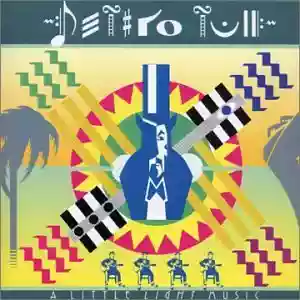
Live recordings resulted in an album titled "A Little Light Music," named after the 1992 acoustic tour, itself taken from a song in the previous album "Catfish Rising": specifically, it is the track Rocks On The Road (Now how about a little light music / to take it all away). It truly will be a little light music.
Even the first recorded dates were discarded due to the excessive nervousness of the entire band about the project: which says a lot for those who boast a solid live experience like Jethro Tull. Thus, the disc contains tracks recorded in London, Dortmund, Frankfurt, Mannheim, Munich, Berlin, Prague, Zurich, Ankara, Jerusalem, Caesarea, Graz, and in Athens, where Greek singer George Dalaras joined as a guest for a (useless) version of John Barleycorn and one of Ruby Tuesday, the latter cover fortunately not included in the disc.
The use of the semi-acoustic in Nursie and its arrangement, the choice of pieces like From A Dead Beat To An Old Greaser, leave a bit of a bitter taste. The sound of David Pegg's acoustic bass is unusual and provides a quirky touch to the pieces, not to mention Ian Anderson's voice, which struggles with the new volumes; speaking of which, his declining vocal phase began after the recordings of "Under Wraps," though still quite acceptable (the final blow came when he fell off the stage and nearly died of thrombosis, which affected his vocal situation up to the present day). There are, however, some really splendid interpretations, such as the instrumental version of the acoustic gem Under Wraps #2, as well as the excellent Life Is A Long Song and A Christmas Song. Ian Anderson's presentations, too, are epic, as he jokingly takes on Martin Barre and David Pegg. Yet, on the whole, it seems that the sound is indeed very scant at some points, besides the general redundancy of some arrangements (the blues rehash of Look Into The Sun rather than the intro of Too Old To Rock'n'Roll Too Young To Die, to name a couple).
In short, I frankly don't think I would have gone home very satisfied if I had gone to see a concert from this tour, even though many fans didn't mind this phase at all. I'm not saying one would go back disgusted or disappointed, because the level of the show is certainly always excellent, but neither would one jump for joy over the new change.
Perhaps such a project would be far more suited for Jethro Tull today, given that Ian Anderson's voice is nearly gone. Focusing on a predominantly acoustic repertoire would be less demanding and yield better results. But the real weak point of "A Little Light Music" perhaps remains the fact that the pieces, besides being rearranged, are less incisive compared to the originals, or even just compared to other live performances (consider the excellent Bursting Out from 1978 as an example!). "A Little Light Music" is a project on the edge. Even the cover design, though graphically well thought out, appears a bit kitsch and perhaps is just saved by the original logo made with musical symbols.
Jethro Tull will try to change the pieces again the following year with the mediocre Beacon Bottom's Tapes from the 25th-anniversary box set, before realizing that the more faithful to the original one remains, the more the audience appreciates it. Rightly so!
Loading comments slowly
Summary by Bot
Jethro Tull's 'A Little Light Music' captures their 1992 acoustic tour marked by rearranged classics and lineup shifts. While some performances shine, others feel less impactful compared to original versions. The album reflects both the risks and rewards of reinterpreting a vast repertoire acoustically and offers insight into Ian Anderson's evolving vocal condition. Overall, it appeals more to dedicated fans but may leave casual listeners less enthusiastic.Tracklist Lyrics
Jethro Tull
Jethro Tull are an English rock band formed in 1967 and long led by Ian Anderson. They are known for blending progressive and folk rock around Anderson's prominent flute and for landmark early-1970s albums such as Aqualung and Thick as a Brick.84 Reviews
