
 •
Rating:
•
Rating:
THE REVIEW
Two years after the dazzling metropolitan odyssey sparked by the cry of "Sex Is Violent," Jane's Addiction emerged from the twisted circles of the City of Angels to churn out their crowning work, as well as the natural evolution from their previous masterpiece. "Nothing's Shocking" had forged the perfect sonic suit for Jane, rejuvenating metal and inspiring alternative and grunge with a spirited and wild fusion of hard rock, new wave, and psychedelia.
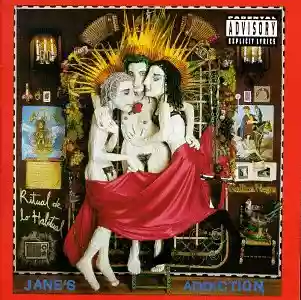
Driven by centrifugal forces that translated into an unparalleled creative tension (due to the contrasts between the different personalities, the group would soon disband), "Ritual De Lo Habitual" managed to avoid the pitfalls of déjà vu and reinvent the band's sound matrix. Where "Nothing's Shocking" was a deeply gothic and nocturnal work, "Ritual De Lo Habitual" immediately strikes with the sunshine and Latin viciousness that permeates it: evident from the title, from the introduction in Spanish, and from the booklet images, bearing folkloric fragments of the perverse microcosmos of L.A.'s Latin barrio.
The first side depicts a stunning electric assault, a dry synthesis of zepplinian sharpness and new wave sinuosity. "Stop" starts the show at its best, with hysterical funky-thrash riffs that flow into a rarefied and fiery spiral. "No One's Leaving" and "Ain't No Right" accentuate the group's glamorous reverb, while "Been Caught Stealing" dilutes the sophisticated mixture of Toxic Jane into an irresistible pop-funk-metal hybrid. "Obvious" is instead the first fracture: unsettling reggae rhythms support sumptuous diversions now funk, now psychedelic labeled Dave Navarro, who paints dazzling oceanic horizons with his six strings.
The second side touches on more sophisticated realms, exploring an unusual dreamlike dimension and conferring a monstrous value to the album. "Three Days" unravels in 11 minutes the band's immense potential. Eric Avery's bass shapes an obsessive and disorienting mantra, behind the drums Stephen Perkins marks the rhythm with incomparable skill while Navarro alternates coral-colored phrases, repainting Hendrix's "Third Stone From The Sun", with lush solos. Perry Farrell, for his part, molds it all with his sick and touching lyrics, hermetically condensing sex and drugs. It is the group's "Stairway To Heaven", epitome of Jane's style and aesthetics, and just like the more famous Zeppelin song, reaches its zenith in an explosive finale where all the pieces of the mosaic magically intertwine.
With "Then She Did" we further sink into psychedelic and Latin atmospheres, the ideal soundtrack of the mestizo Los Angeles. It is a poignant elegy from Perry to his mother who died by suicide: in seven breathtaking minutes, one moves between soft acoustic timbres, sudden guitar surges, bizarre piano flashes, and masterful orchestral accelerations to admire a musical sacrament suspended in a limbo of pure beauty. No less successful is the gypsy canvas of "Of Course", where Farrell's voice soars shamanically amidst a frenzy of guitars and violins, while the dreamy folk atmospheres of "Classic Girl" reveal the last jewel in Jane's Addiction's treasure chest, shining like a sunset on the West Coast.
Lastly, we must not forget the cultural value of the work, released in 1990, during a time of great ferment in the USA: both musical ("Nevermind" was just around the corner) and social changes (we were in the full Reaganite reflux). Farrell proclaimed himself the spokesperson for a bewildered youth after the desert of the 1980s (also highlighted by films like "My Own Private Idaho", the novels of Easton Ellis or Coupland, or contemporaneous albums like "Daydream Nation" by Sonic Youth) with the brilliant idea of launching the traveling Lollapalooza festival in 1991. This movement, in addition to spreading the best music produced in those years in the States, would contribute to forging political awareness among the torpid, nascent "Generation X", attentive also to issues like ecology and freedom of expression.
"Ritual De Lo Habitual" is to be counted among the milestones also for this.
Loading comments slowly
Summary by Bot
Jane's Addiction's Ritual De Lo Habitual marks a creative pinnacle that blends hard rock, psychedelia, and Latin influences. The album contrasts with their previous gothic style by infusing sunshine and Latin energy. Highlights include diverse styles from funk-metal to reggae and psychedelic explorations. Its cultural significance is tied to the early '90s musical and social movements, including the birth of Lollapalooza and Generation X identity. The album remains a milestone in alternative rock history.Tracklist Videos
Jane's Addiction
Jane's Addiction are an American rock band formed in Los Angeles, widely credited as key pioneers of alternative rock. Their classic lineup features Perry Farrell, Dave Navarro, Eric Avery, and Stephen Perkins, and their late-80s/early-90s albums are frequently cited as landmarks of the genre. Farrell also founded the Lollapalooza festival.13 Reviews
Other reviews
By diamond_darrell
An eccentric Perry Farrell, incredibly inspired in every aspect, both at the microphone and in yet another scandalous cover.
The masterpiece of JA.
