
 •
Rating:
•
Rating:
THE REVIEW
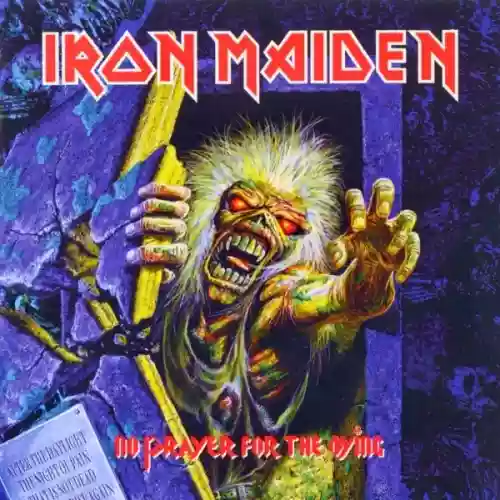
Once playback is finished, the listener becomes aware of a truth about “No Prayer For The Dying”: it presents no novelty, there's an air of déjà vû throughout the album. If one excludes the evident self-plagiarism that Iron Maiden have committed, it must be said that the music generally presents gray, barren, lifeless tones, better described as "dying." The tracks have no flavor, do not stimulate, do not evoke any emotion in the soul of those who patiently commit to listening to the record, and this can be linked to the fact that the sounds have a certain, or better yet, more than a certain déjà vû feel.
The British band, after two years from their last album of original songs, “Seventh Son of a Seventh Son,” an ambitious concept album in which the synthesizer appears for the first time, releases, on October 1, 1990, the eighth studio album of their career, "No Prayer For The Dying." Perhaps it is thanks to the polemical tone of the lyrics and the title itself that “No Prayer For The Dying” gains some appeal, marking a positive point. Not that Iron Maiden had never been polemical and direct in their lyrics before, but the renewed critical approach towards the world's harshest realities, including war, imperialism, prostitution, the mind control exercised by TV, preachers, and religious propaganda in general, manages to impact and inspire trust towards an album that, if not for the lyrics, would be quite mediocre.
Ten tracks follow one another without incidents, an old heavy metal, feeling as if it has lost its luster, pleasant in its simplicity, but banal, extremely banal. If “Seventh Son Of A Seventh Son” had represented the last resort, the last decisive step of the band's golden age, to which credit is given for reviving heavy metal with the eponymous debut (Bruce Dickinson was not part of it yet), along with the coeval Judas Priest, “No Prayer For The Dying” is the album that gathers the glorious remains of an era now ended, picking excerpts here and there from the most famous songs.
Bruce and company are no longer the band they used to be, but a copy of the band that artistically faded away in '88. The intro of the title track is almost identical to the intro of “Infinite Dreams” from the aforementioned predecessor, the electric guitar phrasing of “The Assassin” over which Bruce repeats the title word four times is that of “Can I Play With Madness,” again from “Seventh Son Of A Seventh Son”... The intro of “Run Silent Run Deep” “strangely” resembles Metallica’s “One” from two years earlier, while the violent guitar proceeding that follows is very similar to that of “Powerslave,” 1984, by Iron Maiden themselves. Not even “Mother Russia,” the most articulate of the album, is saved, because the culminating musical moment, the point where the pathos takes hold, is very similar to that of “Hallowed Be Thy Name” from the renowned “The Number Of The Beast” from 1982, the first album featuring Dickinson's epic voice, replacing that of Paul Di’Anno, one of the most bewildering vocalists in heavy metal history, whose vocal range can be compared to that of an emerging heavy metal bigwig, Ian Gillan.
Summarizing and repeating what has already been said, “No Prayer For The Dying” is a banal, ordinary album, lacking a backbone: if not mediocre, definitely insufficient. It is not an album that must be listened to, but naturally, if one wants to get an idea of the transition from stars to downfall by Iron Maiden, it is highly recommended. Anyway, honor and glory to Bruce and company in good times and bad, and so it is. Up the irons!
4/10
Loading comments slowly
Summary by Bot
No Prayer for the Dying by Iron Maiden is criticized for lacking originality and emotional impact. Compared to previous works, it reuses old riffs and melodies, making it feel uninspired. However, the album's polemical lyrics offer some value. Overall, it's considered a mediocre album marking a decline from the band's golden age.Tracklist Lyrics Videos
Iron Maiden
British heavy metal band formed in 1975, led by bassist and principal songwriter Steve Harris. Famous for epic studio albums, theatrical live shows featuring vocalist Bruce Dickinson, and the mascot Eddie.180 Reviews
Other reviews
By velvetunderground
No Prayer For The Dying is the calm after the storm!
Only the most faithful will find themselves there to visit this hidden cemetery, to bring some shy flowers to their loved ones!
By Starblazer
"No Prayer For The Dying is worthy in every respect of being part of the Iron Maiden saga."
"Mother Russia is a real masterpiece of the album: of rare beauty and evocative power."
