
 •
Rating:
•
Rating: THE REVIEW
I have never hidden the fact that I miss the first waves of prog-metal, the ones still tied to the Dream Theater style, which peaked between the ‘90s and 2000s. I’ve also often voiced small criticisms regarding the direction the genre has taken over the past 15 years, dominated by almost exclusively extreme guitars, and a lack of really strong keyboards and melodies. But that doesn’t mean I don’t appreciate this new course; over time, I’m coming to value it much more, and the worth of the new generation is absolutely beyond question. After all, “progressive” really does mean “progressing,” and if you truly want to be consistent, you need to move forward, face new things without fear, and not remain anchored to a glorious past.
This past year, I was truly struck by a British band (and that’s somewhat notable, since British bands are more active in prog-rock, less in prog-metal, which is a product much more American, Swedish, or Norwegian in nature). I’m talking about Ihlo. Ihlo are not totally free from the stereotypes that saturate the genre’s recent incarnations—their toolkit doesn’t lack extreme guitars, technical flourishes, or djent-inspired ideas—but these aren’t as pronounced as they are in other bands. And most importantly, they bring back to the forefront what was perhaps the main star of the earlier waves: melody. With Ihlo, melody isn’t a garnish, it’s extensively developed and often plays a leading role—even during the moments when the guitars hit hard. What especially captured my attention is the significant electronic component. Ihlo don’t dust off old retro-prog synths or vintage AOR flourishes; instead, they focus on bright, repetitive yet varied electronic loops, which always do a good job of carrying the melodies. As someone who loves sound experimentation, I can only appreciate this; besides, the electronics have the great virtue of never truly feeling overdone, even when they don’t add strange new things—unlike, say, a Hammond organ solo, which always runs the risk of becoming stale.
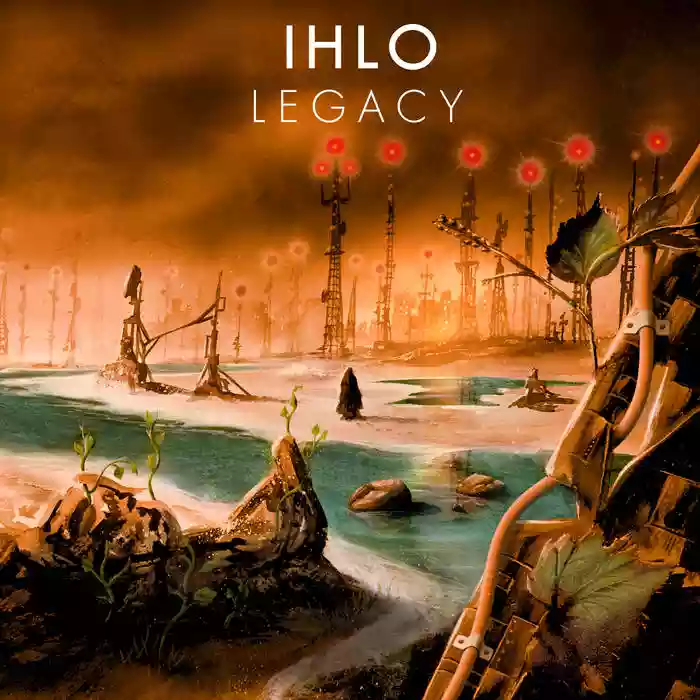
In 2025, this British band released their second album, titled “Legacy,” a full 6 years after their already-strong debut “Union.” It’s a record that expands upon the ideas of the first album, even if not in an immediately obvious way, but enough to highlight them more powerfully. The electronic element, in particular, has been significantly reinforced, reaching an interesting variety; the track “Storm” is significant in this respect, serving as a true electronic interlude, and the first part of “Source” likewise benefits greatly from its sharp arrangement. From the melodic angle, there has been real progress: here, the centrality of melody is truly confirmed, and as previously mentioned, it dominates even in the heavier moments. The album sounds bright and dreamy from start to finish; the vivid red and orange hues of the cover art seem to introduce us to a sunny yet autumnally melancholic atmosphere. Testifying to the dominance of melody are, for example, the long, delicate intros of tracks like “Replica” and the aforementioned “Source,” which reach or exceed the 2-minute mark before heavy guitars come in. “Empire,” on the other hand, is the clearest example of a track that always keeps melody at the center, where the metal component never tries to take over. But the clearest evidence of this melodic nature can be found in the long, sprawling tracks; these pieces, which last over 7-8 minutes, characterize much of the album, but there are three of them that are almost entirely (or fully) delicate, and it’s these that really help us to understand the true essence of Ihlo. It’s impossible not to be caressed by the swaying, dreamy, sunlit flow of “Mute” and “Signals,” which stand as brilliant examples of modern-day neo-prog along the lines of bands like Airbag, while the title track “Legacy” has darker, more melancholic, and introspective rhythms, featuring a crescendo of intensity that even brings us into post-rock territory. These turn out to be the album’s most successful and complete moments, so much so that it’s only natural to wonder… What if Ihlo are actually a progressive rock band merely pretending to have a metal side? It’s not so outlandish to think so, especially since, when they go hard, it’s never truly aggressive—nothing that makes you want to throw yourself into a mosh pit; they’re simply not the kind of band for moshing and headbanging. I sense that if, one day, they decided to shed the metal aspect entirely and dive headfirst into melodic prog-rock, they’d hit the bullseye—they could literally soar, creating something even greater than what they’ve already accomplished. In their case, time will truly tell; there are several bands to whom the “metal” label always felt tight and almost forced, who later revealed their true identity—Pain of Salvation and Leprous come to mind (I’d even add Opeth).
Putting any philosophical debate aside, Ihlo have partially broken the rules of today’s prog-metal and have given us an album that brings back to the genre a depth and sensitivity that seemed lost along the way—yet they’ve done it without looking back, instead facing the present and maybe even the future. This is an album that seems made to win back listeners disillusioned by the genre’s latest wave, but without bending to their every whim, without falling back into old clichés. Boh, for me, this has been the album of 2025!
Loading comments slowly
Summary by Bot
The review offers a balanced critique of Ihlo's 'Legacy' album, highlighting its progressive metal elements. Rated 3 out of 5, the write-up discusses both strengths and areas for improvement. The analysis aims to give potential listeners a fair impression of the debut work. It caters to fans curious about emerging progressive metal acts. Overall, the review provides valuable insights but stops short of high praise.
Ihlo
Ihlo are a British progressive band discussed as operating in prog-metal territory while strongly emphasizing melody and electronic elements.01 Reviews
