
 •
Rating:
•
Rating:
THE REVIEW
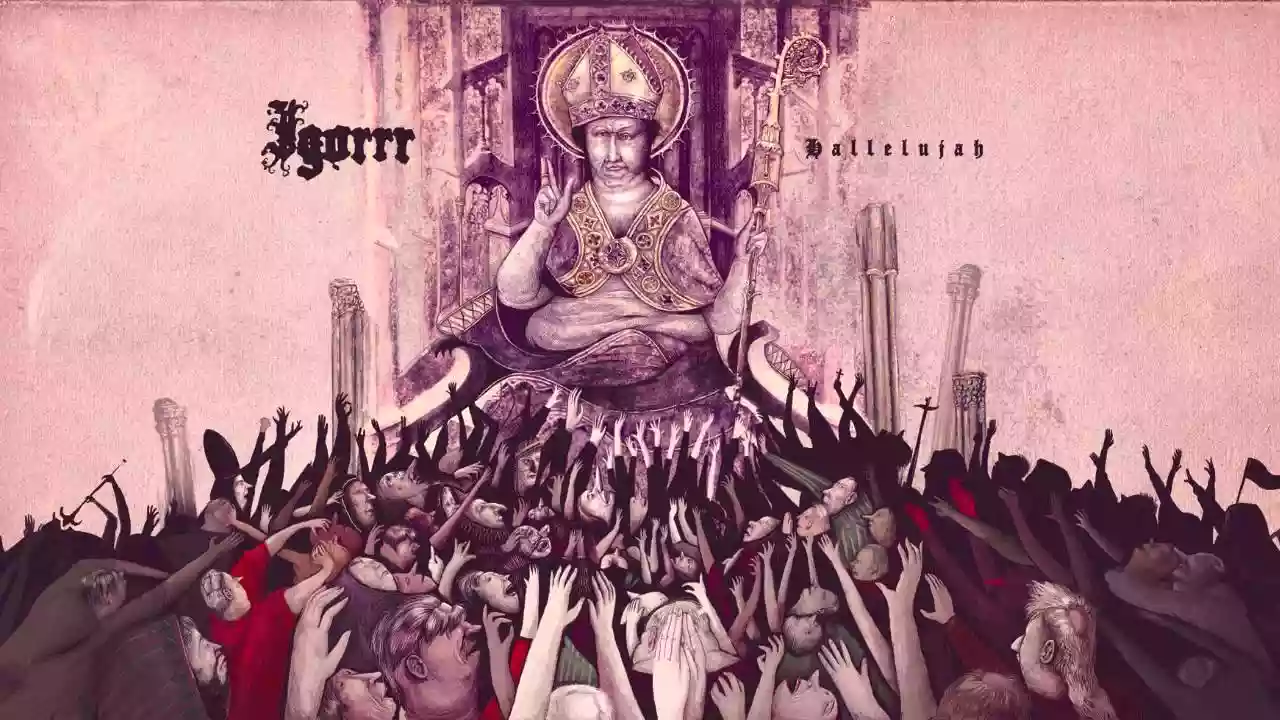
“Hallelujah” by “Igorrr” is probably a work with a dual soul: banal, scholastic, infantile from many points of view, yet at the same time talented, unique, strongly ironic.
First of all, let's focus on the not too daring choice of the composer to use almost entirely a 17th-century melodic register now dead and buried, accompanied in all manners by “Jazz” and “Death Metal” phrasings of unrefined craft, which lead the listener into the world of the banal, the predictable, the already done, already heard, the glossy commercial which every musician and/or true music critic should well abhor.
Apart from this heavy sore point, the rest of the work is definitely valid and out of the ordinary...
Indeed, the quality of execution of the various guests, coming from the most diverse musical scenes (Mahyem, Xoox oxxo, Mulk, Niveau Zero, Tryo, Pryapisme, City Weezle, John Zorn, Vladimir Bozar'n ze Sheraf Orkestar), is excellent.
If we then take into account the ability of “Igorrr” as a sound engineer, we immediately realize that we are facing a work that, from a technical point of view is flawless.
But the true masterpieces are, without too much doubt: the eruption of concrete music (decidedly more modern and less mainstream, where we can also find some citation to the well-known pianist “John Cage”) of which he makes a knowledgeable, yet curious, use of contrapuntal type.
Always in line with the coordinates of baroque music, throughout the work there is an exaggerated form of variation and fugue on the main theme (which can last from half a second to a minute and more), executed mostly with electronic effects, digital and samples of real sound that phrase among themselves, they talk to each other.
The “Drum machine” is a universe unto itself; indeed, if most of the melodies are mostly more or less successful imitations, it, on the other hand, is in perpetual motion marking times as absurd as they are neurotic and personal, giving a strong expressive sense to the entire work.
Moreover, the sound, in continuous mutation and in continuous motion, just listen, with a good system and/or good headphones, to hear how it keeps moving between right, left, diagonal, behind, in front, ect, ect...
The result is akin to a gigantic “Maelstrom” of perfectly calibrated and orchestrated sounds, offering us curious combinations of the most diverse genres, in an amusing work with traits as much Dadaist as they are commercial...
Conclusions:
“Hallelujah” is undoubtedly a good work, carefully crafted and personal. A fanciful and singular reinterpretation (and I emphasize reinterpretation) of music commonly divided by genres, here, united under one great banner.
Loading comments slowly
Summary by Bot
Igorrr's 'Hallelujah' is a technically flawless and unique album blending 17th-century baroque melodies with death metal, jazz, and experimental electronic sounds. Despite some predictable choices, the album shines through guest performances and intricate sound engineering. It showcases clever contrapuntal methods and continuous audio motion creating a dynamic listening experience. The work is an imaginative reinterpretation that crosses traditional genre boundaries with ironic and personal touches.Tracklist Videos
Igorrr
Igorrr is the project of French musician Gautier Serre, known for fusing breakcore, baroque/classical elements, and extreme metal. Early work appeared on Ad Noiseam; Savage Sinusoid was released by Metal Blade in 2017. Reviews highlight his technical production, eclectic influences, and use of operatic voices and harpsichord alongside blast beats.03 Reviews
