
 •
Rating:
•
Rating:
THE REVIEW
The line between grand and grandiosely boring is very thin and delicate, and usually when a metal band experiments with a more complex and lengthy album than usual, the final result can be a masterpiece, such as Dream Theater's "Octavarium," or a certainly interesting but inconclusive and watered-down album like DT's own "Six Degrees Of Inner Turbulence." In 2007, marked by both great albums and equally great flops (Dimmu Borgir, Nightwish), the glorious Iced Earth returns to the scene with the first part of a concept album, titled "Framing Armageddon (Something Wicked Part 1)," practically a solo album by Jon Schaffer, after the departure of Ralph Santolla, who decided to put his undeniable talent and guitar verve, which had characterized the previous, excellent "The Glorious Burden" at the service of Deicide (his choice...).
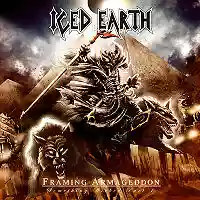
Getting to the point, "Framing Armageddon" features a very beautiful artwork that effectively conveys the excellent plot of the album, which combines science fiction with ancient Egyptian prophecies, laying the foundation for an interesting album; promises that, however, will be fulfilled only in part.
Out of the 19 tracks that make up the album, only eleven are actual songs, the rest are instrumental parts (both the intro "Overture," with tribal percussion and cello, and the outro "The Awakening," entirely composed of oriental vocalizations, are excellent) or short sung fragments, still good, like "Motivation Of Man" and "Reflections," while the various "Invasion," "Execution," "Cataclysm," and "Something Wicked part 2" do nothing but weigh down an album that's already not very smooth.
But honestly, among oriental airs and futuristic concept album manias, what on earth are Iced Earth proposing in this album?
Primarily Maiden-esque gallops of 3-4 minutes like "Something Wicked part 1," "Setian Massacre," "A Charge To Keep," "Ten Thousand Strong," "Order Of The Rose," "Infiltrate And Assimilate," and "Retribution Through The Ages," all very catchy and well-crafted songs (the first two especially have a really remarkable verve), but they seem cookie-cutter and give, at least on the first listen, the unpleasant sensation of hearing the same track repeatedly, now more aggressive, now melodic and solemn, and above all, they absolutely do not highlight the incredible abilities of one of the most beautiful voices in metal history, that Tim Owens who here simply performs his task well and seems really like a distant relative of the extraordinary Ripper Owens, ex-frontman of Judas Priest.
The most successful points of the album are undoubtedly "The Domino Decree," enriched by a long solo and small but significant keyboard touches that confer the song a solemnity and richness above average, "Framing Armageddon," the hardest point of the album, where good old Timmy manages to bring out the voice almost like in the times of "Jugulator," "When Stars Collide," an excellent closing track, cloaked in solemnity and dreamlike grip where an excellent Owens manages to make a difference very admirably and especially "The Clouding," where the first five minutes stand out, very soft, melancholic, and vaguely psychedelic, dominated by Schaffer's arpeggios, where the former Judas Priest is finally free to show the sweeter and more enchanting side of his voice, the one that made me love songs like "Cathedral Spires" or "Close To You" to madness.
In conclusion, "Framing Armageddon" is still a good album, which requires multiple listens to be well understood or appreciated. Jon Schaffer remains an axe-man of consummate skill and class, although the golden days of "Night Of The Stormrider" and "Burnt Offerings" will probably not return. For an overall assessment of the work, I eagerly await "The Crucible Of Man," which will see the return of Matt Barlow, whose lower and deeper voice better suits the music of Iced Earth, while to the great Ripper Owens I extend my best wishes for the second album of his Beyond Fear, who are tasked with setting the metal 2008 ablaze, along with Iced Earth themselves, Judas Priest, Blaze, and Cradle Of Filth.
Loading comments slowly
Summary by Bot
Framing Armageddon by Iced Earth is an ambitious concept album blending science fiction and ancient prophecy themes. While the songwriting shows moments of strength and Tim Owens delivers a competent vocal performance, the album suffers from excessive instrumental interludes and somewhat repetitive tracks. It requires multiple listens to appreciate. Fans await the next installment with the hope of Matt Barlow's return.Tracklist Lyrics
01 Overture (02:24)
02 Something Wicked, Part 1 (05:02)
03 Invasion (01:00)
04 Motivation of Man (01:34)
05 Setian Massacre (03:48)
06 A Charge to Keep (04:24)
07 Reflections (01:50)
09 Execution (01:27)
10 Order of the Rose (04:51)
11 Cataclysm (01:30)
13 Infiltrate and Assimilate (03:48)
14 Retribution Through the Ages (04:31)
15 Something Wicked, Part 2 (02:59)
16 The Domino Decree (06:36)
17 Framing Armageddon (03:40)
18 When Stars Collide (Born Is He) (04:17)
19 The Awakening (02:01)
Iced Earth
Iced Earth is an American heavy/power metal band with prominent thrash influences, founded and led by guitarist/songwriter Jon Schaffer. Reviews emphasize the band’s 1990s run (with vocalist Matthew Barlow) as a high point, highlight the live album Alive in Athens, and discuss later vocalist eras including Tim "Ripper" Owens and Stu Block.13 Reviews
Other reviews
By Balthus
It almost seems like the band wrote under duress, and you can really feel the lack of that typical rage found in albums like Night Of The Stormrider.
From Schaffer and company I expected more.
