
 •
Rating:
•
Rating:
THE REVIEW
Once again, Ian Russell McEwan has pleasantly swept me away into a story divided into two parts: a dystopian section that delves deep until it reaches the present, dense with ingredients (as is his custom). The first part is split into twenty-one chapters, where we are catapulted into 2119 and the world resembles a kind of “little/big Day After” in which the global population has been nearly halved due to ecological catastrophes triggered by nuclear events set off by wars among various nations. The generations of survivors try to return to normality as best they can; possibilities for travel for leisure, as we do so merrily in our time, are scarce if not non-existent (so much so that in the USA partisan wars are still being fought between states). One cannot even find the many delicious foods, wines, etc., that grace our bountiful tables, precisely because of the various ecological disasters—not least the rising seas that have swallowed up vast coastal and inland areas. Among the many who are trying to save what can be saved are two university researchers who work tirelessly around the poetry and literature of the 1990/2030 period, and specifically on a poetic manuscript from 2014 that Francis, a renowned poet, gave as a birthday present to his wife Vivien after destroying all other copies. However, this poem proves impossible to find. The two researchers (a husband and wife, both university professors), who, over the course of the story, come together, then separate, then reunite, will do everything in their power to recover this manuscript as if it were a real treasure hunt.
In the second part, it is Vivien who narrates her story and the people she meets and who become part of her life (all characters we already know from that dystopian future described in the first part), and here we are surprised by a chain of events that will conclude in 2020—events that (at least for me) will leave you speechless and breathless.
The themes explored are many: from history to philosophy, economics to ecology, poetry to prose, love to sex, and unfortunately war—including those in Ukraina and in the rest of the world. As I mentioned at the beginning, once again this capable writer did not disappoint my expectations—in fact, quite the opposite...
PS the genre or subgenre is described as follows by wikipedia: Fantascienza speculativa, Cli-Fi, Giallo Letterario
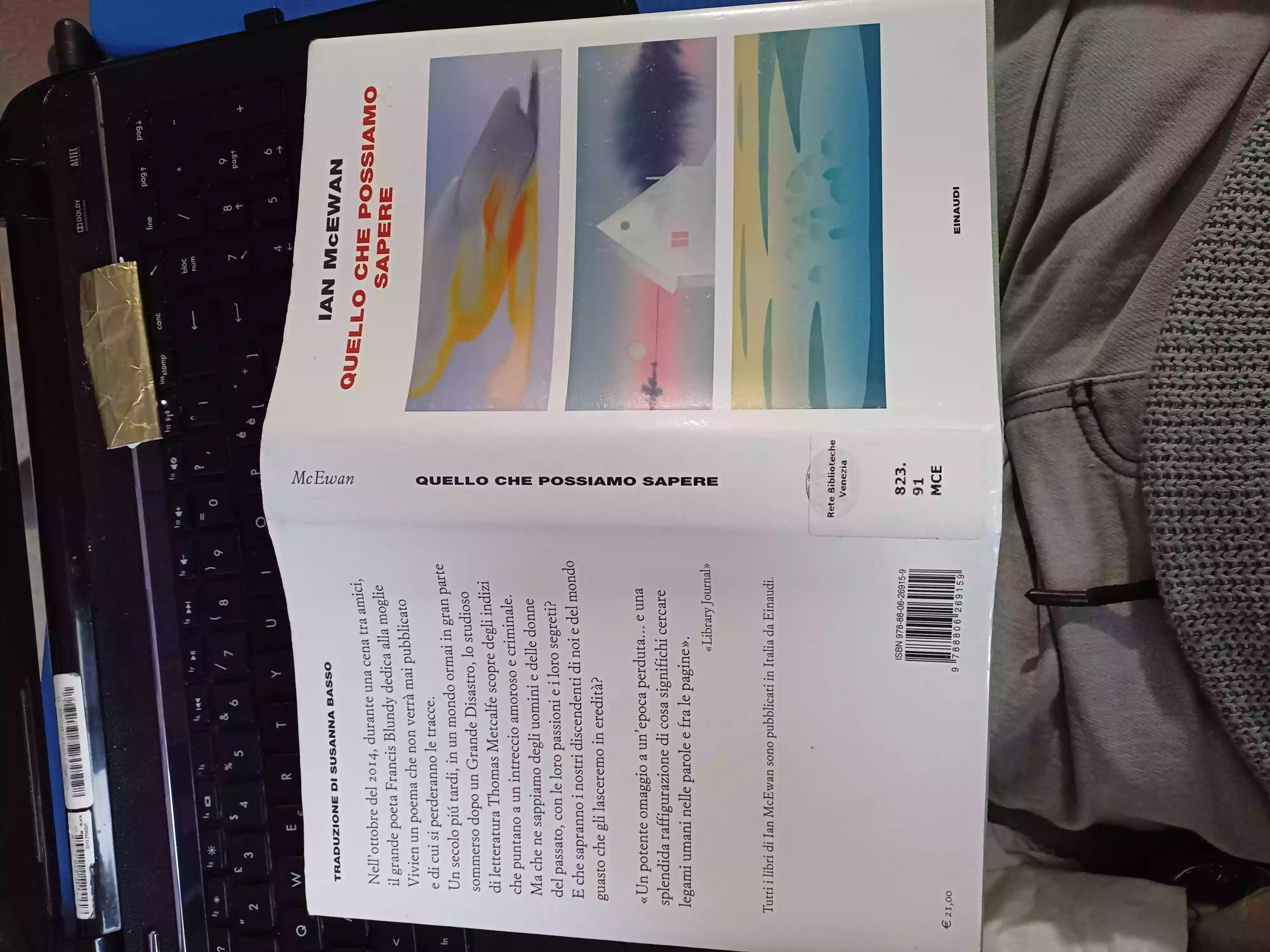
PS2 this review was written and kindly provided by my eternal friend Stanlio, whom I occasionally host here (since I have far more to do in these years of retirement, during which I use my free time and space for my own exclusive pleasure), and even the blurry photo was badly taken by the same.
Loading comments slowly
Summary by Bot
The review highly praises Ian McEwan's 'Quello che possiamo sapere,' highlighting its thematic exploration of human knowledge and emotion. The reviewer is impressed by McEwan's ability to provoke thought and feeling through his storytelling. The novel is recommended for its literary quality and depth. Both newcomers and McEwan fans will find value in its pages.
Ian McEwan
Ian McEwan (born 1948) is a British novelist and short‑story writer known for precise prose and moral complexity. He won the Booker Prize for Amsterdam and achieved worldwide acclaim with Atonement.06 Reviews
