
 •
Rating:
•
Rating:
THE REVIEW
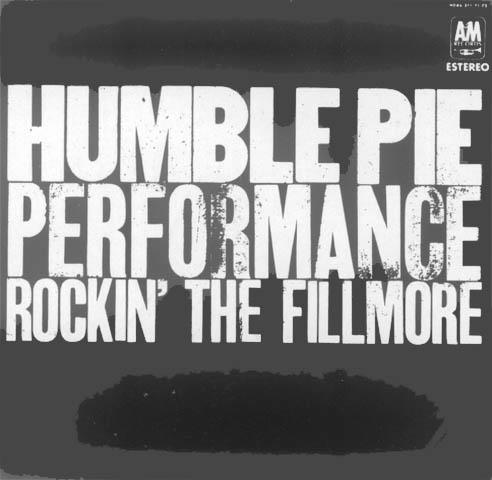
"Ok for the last time at the Fillmore, the Humble Pie!". This is how the concert held by Humble Pie in the historic hall owned by impresario Bill Graham, now close to closing, begins. It's the end of 1971 and Performance Rockin' The Fillmore is the ultimate live manifesto of a historic hard rock band, underrated and with mixed fortunes. The group revolves around guitarist and singer Steve Marriott, coming from the Small Faces, with whom he developed a pronounced Rhythm & Blues sense that sometimes sneaks in strongly in Humble Pie's compositions. Supporting Marriott's guitar, there's a very young Peter Frampton, an imaginative and melodically gifted guitarist, who would stay with Pie for only a couple of years. To complete the rhythm section, we have bassist Gregg Ridley and drummer Jerry Shirley.
From the first notes of Four Day Creep, it’s immediately clear that the four Englishmen are at ease on stage and start to warm up the audience with gorgeous guitar chases between Marriott and Frampton, all seasoned by a frenzied drum session by Shirley. Then it moves through Stone Cold Fever, always at very high volumes as in almost the entire concert, to reach a cover of Dr. John's I Walk On Glided Splinters, where blues and Rhythm & Blues triumph. It then continues with bluesy themes with another cover, this time it's Muddy Waters with a Rolling Stone served with venom, where Marriott sings as if he were a black man from Alabama and the ecstatic crowd screams with him.
Then it's the turn of another classic called Hallelujah I Love Her So where both Marriott and Frampton alternate on vocals, sending the audience into raptures. This rare moment of calm on the record is nothing more than a preview for the final tsunami where another Rhythm & Blues gem is covered, I Don't Need No Doctor. This track is violently and wildly transformed for almost 8 minutes by terrifying rock, hammering drums, breaks, stops, and restarts, seeming to have no end.
After the album's release, Peter Frampton left the band to try his luck as a solo artist, but after the release of his work in 1976, he went through a period of crisis, from which he emerged a few years later, becoming a well-regarded session man.
Humble Pie, on the other hand, found another guitarist in the figure of David "Clem" Clempson, formerly of Colosseum, and continued recording with mixed results until the late '70s.
Loading comments slowly
Summary by Bot
Performance Rockin' The Fillmore captures Humble Pie at their energetic best during a historic 1971 concert. The album blends powerful hard rock with soulful blues, spotlighting Steve Marriott and young Peter Frampton. With passionate covers and dynamic interplay, the band delivers a memorable live experience. This recording remains an essential document of a talented yet underrated band at a pivotal moment.
Humble Pie
Humble Pie are a British blues/hard rock band formed in 1969 by Steve Marriott (ex–Small Faces), Peter Frampton, Greg Ridley, and Jerry Shirley. Celebrated for high-energy live shows and blues-soaked riffing, they hit their stride with Rock On and the live set Performance: Rockin’ the Fillmore; Frampton departed soon after, and the band scored with Smokin’.02 Reviews
