
 •
Rating:
•
Rating:
THE REVIEW
Chester Arthur Burnett, better known by his stage name Howlin' Wolf (likely a tribute to his grandfather who used to tell him stories about wolves as a child), learned to play the guitar from Charlie Patton, whom he imitated quite shamelessly in his youth, and later he learned to play the harmonica from Sonny Boy Williamson II.
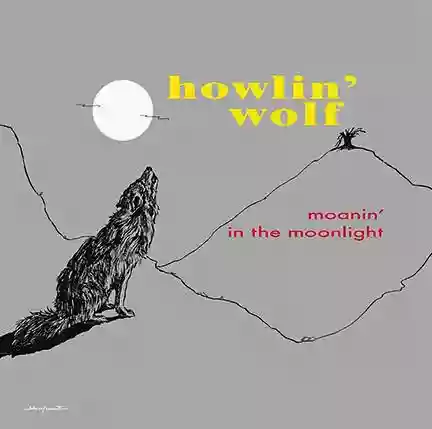
"Moanin' in the Moonlight" is his first album, compiling a series of singles released between 1951 and '59; the line-ups change throughout the tracks, but the only constant presence, when the song calls for it, is the double bass of the great Willie Dixon. The Wolf/Dixon duo would henceforth become a unique trademark in the history of blues for the proverbial power and hardness they could lend to their sound.
The album opens with the splendid title track "Moanin' In The Moonlight" from '51, a piece with twists that could be described as ancestral. Wolf impresses with his vocal magnetism; he is accompanied by the harmonica and is driven by the reverberating guitar of Willie Johnson and the sparse, rural drumming of Willie Steel, and from here, it can already be inferred that the blues would never be the same.
A gem is "Smokestack Lightnin'" from '56 (he recorded an earlier beautiful version in '52 titled "Crying At Daylight"). This track is the most famous on the album, immediately capturing the listener with its immediate and effective riff that extends throughout the piece. Howlin' Wolf's voice is vigorous and harsh, always ready to emit those typical lone wolf howls.
Another gem, supported by a robust sextet, is "Evil" from '54, and it is one of those simple but unique tracks that show the luciferous nerve of the Wolf/Dixon pairing.
The enjoyment obviously doesn’t end with the three songs I chose to examine.
This album is an essential starting point for a new path of the blues and to discover how much influence it has generated on all the rock to come, although the definitive consecration would come, thanks also to greater rapport and cohesiveness of the sidemen, with the following album, namely the milestone "Howlin' Wolf" also known as "The Rockin' Chair Album" due to the effective cover image (here on Deb you'll find a good review: https://www.debaser.it/howlin-wolf/howlin-wolf/recensione).
If you don't know him (is that possible?), listen to these recordings and the primal howl of Mr. Wolf; I assure you, it will never leave you.
Loading comments slowly
Summary by Bot
Moanin' in the Moonlight is Howlin' Wolf's debut album compiling singles from the early 50s to late 50s. The review highlights his vocal power and the influential partnership with bassist Willie Dixon. Key tracks like 'Moanin' In The Moonlight,' 'Smokestack Lightnin',' and 'Evil' showcase the blues innovation this album offers. It's marked as an essential entry in blues history, paving the way for rock genres to follow.Tracklist
01 Moanin' At Midnight (02:43)
02 How Many More Years (02:58)
03 Smokestack Lightnin' (02:32)
04 Baby, How Long (02:18)
05 No Place To Go (02:31)
06 All Night Boogie (02:16)
07 Evil (03:01)
08 I'm Leavin' You (02:29)
09 Moanin' For My Baby (02:17)
10 I Asked For Water (She Gave Me Gasoline) (02:47)
11 Forty-Four (03:02)
12 Somebody In My Home (02:59)
Howlin' Wolf
Chester Arthur Burnett (Howlin’ Wolf) was an American blues singer, guitarist and harmonica player from Mississippi. Mentored by Charley Patton and Sonny Boy Williamson II, he recorded for Chess Records from the early 1950s, shaping Chicago blues with classics like Smokestack Lightnin’, Spoonful, Little Red Rooster and Back Door Man. His powerful voice and work with Willie Dixon and guitarist Hubert Sumlin deeply influenced British and American rock. He died in 1976.07 Reviews
