
 •
Rating:
•
Rating:
THE REVIEW
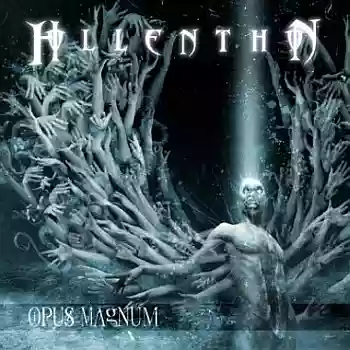
I'm about to review the third work of the Austrian band Hollenthon, "Opus Magnum," released in 2008, a full seven years after their last, "With Vilest of Worms to Dwell," which itself followed the debut album "Domus Mundi" from 1999.
First and foremost, how should one define Hollenthon's genre? I would say, as Sly aptly highlighted in his review, it is a blend of melodic and symphonic death metal, with power influences, extremely fast and grandiose, in which the male growl vocals, absolutely predominant, alternate with clean male and female vocals. Thus, you can already sense how the musical proposition of this band is characterized by originality and notable complexity, not being easily or immediately assimilated. That said, the previous albums managed to synthesize well into a coherent and meaningful whole, I would even say fascinating, all the elements just mentioned, and were, in my opinion, really good. This latest one essentially did not disappoint me, albeit with the necessity of a few distinctions that I will explain further here.
"Opus Magnum" comprises eight tracks of varying nature, in which traditional metal sections alternate with orchestral parts worthy of a movie soundtrack ("Of Splendid Worlds"), moments of greater delicacy (see the slow insert with female vocals in "Son of Perdition"), and echoes of oriental music ("Misterium Babel," truly an intriguing piece). The album's merits are undoubtedly a sense of great epicness that rarely slips into the cloying (a danger, as we know, inherent in the symphonic genre), combined with an impression of dark unease that grips the listener and irresistibly drags them into a peculiar world. Compared to its predecessor, "Opus Magnum" aims (as I believe the name itself intends to indicate!) to be more bombastic and insistent, but also darker and harsher, less "easy-listening" (pardon the expression, perhaps not suitable to the genre!), and succeeds completely. However, this shift has negative aspects as well: "Opus Magnum" is less varied in proportion to its predecessor, and perhaps less surprising. It is indeed true that the tracks in this album, as in the previous ones, have different souls and varied components, as highlighted above, but ultimately they seem more similar to each other than in "With Vilest...," perhaps precisely due to the predominance of the orchestral part and the constantly "driven" rhythms.
Nonetheless, a great band and a great album, to which I give 4 stars.
Loading comments slowly
Summary by Bot
Hollenthon's 'Opus Magnum', released in 2008, blends melodic and symphonic death metal with orchestral and oriental elements. The album is darker and more bombastic than its predecessor, featuring a mix of harsh growls and clean vocals. While it offers less variation compared to earlier works, it delivers a compelling and epic listening experience. Overall, a strong and complex album from the Austrian band deserving of praise.Tracklist Lyrics Videos
Hollenthon
Hollenthon is an Austrian band blending symphonic and melodic death metal with orchestral and choral elements. Led by Martin Schirenc, with drums by Mike Groeger, they released Domus Mundi (1999), With Vilest of Worms to Dwell, and the darker, bombastic Opus Magnum (2008), plus the EP Tyrants and Wraiths.02 Reviews
