
 •
Rating:
•
Rating:
THE REVIEW
If I ever met Courtney, I would advise her to die, one way or another. Her vain artistic outbursts, the experience with Hole, her acting career, her strenuous efforts to live up to the standard of American rock songwriting, both underground and not, would make sense, and maybe, even historiography would be convinced, would stop labeling her as mediocre, and for a few weeks, celebrate her as divine, just to fill a few more pages.
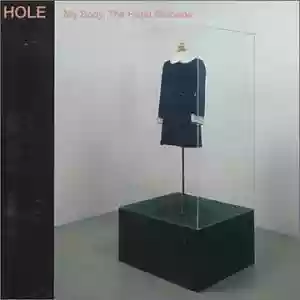
But if there's something I've understood about her over the years, it's definitely that she is certainly not an artificial person. She is naive, acts without much reflection, is driven by instinct and a unique brand of pathos. All this, even though it translates musically into a lack of method and basic knowledge, nevertheless results in a highly varied compositional vein, stemming from the multiple life, musical, and cultural experiences that make up her background. Love's eclecticism has led over time to very different musical outcomes, in virtue of which we can consider Hole's production quite fragmented, if not downright lacking in coherence. And in an apparent lack of unity lies the resolution of the album in question: a kind of collection of unreleased tracks, unplugged versions, and covers, in which the entire history of Hole is organically synthesized: from noize origins to foxcore, up to grunge pretensions and the overly heavy competition with the shadow of Kurt Cobain.
It must be said that Hole had strange relations with foxcore: although constantly referencing that world, they certainly weren't purists. Indeed. To Courtney, the riots of Olympia must have seemed, at some point, quite stereotypical and needlessly pretentious, judging by the lyrics of "Olympia". If Hole ever did foxcore, we might only find it on this album: "Turpentine", "Phonebill Song", "Burn Black", "Dicknail", tracks removed from the "Pretty On The Inside" tracklist, which nevertheless highlight Courtney's originality in interpreting the genre's stereotypes. Then came grunge and the "Live Through This" album, which reiterated the concept in a sweetened but, if nothing else, personal guise: we have some unplugged pieces: the famous "Miss World", "Softer, Softest", "Asking for It". And if Cobain's shadow looms over that album, we then have "Old Age", a Nirvana cover recorded for MTV's unplugged, still echoing the emotions stirred by Kurt's death and Courtney's emotional state, which seems concentrated in the repeated final "I'm sorry".
To celebrate Nirvana at that moment and in those circumstances had a very particular meaning. Just prior to that occasion, Nirvana had delivered an exceptionally evocative performance, from which a highly successful record, "Unplugged in New York", was produced, through which, justifiably, Nirvana positioned themselves among the ranks of great songwriters in the American tradition. In this sense, the tribute to Nirvana by Hole is a celebration of memory and, at the same time, an acknowledgment of their now definitive position in the rock imagination. But it's also a sense of belonging to a model, to ideals whose weight turns out to be, to this day, quite difficult to bear. A burden with which today's rock musicians constantly live and which, probably, no one will take on further.
Yet, Kurt Cobain, just like Courtney Love, were never musicians in the strictest sense. We cannot say that they invented something. Their peculiarity lies rather in an original reworking of a long musical tradition: mostly white rock, from country to punk avant-gardes. And it's in a nod to tradition that we can frame the covers present in this album: "Seasons of the Witch" by Donovan, the British avant-gardist version of Bob Dylan, and "He Hit Me" by Carole King, a renowned singer-songwriter, woman, and American: and it's also in the choice of these two pieces that the fragmentariness of this album is cemented: it is the biography of Hole, their varied, complex, contradictory world, an emotional document of a human story more than a musical one, and as such, a completed object of art.
Loading comments slowly
Summary by Bot
This review highlights the unique and raw nature of Hole's album 'My Body, The Hand Grenade.' It emphasizes Courtney Love's instinctive artistry and the album's fragmented yet deeply emotional composition. The collection showcases the band's evolution from foxcore roots to grunge, including unplugged versions and tributes to Nirvana. The album serves as a personal and historical document of Hole's complex journey in rock.Tracklist Lyrics Videos
Hole
Hole is an American alternative rock band formed in Los Angeles in 1989 by Courtney Love and Eric Erlandson. The group became a fixture of the 1990s alt‑rock scene with the albums Pretty on the Inside (1991), Live Through This (1994), and Celebrity Skin (1998), later returning with Nobody’s Daughter (2010).09 Reviews
