
 •
Rating:
•
Rating:
THE REVIEW
Play to win.
When Robert Fripp chose not to take the Crimson King machine on tour any longer, imposing a monastic isolation on himself that seemed as eternal as it was inevitable, he found refuge at home, after a long time. He rested his guitar on the armrest of the chair for a moment, letting his imagination run free. Sunk in that resting place, he began to piece together the puzzle. It was impossible to continue like this, he reflected, because the excesses and enormities of those gargantuan tours around the world, now that success finally smiled upon him, would risk killing him or at least sending him into depression. There was a need for "a small, mobile, and intelligent formation," as a refined alternative to the heaviness of rock ensembles: the great dinosaurs of rock, to which KC had inevitably affiliated themselves, with their cumbersome shows and dozens of collaborators, from musicians to the last groupie, would inevitably be overtaken by other, more free and agile artists, no longer chained by the show-biz. It was 1973. In some way, Bob had foreseen one of the causes for the advent of punk.
It was by fortunate chance that almost at the same time, his confidant Eno appeared at the door, just having left Roxy Music, with more or less the same ideas in mind. With him, he recorded the duo "(No Pussyfooting)" and "Evening Star" between 1973 and 1975, redefining once again the role of the guitar in rock.
Now, starting with Fripp to open a write-up on one of the synthpop champions (as that's what we're dealing with, isn't it?) may seem like a stretch. However, about a decade later, Fripp and Eno could be proud of their insights if it was true that the seeds they scattered had taken root as far as Sheffield. Martyn Ware and Ian Craig Marsh weren't exactly aligned with punk and definitely not with prog, and yet success hadn't come to them neither with the former nor with the electronic experiments of their creation, Human League. From this social entity, they were kindly booted out right after "Travelogue," and just before the interplanetary success of "Dare." Demoralized, disappointed, defeated, they were convinced by Bob Last, the same manager who had orchestrated their breakup, to start again from zero once more. The first step was to adopt the idea mentioned a few lines before: to establish a production company, dynamic and flexible, capable of dealing directly with record labels. No more subjected groups, paid a pittance and exploited to the core. They would call it the British Electric Foundation, BEF, and it would open doors worldwide. Besides Fripp, their other models were the Chic Organization and the empire of Parliament/Funkadelic by George Clinton, renowned in the scene for managing an infinity of contracts with the most diverse record labels. Conceptually, the BEF preached the same calligraphy already brought to light by the Eno/Fripp duo: to propose music that was "a soundtrack for your life," honoring the anti-rock rhetoric born from the desire to abdicate the revolutionary force of music. No more barricades, just entertainment. Almost what's happening to the Human League of Don’t You Want Me.
Apparently, it wasn't so easy for Ware and Marsh to completely shed those clothes, if it's true that they titled their first irresistible single (We Don't Need This) Fascist Groove Thang and the lyrics, arrangement, and atmosphere were anything but disengaged. The intro is the most misleading thing you'll hear from Heaven 17: percussionists coming from somewhere between Bali and a Pakistani suburb in London jamming with an African tribe of your choice. The coordinates appear seconds later: the earth-shattering funk rhythms of the masters are the backbone of all the pieces. White rhythms, mind you, but still incendiary – the bass lines are a real joy for anyone who loves funk, try and see. As if that wasn't enough, we add the most cutting-edge electronics of the era, with the drum machine Linn rhythms programmed by the non-drummer Ware. The frame is sparkling and the arrangements glisten with a futuristic flair that sounds surprising even today, let alone then. The cherry on top is the incredible, tightly controlled, and thoroughly European voice of the baritone Glenn Gregory, pulled up during the Berlin sessions of the Duke.
Bowie himself is another predominant influence for Heaven 17, as well as for the entire New Wave (maybe a day will come when this influence will be fully acknowledged, who knows...). Raise your hand if you don't hear the sax of "Heroes" right in the middle of Fascist Groove Thang, or haven't noticed the exact division between the lively first part and the more reflective second part, where the rhythms try to be less intricate and more reasoned, just as happened in the first two albums of the trilogy. Then again, the second part, being the less inspired and tied as it is to certain post-"Travelogue" experiments, only counts in the perspective of subsequent albums (and Heaven 17 would treasure this).
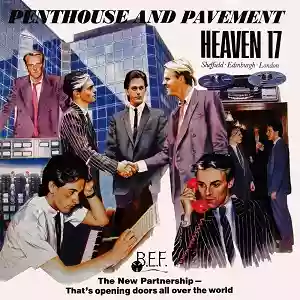
The album unfolds over a sort of concept, which was the very creed upon which the entire BEF was built, and also the same one found on the cover. The contemporary man can no longer pursue the same ideals of peace, love & innocence flaunted in the '60s (and ruinously shipwrecked in the '70s): from this perspective, Heaven 17 are punk in the fullest sense of the word. The career has become the focal point in every person's life, the same ambition instilled in you at university until you start a decent job, because only in this way can you have a stable existence and feel valued within a consumerist society, seasoned with fake smiles and handshakes like traps. Ware described it thus: "we wanted to dismantle the mythology of the musician as a wandering minstrel stripped of everything by the record label and paid only to get high. It was an operation of truth: Bob Dylan might think he's a rebel, but in reality, he's a multinational asset. Anyone signing with a major is part of a huge commercial machine. The idea was, 'Let's get rid of all that hypocrisy like 'We're artists, we don't care about money.' Let's tear off the mask and see what's underneath.'" Ultimately, the same path that the Gang of Four were also treading. The second side bites the brake and takes a breather, trying to reflect on itself rather than the world around. In this whirlwind of emotions and impulses, Marsh, Ware, and Gregory also find the inspiration to envision the '90s, when cable TV broadcasts porn flicks with Japanese girls exciting the tired insomniac thirty-somethings from stress (Geisha Boys and Temple Girls), or foresee massacre as the only way out of repetitive work cycle apathy (Let's All Make a Bomb). Here, the keyboards dominate, with the guitar taking a backseat: it seems that the danceable and frenetic rhythms of the first side, those of the "penthouse," must inevitably be replaced by the nightly sensations of the multiple stimuli of synthesized late night music. No more movement, just contemplation on the pavement. In all this stands out The Height of the Fighting, undoubtedly the peak of side B.
Everything seems decided, but at the end Heaven 17 backtrack, declaring peremptorily that "we will live very long," at least as long as there is a dance floor. I still haven't figured out if it was a hope, lack of courage, or a threat.
Loading comments slowly
Summary by Bot
Heaven 17's Penthouse and Pavement is a groundbreaking synthpop album that blends funk rhythms, political lyricism, and cutting-edge electronics. Inspired by pioneers like Robert Fripp and Brian Eno, Martyn Ware and Ian Craig Marsh crafted a dynamic sound that challenged rock's excesses. The album's concept critiques consumerist society and embraces a futuristic, danceable aesthetic. Despite some less inspired moments, the record remains a touchstone of early '80s electronic music and cultural commentary.Tracklist Lyrics Videos
Heaven 17
Heaven 17 are an English synth-pop group formed in Sheffield in 1980 by Martyn Ware and Ian Craig Marsh after leaving The Human League, with Glenn Gregory on lead vocals. Known for sleek electronic production and funk influences, they scored major UK hits including Temptation (1983), Let Me Go, and Come Live With Me, and released influential albums such as Penthouse and Pavement and The Luxury Gap.01 Reviews
