
 •
Rating:
•
Rating:
THE REVIEW
Line-up:
Dave White - Vocals
Lee Altus - Guitar
Doug Piercy - Guitar
Marc Biedermann - Bass
Darren Minter - Drums
Label: Roadrunner Records
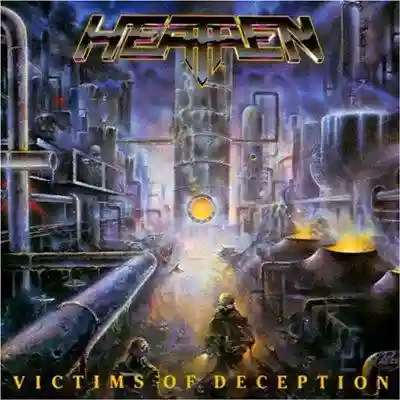
The year is 1991, precisely in the Bay Area of San Francisco, a place where myriads of Thrash Metal bands have formed. Among these bands are Heathen, who after debuting with the beautiful 'Breaking The Silence' (1987), bring to light one of the most colossal and phenomenal albums of the entire genre: 'Victims Of Deception'.
The album in question was born in an unfortunate period, the 90s, which represent the decade of decline for Heavy Metal in general, in favor of a phenomenon known as Grunge. To tackle this inconvenience, bands like Metallica, Megadeth, Anthrax, Testament, etc., preferred to shelve their old sounds in favor of more radio-friendly material to keep up with the times. However, Heathen maintained their Thrash Sound, but with something more: a monstrous technique. Victims Of Deception is not at all a canonical and traditional Thrash Metal album; it's not just sound violence for its own sake, but a complex, intricate, highly technical and damn engaging album. It could be described as Progressive Thrash or Technical Thrash, as the affinities with bands like Megadeth, Toxik, Dark Angel, and Coroner are quite evident here, not to mention a slight influence of Anthrax, especially in David White's singing, which vaguely resembles Joey Belladonna's. I would define this album as a combination of the complexity and length of Time Does Not Heal (Dark Angel) and the power of Among The Living (Anthrax).
I consider this album a masterpiece, if not only for the excessive length of the tracks, which slightly weighs on the immediacy and for the presence of some fillers that completely clash in an album of this kind, such as the Rainbow cover 'Kill The King'.
But let's do a Track By Track analysis: the album opens with Hypnotized, which immediately presents itself as one of the best tracks on the album; preceded by an intro where you hear an obsessive voice, almost intent on hypnotizing the listener. The song aims to condemn, in a certain sense, religion that manipulates the minds of human beings, preventing them from thinking with their own heads. After the long intro, the song finally starts, revealing itself to be extremely engaging thanks to the devastating and ultra-technical riffs of Lee Altus, all accompanied by White’s beautiful voice, which fits perfectly with the sound proposed. Immediately, another of the best tracks of the album kicks in, "Opiate Of The Masses", a stunning track, more paced compared to the first song, but decidedly more lethal. I challenge any respectable Thrasher to resist Headbanging, which here seems to come out almost naturally. Closing the initial trio of the best tracks of the album is Heathen's Song, a semi-ballad that is simply exciting. Introduced by an arpeggio vaguely reminiscent of the song "Beneath The Remains" by Sepultura, it immediately stands out for Dave White's ability to range his voice from the angrier singing of the previous songs to a much more melodic singing. As I said, it's a Semi-Ballad, as the other part of the song picks up the power previously experienced. After the fantastic trio comes the Rainbow cover 'Kill The King', which I find quite useless, it feels out of place with the general sound of the album, and given the band's capabilities, I would have preferred another original song instead of a filler cover, which fits well in other types of albums in my humble opinion. They recover with Fear Of The Unknown, where the great skills of bassist Marc Biedermann are showcased. Prisoners Of Fate is another very beautiful ballad. The album continues with Morbid Curiosity, a great song with a fast and pounding rhythm. Guitarmony is an amazing instrumental, dominated by the guitars of Lee Altus and Doug Percy, who with great mastery display a beautiful solo. With Mercy Is No Virtue, they return to the majesty of the first 3 tracks, as I consider it the fourth best song of the entire album, incredibly powerful, fast, with a hair-raising solo, simply inhuman. The album closes with Timeless Cell Of Prophecy, actually a bonus track.
What else can I say, I hope I've convinced you to give it a listen. Absolutely don't miss this masterpiece that I recommend to all Thrash lovers and others.
Loading comments slowly
Summary by Bot
Victims Of Deception by Heathen is hailed as a monumental thrash metal album from 1991, standing out for its intricate musicianship and honest thrash sound during the 90s metal decline. The review highlights the album's technical complexity and powerful tracks, despite some filler moments. Particular praise is given to songs like 'Hypnotized,' 'Opiate Of The Masses,' and 'Mercy Is No Virtue.' The cover of Rainbow's 'Kill The King' is seen as an outlier. Overall, a must-listen for fans of thrash and technical metal.Tracklist Lyrics Videos
Heathen
Heathen are an American Bay Area thrash metal band formed in 1984 in San Francisco. Known for precise, technical riffing and David White’s soaring vocals, they debuted with Breaking the Silence (1987), reached a technical apex on Victims of Deception (1991), and returned with The Evolution of Chaos (2010) and Empire of the Blind (2020).04 Reviews
Other reviews
By Psycroptic
This album is highly recommended to those who were disappointed by the black album in 1991.
If you love Metallica (the real ones, drunk and pissed), this album will present you with more than one pleasant surprise.
