
 •
Rating:
•
Rating:
THE REVIEW
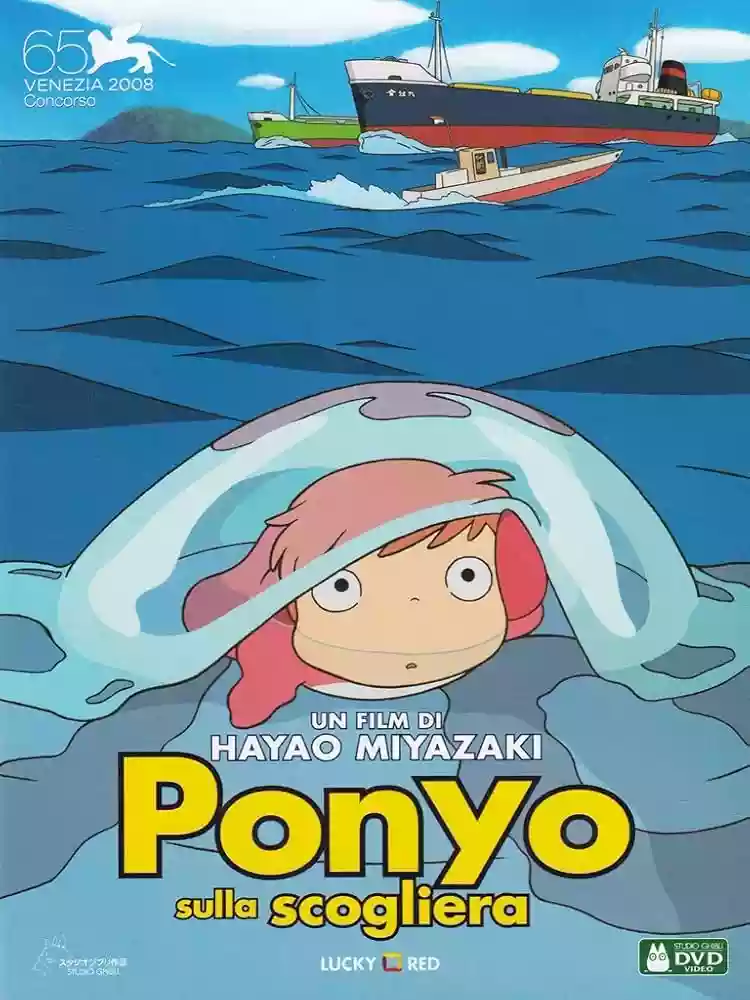
Unjustly overlooked by the public and dismissed by critics as too snobbish, "Ponyo on the Cliff" is one of Hayao Miyazaki's happiest and least childish works. Just as in 1988, "My Neighbor Totoro" was considered a simplistic work (only to later become, at least in Japan, a cult classic), this film suffered a similar fate. However, it has yet to become a must-see and is often relegated to the bottom of the many loved/hated rankings of Miyazaki’s films (and Studio Ghibli productions in general).
It’s true that all the major Miyazakian themes are present in abundance (respect for the environment; the warlike nature of mankind; pacifism as the only weapon against the world’s evils) but everything is presented in a less apparently adult formula than in his masterpieces of the past ("Spirited Away", 2001; "Howl’s Moving Castle", 2004). In a Japan outside of time, Brunilde (a fish-girl) escapes from her refuge, ends up on a beach, and is picked up by little Sosuke. She falls in love with him, he returns her affection, and calls her Ponyo. But Brunilde is forced to return to the depths of the sea by her Lucifer-like father Fujimoto, a scientist-sorcerer who hates humans, but through a bit of magic, Brunilde/Ponyo manages to become human.
In his tenth film, Miyazaki opts for a classic style, with soft-colored backgrounds and metaphorical narrative inventions of great impact (the fish-water that adults mistake for waves, visible only to the youngest viewers), and allusions to Japanese culture (the ambiguity of the sea; the centrality of the feminine figure compared to the masculine) in a fairy tale imbued with the flavor of ancient and beautiful things that seem lost in time. As with all his films, there are no limits to the director’s visionary imagination, as he challenges the most basic rules of physics and logic with strange cause/effect relationships bordering on the unreal—as if a story of humanity and lightness couldn't exist in the everyday reality governed by the most obvious and predictable mechanisms.
The technical achievement is impressive (170,000 animators), and there’s a unique touch in depicting the features of the city where the film is set (inspired by the town of Tomonoura), as is customary in Miyazaki’s filmography (think of the mix of cities used as examples in "Kiki’s Delivery Service", 1989). Likewise, the features of Fujimoto are inspired by the style of Osamu Tezuka (one of the geniuses of Japanese animation between the '50s, '60s, and '70s). In this light, the accusation of infantilism is truly unfair, given the continual references to prestigious figures from past Eastern cinema, and also considering the film’s rhythm, which is far from childish (even a bit too slow in the central section), but redeemed by moments of enormous emotional and, above all, visual tension (the flooding sequence of the city is cinematic gold).
(Global) box office takings were far below average (in Italy it didn’t even make the top 100 at the box-office), so much so that Miyazaki immediately set to work on his next film, "The Wind Rises" (2013), which he would present to the public as his final work. We know, fortunately, that it wouldn’t be so.
Loading comments slowly
Summary by Bot
This review highlights 'Ponyo', Hayao Miyazaki's 2008 animated masterpiece. Praised for its charming animation, the film's story combines innocence and fantasy. The review commends the heartfelt narrative and visual artistry. It's recommended for fans of family-friendly fantasy and those seeking magical storytelling. Rated 4 out of 5 stars.
Hayao Miyazaki
Hayao Miyazaki (born 1941) is a Japanese animator and filmmaker, co‑founder of Studio Ghibli (1985). His films include My Neighbor Totoro, Princess Mononoke, Spirited Away (Academy Award for Best Animated Feature), Howl’s Moving Castle, Ponyo, The Wind Rises, and The Boy and the Heron.17 Reviews
Other reviews
By panapp
The film’s pencil-like quality erupts in extraordinary visual inventions such as the tsunami wave, rendered as a school of frenzied water fish.
The worst was the glaring artificiality of the language. It sounded like dialogues translated word for word and not adapted.
