
 •
Rating:
•
Rating:
THE REVIEW
December 2020.
«I feel empty, suddenly lost and unprepared for this… His last words to me were “Adios amigo” … they will remain with me forever. He left an enormous void with the name Harold Budd written above».
Robin Guthrie (former Cocteau Twins) described the passing of his greatest friend and colleague Harold Budd this way.
It was a peculiar moment for humanity: The pandemic, the isolation, the unrest of a forced silence that split the clamor and industriousness of the world in two.
In an instant, among scattered piles of dense black notes, sudden chasms of pauses materialized on the staff, reducing the sound of the piano to zero again and again, until an uncertain date.
TACET. At least for a while, who knows.
In this undefined context (In the Mist) Guthrie repeatedly associates the word “void” not only with Budd’s death, but also with his name. Which also means with his music made of soft vessels from which often emanates the void of musical notation. Silence, indeed.
But it is a silence that, in sixty years of career, Budd had strongly valued from the beginning. The description of a constant void among serial blocks of notes originated from contemporary classical masters (John Cage and La Monte Young) and from the paintings of Mark Rothko.
In an artistic journey dictated by desire and hunger (not fame), on the road to Los Angeles through the Mojave Desert, Budd abandoned the strict Minimalist Avant-Garde to exploit a surprisingly (for those times) anti-narcissistic and collaborative creativity (Eno, Hassel, Foxx, Cocteau Twins, Partridge, etc).
With Brian Eno he dedicated himself to synthetic-pianistic rarefied composition, de facto creating the milestone records of ambient music today universally known (Ambient 2 – Plateau of Mirror and The Pearl).
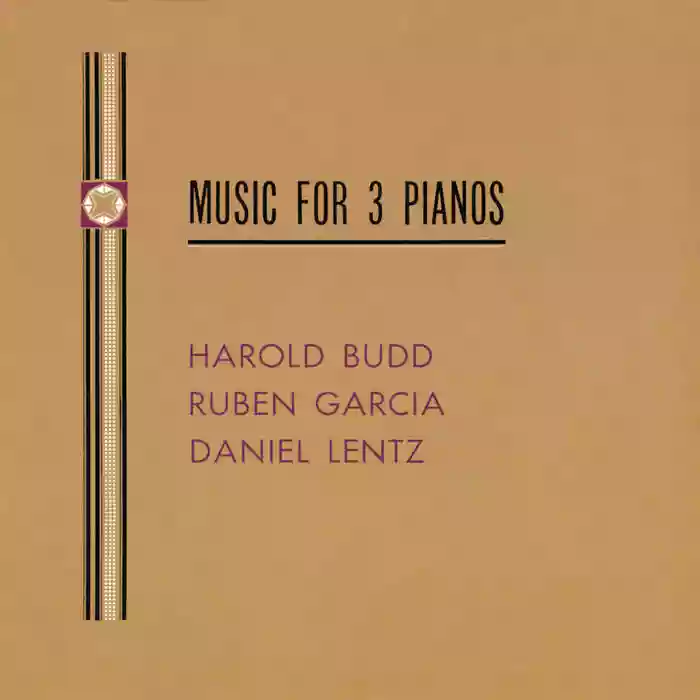
The compositions for Three Pianos recorded in 1992, inspired by Morton Feldman and attributed to the collaboration between Budd, Ruben Garcia, and Daniel Lentz, are, in my opinion, the soul and poetic framework of everything Harold Budd wrote before and after this recording.
Being solely for piano, rather, three pianos alone, Budd rebuilds the frayed and original beauty of his ideas without resorting to any synthesizers or mono-chord drone-style soundscapes, today frankly overused in this genre of music.
The trick is in the title of the first of these brief episodes: “Pulse Pause Repeat”. These are highly repetitive patterns where the slight temporal displacement of the three pianos produces liquid shadows on the fingertips, very slow pursuits, harmonic abandonments without return, and pauses of silence where everything is TACET.
The material is pure and unusual. It is not just chamber music, but neither is it a variation of Fripp/Eno’s Soundscapes. Despite mostly consonant chords, the listener is abandoned in indefinable territories of emotional anticipation and meditation. Certainly pervasive emotions, but preparatory, nuanced, leaving space for the ears and imagination of those who experience the work.
We are far (fortunately) from the exaggerated romanticism and somewhat calculated melody of certain highly celebrated neo-minimalist pop environments among which today stands out Ludovico Einaudi, but only to mention one of the many who have chosen, in my opinion, the main road of audience appeasement.
Harold Budd indeed embodies “Discreet Music” in the noble sense of the term. He is far from the bombastic spirit of this time and closer to the time of intimate daily spirituality. He is close to the sensitivities of early Minimalism but, without making it an isolationist banner, he has re-elaborated for a more sensitive non-musician audience his main concepts of silence and repetition.
Like precious objects we no longer see in the rooms of our home, his background music, I am convinced, will continue to outlive us for many, many years.
Adios amigo.
Loading comments slowly
Summary by Bot
This review reflects on Harold Budd’s 'Music for 3 Pianos' as a profound ambient and minimalist piano work that embraces silence and repetition. It situates the album within Budd’s artistic journey and collaborations, praising its purity and emotional subtlety. The review contrasts Budd’s refined musical approach with more mainstream neo-minimalist pop trends, highlighting the album’s timeless and intimate qualities. It also touches on the impact of Budd’s passing and his enduring legacy.Tracklist
Harold Budd
Harold Budd was an American composer and pianist associated with ambient and minimalism. He collaborated with Brian Eno on Ambient 2: The Plateaux of Mirror and The Pearl, and with members of Cocteau Twins. His work emphasized silence, restrained piano, and luminous atmospheres. He died in December 2020.09 Reviews
