
 •
Rating:
•
Rating:
THE REVIEW
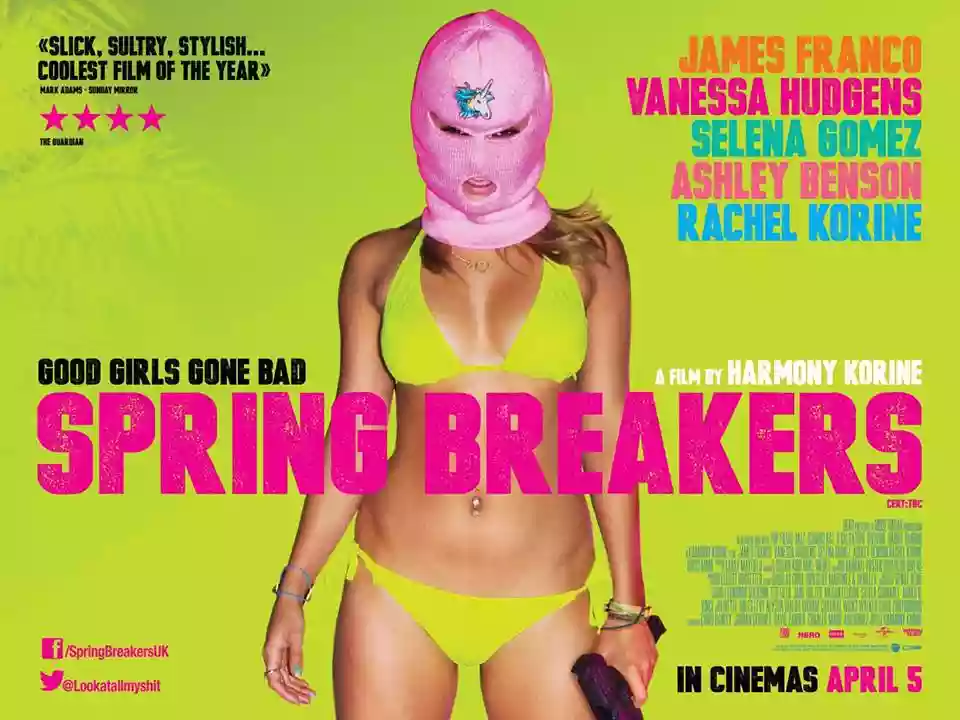
Halfway between a Tumblr image gallery and a David Guetta music video, Spring Breakers, directed by Harmony Korine, has divided critics and, of course, viewers. Some see it as a banal and superficial depiction of an equally banal teenage holiday masquerading as a journey of self-discovery, while others have praised the new dissociative work of an unconventional and offbeat director, appreciating its irony and emphasizing that the above-mentioned flaws are all intentional.
Harmony Korine is already known as an independent film director and as the screenwriter for perhaps the more famous Larry Clark, but in both roles, he stands out for a style that would be an understatement to call grotesque, and for using borderline characters and situations, with protagonists who are schizophrenic, socially awkward, afflicted by physical and mental pathologies, and morally degraded, set in landscapes and settings equally devoid of any empathy. In Spring Breakers, however, unlike films like Gummo or the more extreme Trash Humpers, the protagonists and their background are rather conventional and recognizable: four American college girls, pretty and made-up, who dream of escaping from their provincial lives where they only drink and smoke and dream of places where they can drink and smoke more, dance and get high like most teenagers in American cinema, and beyond. To do this, they decide to rob a fast food joint, and with the money thus obtained, they can finally set off in pursuit of their dream, during Spring Break, the early spring break from American schools and colleges along the West Coast. The outcome is a spiral of drugs and violence, accompanied by the pleasure inherent in transgression, fun, and some regrets.
Such a banal plot must have a hidden meaning; otherwise, it's just a crappy film. It's not because we are on a plane far from the didactic or documentary.
Korine also visually moves away from the aesthetics of his previous works but doesn't abandon the stylistic signature of exaggeration, using an aesthetic with strong scenic impact. The lights and photography contribute to building a suspended, dreamlike atmosphere, where every frame is a world apart in itself and which, with seductive visuals, emphasizes the vacuity of the characters' words and actions. One might think that it's impossible for such a beautiful frame to host such an ugly picture because the frame and picture match, they seem made for each other, so much so that this apparent contrast doesn't clash, or rather, yes it clashes, but it's a harmonic discord; in other words, a discordant but perfect contrast. Such a banal story, as I said earlier, isn't new to the big screen, even a very respectable big screen like that of Venice, where the film was presented; at most, the difference is in the way it's narrated: Spring Breakers doesn't don any didactic, paternalistic, or condescending rhetoric, nor an objective and documentary gaze; Spring Breakers lives the same fun as its characters (including a splendid James Franco. When is James Franco not splendid? Well, I must say that I found him phenomenal here, even more than as Greg Sestero in The Disaster Artist. I mean, it was like he was genuinely having fun) and lets a certain cockiness transpire, like a DJ dancing with his audience but privately giggles at that horde of people that doesn't even know what they're dancing to. Even the use of actresses like Selena Gomez, Vanessa Hudgens, and Ashley Benson is clearly aimed at defining the film's reach, not because it 'breaks in' actresses coming from the world of youth entertainment but because it increases the film's popularity and its appeal to a target audience of the protagonists' contemporaries. Calling it provocation, in my opinion, would be exaggerated: it's all part of the same game; I'm making a film about wasted youth, and in the meantime, I'm feeding the fire because if I wanted to stay out of it, the fire would feed itself anyway, but especially, if I didn't want to feed this fire, I would make a film about something else.
In Bling Ring, Sofia Coppola presented the story of a group of teenagers who stole clothes from the homes of celebrities and showbiz figures: based on true events, the story was portrayed almost as a social chronicle, with a certain empathy and closeness to the protagonists, to emphasize how a series of factors, such as parental absence, has a severe impact on teenagers. In Spring Breakers, the characters lack psychological depth, their motivations aren't explored, there's no room for impactful phrases about their lives and dreams; in fact, when they do appear, they're ironically empty and meaningless. The crimes committed by the protagonists are treated with the same gaze they would receive in a Rihanna video (for which, incidentally, Korine directed the video for Needed Me): there's nothing to judge or justify, only to watch and see if you like it.
<<Spring Break. Spring Break Forever.>>
Loading comments slowly
Summary by Bot
Spring Breakers by Harmony Korine generates mixed reactions, praised for its striking visual style and ironic treatment of teenage excess. The film portrays four college girls spiraling into crime and drugs during spring break, framed in a dreamlike atmosphere. Characters lack psychological depth, emphasizing style over substance. The film’s approach resists didacticism, opting for a provocative but ambiguous portrayal of youth culture.
Harmony Korine
Harmony Korine is an American filmmaker, screenwriter, and artist known for writing Kids (1995) and directing Gummo (1997), Julien Donkey-Boy (1999), Mister Lonely (2007), Trash Humpers (2009), Spring Breakers (2012), and The Beach Bum (2019). His work blends independent and experimental sensibilities with provocative portraits of American subcultures.05 Reviews
Other reviews
By Hellring
The film is a depiction of the hell that the four girls will experience. A self-created hell that responds to the demands of ephemeral freedom.
Korine builds on all this a work that is appropriately harsh, engaging, even 'cunning' in its staging.
