
 •
Rating:
•
Rating:
THE REVIEW
The war doesn’t end the moment you leave the battlefield; the memories and suffering persist, and it’s impossible to return to normal. The problem of veterans is common to every conflict, and many writers have addressed it very well in literature: Fenoglio ("La Paga Del Sabato"), Boll ("E Non Disse Nemmeno Una Parola"), Remarque ("Tre Camerati"), to name just a few. In cinema, a similar analysis is conducted, though perhaps less comprehensively; "Coming Home" by Hal Ashby is one of the first films to address the Vietnam War veterans. We're in 1978, the same year as Cimino's "The Deer Hunter," but here a different aspect of the problem is depicted: reintegration into society and emotional relationships.
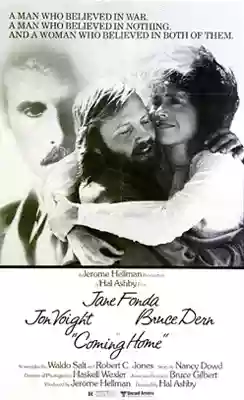
The screenplay is written by Robert C. Jones, who would also write the masterpiece "Being There" the following year, again directed by Ashby. "Coming Home" brings us the story of three characters marked by a common reason. Luke Martin (Jon Voight) is a veteran who lost the use of his legs in Asia and is hospitalized in a military hospital far from the eyes of regular people; there he encounters his old schoolmate Sally (Jane Fonda), whose husband is a captain in Vietnam. Their meeting helps Luke regain a taste for life but disrupts Sally’s affections, forcing her to reckon with the consequences of her choices.
Ashby directs a film that is perhaps less complex than his "Harold And Maude" but equally successful. For this director, images are very important, so creating detailed scenes to express his vision of the subject matter is important. "Coming Home," therefore, is again a film that conveys a lot through symbols, as was the case with the 1971 film. The parade of coffins draped with the American flag returning from Vietnam, away from prying eyes, says much more than many words. The director’s antimilitarism is evident, but Ashby has the merit of not falling into rhetoric and banality, showing reformed pacifists protesting in improvised sit-ins. He manages to convey a broader view of the problem without unnecessary and trivial shortcuts. The long sequences in the hospital, the soldiers unable to move, those totally traumatized and reduced to an infantile state, are very effective and speak volumes about what a war conflict is and, more importantly, what it leaves on both the body and soul. The characters are well-defined; Voight’s character has lost faith in everything (rightly so) but will manage to find his own dimension thanks to people who do not ignore his past. In a beautiful scene, Ashby shows us Luke in a supermarket, intent on shopping normally, as if people look at him like he is responsible for the USA’s failure in Asia; the hypocrisy of a nation is brought to light in just a few sequences. Jane Fonda is excellent in her role both as the wife of the convinced and established military man (Bruce Dern) and in the more fragile role of a nurse suddenly brought into a reality she thought distant but simply well-hidden from everyone.
Three Oscars, Best Actor, Actress, and Screenplay "Coming Home" boasts a splendid soundtrack, with music by Paul Simon, The Beatles, and many other protagonists of the '60s; a good film of denunciation that, while light in many moments, never loses its spirit. This was Ashby’s cinema.
Loading comments slowly
Summary by Bot
Hal Ashby's Coming Home offers a poignant look at Vietnam War veterans and their struggle to reintegrate into society. The film highlights emotional healing and societal hypocrisy through powerful imagery and strong performances by Jon Voight and Jane Fonda. Ashby's antiwar message is conveyed with nuance, avoiding clichés while delivering emotional impact. The movie won three Oscars, notably for acting and writing, making it a notable antiwar classic from the late 1970s.
Hal Ashby
American film director and editor of the New Hollywood era. Won the Academy Award for Best Film Editing for In the Heat of the Night (1967). Directed Harold and Maude, The Last Detail, Shampoo, Bound for Glory, Coming Home, and Being There.04 Reviews
