
 •
Rating:
•
Rating:
THE REVIEW
Born in Transylvania, like Count Dracula, György Ligeti is one of the most original composers of his generation. His icy and ghostly music manages to impress even when using the most minimal expressive means. Take, for example, "Continuum" from 1968: a short piece for harpsichord where a tangled forest of closely spaced notes creates an acoustic frenzy in a harmonic landscape that is slightly but constantly transforming. Or "Volumina" for organ (1962): sound bands reminiscent of the white noise of electronic music; deep or high-pitched sounds, of very short duration or played fortissimo, that disfigure the traditional image of the organ, transforming it into an angry and screaming machine.
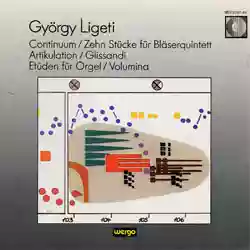
This anthology CD released by the German label Wergo is a beautiful compendium of Ligeti's style (1923-2006), which also includes his only two electronic music pieces: "Glissandi" (1957) and "Artikulation" (1958). The first seems to use sine waves solely to disorient the listener by imitating the well-known instrumental (or vocal) effect of the glissando. The second, lively and convulsive, recalls similar sonic experiments of those years, distinguished by its irresistible exuberance: the title of the piece indeed evokes the articulation of an artificial language (perhaps that of R2-D2, the little robot from "Star Wars"!) with its interjections and background chatter. Ligeti also created a graphic color representation of the piece (a visual score), of which a page is reproduced on the CD cover.
It also features the two "Organ Studies" (1967 and 1969): the first presents alien and enigmatic sounds organized in overlapping bands; while in the second, multiple melodic lines frenetically intertwine with greater dynamic emphasis. Once again, the dear old organ, the one played in church during services, experiences ten minutes of passion after encountering the lucid and twisted mind of György Ligeti.
Of which I leave you to discover on your own the "Ten Pieces for Wind Quintet": in this case, it is the flute, oboe, clarinet, horn, and bassoon that stage a grim instrumental pantomime that perhaps would have pleased Count Dracula himself.
Loading comments slowly
Summary by Bot
This review celebrates György Ligeti's anthology album showcasing his unique blend of avant-garde, electronic, and classical music. From the frenetic harpsichord piece "Continuum" to the innovative organ studies and electronic experiments like "Artikulation," Ligeti's work is described as original, complex, and striking. The reviewer highlights the eerie and ghostly qualities of the compositions, emphasizing their ability to transform traditional instruments into novel sound machines.
György Ligeti
György Ligeti (1923–2006) was a Hungarian-Austrian composer born in Transylvania. A leading post‑war avant‑garde voice, he developed micropolyphony in works such as Atmosphères, Requiem, and Lux Aeterna—later heard in Kubrick’s 2001: A Space Odyssey. He taught for years in Hamburg and wrote across genres from string quartets to opera.04 Reviews
