
 •
Rating:
•
Rating:
THE REVIEW
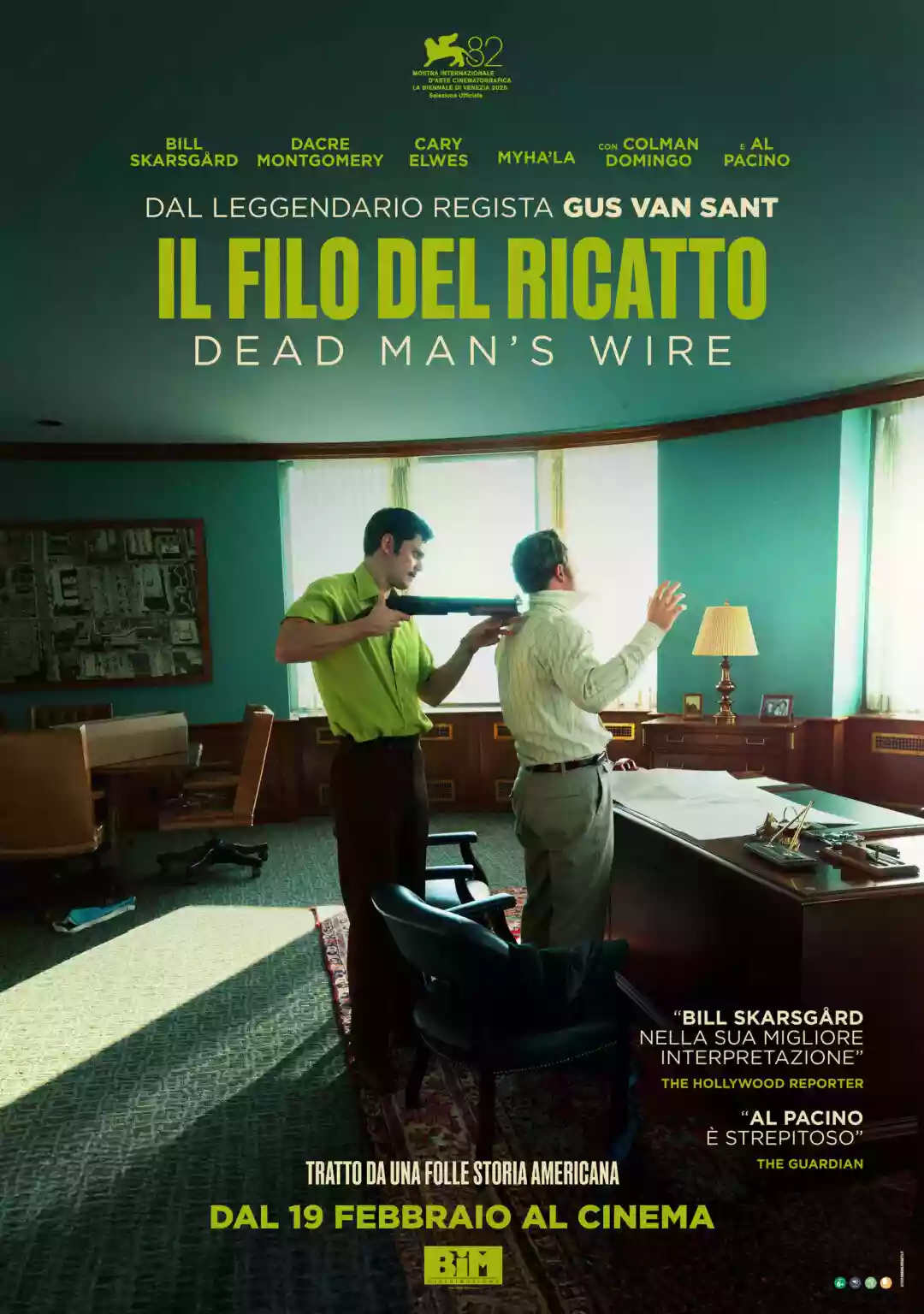
This film, presented out of competition in Venice, comes out with a double title. The original title is definitely more fitting, as it refers to a wire connected to a rifle aimed and tied on one end to the potential victim’s neck and on the other to the executioner’s, so neither can move away without causing the loaded gun to discharge. The dead man’s line, precisely. Very simple and deadly.
Inspired by an event that took place in 1977 in Indianapolis, Gus Van Sant crafts one of his gems.
A man, Tony, whose despair is palpable and intensified by a certain obsessive disorder, kidnaps the president of a mortgage company, Meridian. He demands, in exchange for his release, total immunity, 5 million dollars, and an apology from the hostage’s father, who is actually the real deus ex machina behind the company and is portrayed by the eternal Al Pacino.
Tony believes he has been the victim of a scam by the elderly businessman and has gotten it into his head to let Americans know his story through radio and TV.
This is the starting point of a story that, through a long phone negotiation, takes a path somewhere between the surreal and the humorous, keeping the viewer in suspense and on edge until the end. I won’t go any further into the plot, of course, but I’d like to share a few thoughts.
The story unfolds on many levels: for example, the media—and TV in particular—and their manipulative power. Television is already that ruthless machine that feeds on violence and ratings, with its aggressive reporters always ready to chase an exclusive. And if someone dies, so much the better.
There’s the now classic clash between law enforcement, prosecutors, and the FBI, over whether to use harsher or softer methods to solve problems.
But at a certain point I realized that the real protagonist of the film becomes the music, and here is where you’ll see why this movie is dear to me. I’m not just talking about the soundtrack, but also about precise references to the musical culture of the era. Gil Scott-Heron, Roberta Flack, Donna Summer, Barry White, Yes are just some of the artists you’ll recognize or hear mentioned by the African-American radio host Fred Temple, "The voice of Indianapolis," Tony’s idol and, against his will, involved in the negotiation, even though most of the songs actually play in the background during phone calls or TV interviews. It’s music to my ears.
And above all, there’s Tony’s humanity, whose angry outbursts are followed by even tender moments towards the hostage, and a certain understanding begins to grow between them. In contrast, the old businessman appears with all his petty rationality, refusing to give Tony the apology he demands and accepting that his son might die, placing business principles above his own son’s life.
Van Sant doesn’t lose the spark of his best films, confirming his painful and clear-sighted vision of outsiders—of the marginalized, a bit alienated but always very human. Excellent actors, above all Bill Skarsgard in the role of Tony.
A film that is definitely worth watching. For the sake of completeness, there was a documentary about this story in 2018 entitled “Dead Man's Line” by Alan Berry and Mark Enochs, which you can watch on the tube. Ajò!
For those interested, I’m attaching the setlist of the songs featured in the film:
Also Sprach Zarathustra, by Eumir Deodato
Never, Never Gonna Ya Up, by Barry White
Call Me Africadelic, by Gérard Lévecque
Balada Dulce, by Yago Santos
Cannock Chase, by Labi Siffre
Mr. Twist, by SS
Let A Woman Be A Woman – Let A Man Be A Man, by Dyke and the Blazers
Compared to What, by Roberta Flack
Hell for Leather, by Keith Mansfield
Love to Love You Baby, by Donna Summer
Witchi Tai To, by Harpers Bizarre
Randrops Keep Falling On My Head, by B.J. Thomas
I’ve Seen All Good People: a. Your Move, b. All Good People, by Yes
The Revolution Will Not Be Televised, by Gil Scott-Heron
Loading comments slowly
Summary by Bot
This review offers a balanced take on Gus Van Sant's Il filo del ricatto - Dead Man's Wire. It discusses the film’s merits and shortcomings, with observational analysis of Van Sant’s direction and the storytelling approach. The reviewer awards an average rating, suggesting a mix of notable strengths and areas that fell short.
Gus Van Sant
Gus Van Sant is an American film director known for moving between Hollywood projects and independent, formally adventurous cinema. Reviews here focus on his minimalist long-take style, youth-centered stories, and films that often resist easy moral conclusions.22 Reviews
