
 •
Rating:
•
Rating: THE REVIEW
When we talk about this genre, we're delving into a topic even more complex than the history that defines it. Punk, or rather punk rock, has influenced generations, forms of art, and cultural aspects, starting with music, moving through literature, and finally reaching fashion. It almost becomes automatic to think of the Sex Pistols but also the Ramones, The Stooges, or The Clash. History teaches us how influential and iconic these names have been in the famous first wave of punk. Vivienne Westwood, the "Godmother of Punk," for example, was the living testament to how the Pistols became fashion and cultural phenomena.
Since the early seventies, when it began to emerge on the west coast of the United States (as a continuation of the sixties garage rock), and then landed more concretely in the UK, up to the present day, the genre has undergone progressive evolution.
If English punk was raw, anarchistic, nihilistic, violent, and provocative, the American version took a total reversal in the eighties with the birth of Straight Edge. Towards the end of this decade, it became generally complex to translate the genre into a single stream of thought. The classifications had branched out; ranging from anarchism to communism, through apoliticism or extremism, to the complete rejection of any ideology.
And then came the nineties. Another iconic decade for music, which saw the birth of mainstream phenomena such as blink-182, Sum 41, but also Offspring, Bad Religion, and Green Day. All born under a single trend, punk-rock, eager to rebel against the canonical rules of punk, moving away from nihilism, the bad boy attitude at all costs, the disdain for melody, and the low inclination for lightness. Enough with seriousness at all costs, raw meanness from rebels; punk should have been about escapism, messing around, and fun.
Among others, Green Day stood out in the California scene already in the early years of the decade, being active in the Bay Area punk environment, starting from the 924 of Gilman Street in West Berkeley, also home to Rancid, AFI, and The Offspring. The same gathering place that today, after a radical change of direction and quality of music offered, has distanced Green Day from the favor it once enjoyed. But that's another story.
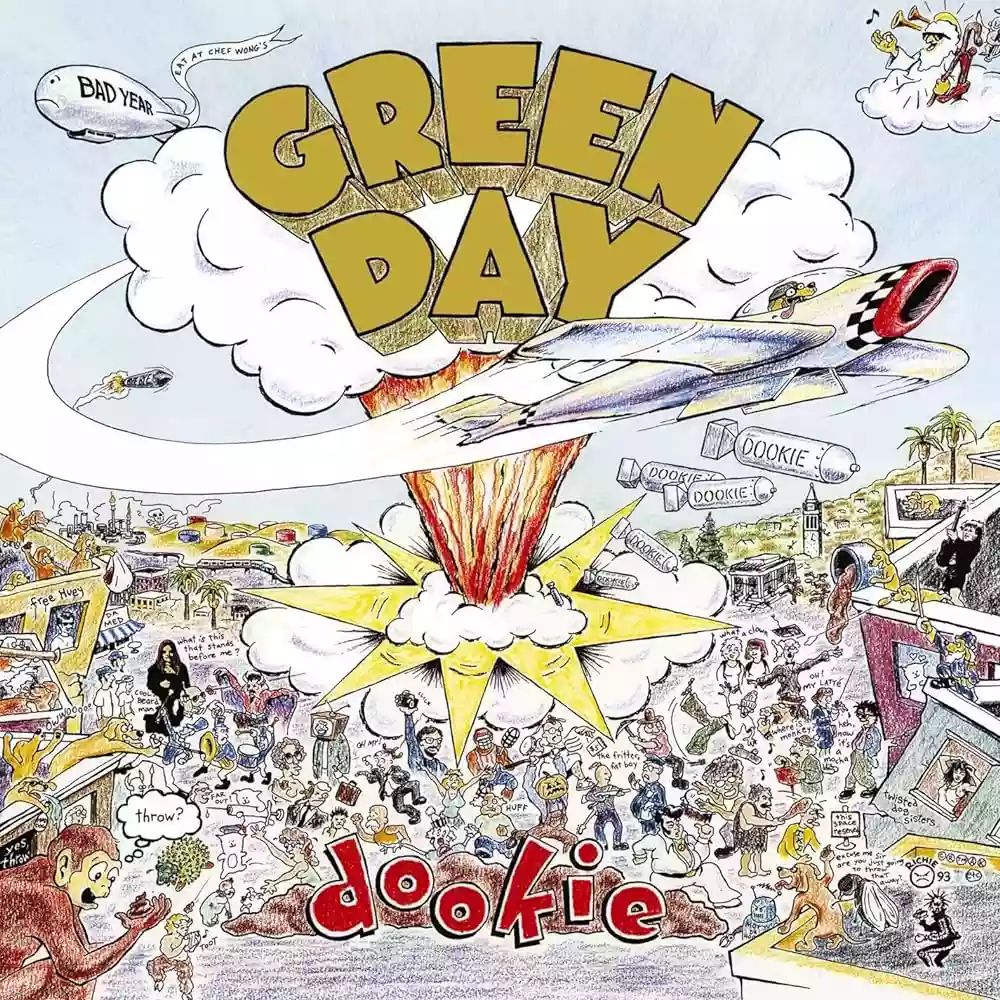
This very year marks the thirtieth anniversary of "Dookie", the third iconic studio album by Billie Joe Armstrong, Mike Dirnt, and Tré Cool, and the first released on a major label (Reprise Records), as well as produced by Rob Cavallo. The first two releases, "39/Smooth" and "Kerplunk", were instead released under an independent label, Lookout! Records.
"Dookie" is an album with a crude and simplistic title (in Italian literally "Shit"), in line with the trend of the era in which it was conceived but nevertheless filled with content resonant with an entire generation. Recorded in 1993, it was conceived and written mainly by Billie Joe Armstrong and is strongly influenced by his personal experiences. There are exceptions in the compositional process, with two tracks: "Emenius Sleepus", made in collaboration with Mike Dirnt, and "All By Myself", a ghost track composed by Tré Cool. The themes touch on boredom, anxiety, sex, masturbation, and relationships (not necessarily in that order).
Among the fifteen tracks, "Longview", "Welcome to Paradise" (re-recorded version already present on Kerplunk), "When I Come Around", "She", and especially "Basket Case", the most famous and representative song of the band, have made history. This song managed to catch Rob Cavallo's attention and secure their first major contract. Armstrong has frequently shared that the lyrics of the song speak about his anxiety and how writing and re-reading the words helped him control his recurring panic attacks.
"Longview" talks about boredom, masturbation, and cannabis, with predominantly adolescent reflections in the lyrics:
«When masturbation's lost its fun/You're fucking lonely»
"She" is addressed to one of Armstrong's girlfriends, much to the peace of his wife Adrienne Nesser, to whom it was initially believed to be dedicated. Perhaps the events narrated are connected to the words of "When I Come Around", which tells of a walk with friends after an animated discussion of the frontman with Mrs. Armstrong.
With "In the End" and "Why do you want him?", Billie addresses his mother and stepfather, without hiding the little esteem he had for the latter.
All the ingredients to excite a crowd of unruly teenagers are present. "Dookie" was released at the most suitable time possible and marked an era, regardless of what genre purists or nostalgic representatives of the first powerful wave might say (any reference to the words directed by John Lydon at the Berkeley band is purely coincidental).
The somewhat confused cover (although entirely "narrated" by the band over the years), the crazy and contemporary style, the power and immediacy of the tracks, only serve to give "Dookie" the good judgment it deserves.
It took three weeks and a demo cassette played through Rob Cavallo's car stereo to reach the goal. For the thirtieth anniversary, the album has been reissued in different versions: a colored vinyl, a collection of CDs enriched with old demos, and an expensive box set with rarities, unreleased tracks, and memorabilia. As usual, a shrewd major label operation, of course. But also an opportunity to own a delightful collectible for all who still can't get this album out of their heads, but most importantly from their hearts.
They decided to call it "crap" and it turned out to be worth gold. And we'll definitely be here to remember it in another thirty years, even with little memory and ears at half capacity.
Loading comments slowly
Summary by Bot
Green Day's 1994 album Dookie marked a pivotal moment in punk rock's evolution, blending personal themes with accessible melodies. Celebrating its 30th anniversary, the album remains iconic for songs like "Basket Case" and "Longview." Drawing from the Bay Area punk scene, it helped bring punk to mainstream audiences while maintaining its rebellious spirit. The anniversary editions offer fans a chance to revisit and celebrate this enduring classic.
Green Day
American rock band formed in 1986 in the East Bay area of California. Core members: Billie Joe Armstrong (vocals, guitar), Mike Dirnt (bass), Tré Cool (drums). Known for blending punk energy with melodic hooks.62 Reviews
Other reviews
By ste84
"There’s a bit of 'Dookie' in all of us!"
"Dookie is the paranoia of someone who just can’t understand themselves to the point of goosebumps."
By John
Dookie was a complete album, the true essence of Punk, a complete work in every sense.
Basket Case brought worldwide success to Green Day and Punk with its chorus that sticks in your head and after years you realize it hasn’t left yet.
