
 •
Rating:
•
Rating:
THE REVIEW
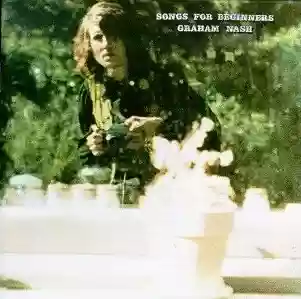
When these "songs for beginners" saw the light of day, its creator already had a career behind him that could suffice and ensure nearly infinite future respect and earnings. Graham Nash from Blackpool (England) had been among the founders of the group The Hollies, who in the latter half of the sixties ignited millions of people worldwide with their fresh and catchy pop. But this wasn't enough for him, so much so that in 1968 he moved to the United States where he began a fruitful artistic and lysergic collaboration with David Crosby, a fresh escapee from the Byrds. The two found themselves in perfect harmony, enough to convince Stephen Stills first and Neil Young just after to join them (both orphans of Buffalo Springfield) to create the supergroup that once again brought the four names to global prominence with the manifesto album "Deja Vu".
Changes were in the spicy air running along the Californian coast, but they were not the ones predicted and desired by the Season of Love, so much so that in the full hippie-psychedelic backflow, Nash paints 11 very soft watercolors, with a firm yet subdued voice, where melancholy and a hint of resignation (his relationship with Joni Mitchell had just ended...) peek through every note.
The anthem "Military Madness" is a heartbreaking stance against war ("In an upstairs room in Blackpool, By the side of a northern sea, The army had my father, And my mother was having me, Military Madness was killing my country, Solitary Sadness comes over me") supported by a robust folk-pop played with the urgency of someone who knows (or believes they know) that the end isn't far beyond... here appears for the first time in the record a languid pedal steel-guitar played by Jerry Garcia, while the brotherly friend Crosby overloads the subsequent "Better Days" with Nash's voice stretched to breaking point. In this track, we also find an unusual Neil Young at the piano, as he also does for the splendid ballad in a pure British style "Simple Man", where the evocations/references to the best of Paul McCartney and Elton John are very strong. But if we must name an artist to whom this record should be compared, it would be John Lennon, even though Nash seems to slightly beat him to the punch, as he takes the album "Imagine" by the illustrious compatriot and maps out the scenarios that he will then embark upon, traversing the entire seventies until reaching the tragic endpoint at the turn of the eighties.
"Wonderful Bird" and "I Used To Be A King" are perfect examples, just as "There's Only One" vaguely recalls the somewhat baroque pop constructs of the dark side of the moon by the yet-to-come Floyd. "Sleep Song" is pure folk for guitar and voices, while "Man In The Mirror" illuminates the path for a certain sophisticated pop that will see Supertramp among the best exponents in the second half of the decade. "Chicago" deserves a particular mention, as, together with "Military Madness", it is the track that carries the album to the top of the charts with its vaguely reggae pace, but paradoxically turns out to be one of the weakest tracks on the album, almost a formulaic piece, flowing into the slightly over a minute of the concluding "We Can Change The World" which reprises its melodic theme and leaves us with the message that probably everyone expected from Graham Nash in 1971.
Loading comments slowly
Summary by Bot
Songs For Beginners marks Graham Nash's transition from The Hollies to an accomplished solo career. The album combines soft folk-pop melodies with deeply personal and political themes. Highlights include the anti-war anthem Military Madness and collaborations with David Crosby, Neil Young, and Jerry Garcia. Nash’s work foreshadows the musical landscape of the 1970s and evokes comparisons to John Lennon's iconic albums. Despite some weaker tracks, it remains a heartfelt classic full of melancholy and hope.Tracklist Lyrics Videos
Graham Nash
Graham Nash is a British-born American singer-songwriter who co-founded The Hollies and later formed Crosby, Stills & Nash (and CSNY). As a solo artist he’s known for Songs for Beginners and Wild Tales, combining tender melodies with social commentary.03 Reviews
