
 •
Rating:
•
Rating:
THE REVIEW
On February 18, 1763, of the common era, as the sun entered the constellation of Pisces, I was carried away into the heavens, as all my friends know. Voltaire
This review is intended as an invitation to (re)discover the Gong, a legendary band, a true must for any enthusiast of the rock's golden age.
First of all, who are the Gong?
As their leader, Daevid Allen, said, “a band that too few people love too much”. A strongly anti-commercial group, thus, nonconformist, innovative, dedicated to unconditional experimentation; a free form of music, deliberately an end in itself, from which one can expect anything and everything and whose description - alas - requires a vast number of adjectives.
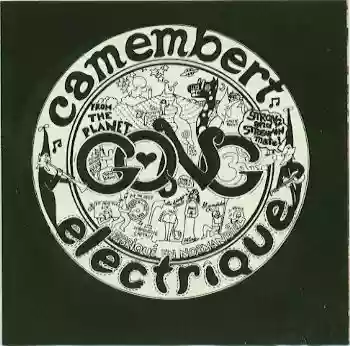
Camembert Electrique, from 1971, produced after a series of inconsequential experiments, is the ideal album to approach the Gong. In fact, while not reaching the opulence and variety of later works born from greater musical maturity, it is a sort of manifesto and appetizer for the Radio Gnome Invisible trilogy, which will render these chronic hippies a cult band. The album essentially consists of seven space rock gems plus an intro, an intermezzo, and an outro spoken, all of which testify to the total madness that had taken hold of these deviated minds. But let’s move on to "Radio Gnome", a distorted voice that seems to announce a radio broadcast from the planet Gong. It's no joke, because the second track, "You can't kill me", forcefully presents the gong sound: a cauldron of Canterbury and psychedelia, jazz and rock, fast, vibrant, hallucinated. The rhythm is swift and pressing, the guitar riffs are extremely acid, the sax elusive in its flutters. It’s the ideal base for Allen's voice, Gilly Smith's moans, and a series of utterly delirious lyrics. It continues with "I’ve bin stone before", a heartbreaking parody of a classical melody, and with "Mister Long Shanks", which starts as a frenetic tune to implode into a very soft and lysergic atmosphere. A moment of cosmic void, rendered by Christian Tritsch's immaterial bass, which however is overturned by the attack of "Dynamite/I am your animal", extremely fast, pounding, continuous space-rock evolution climaxing in a final crescendo. Closing the first part of the album are "Wet Cheese Delirium" and "Squeezing Sponges Over Policemen's Heads", which constitute a disturbing spoken interlude, with another voice repeating: “tu veux camembert.. ?”.
The second part of the album opens with "Fohat Digs Holes in the Space". It is an interminable ride through space, marked by synth chords and Pip Pyle's jazz rhythm, which dissolves to make room for the actual song, with an overwhelming groove, featuring a sax solo by Malherbe that is simply lethal. It is followed by Tried so Hard, a splendid ballad with a freak flavor, marked by a dreamy atmosphere to which Malherbe’s flute - yes, he plays the flute too, so what? - fits perfectly.
The next track, "Tropical Fish/Selene", is a varied and well-expanded suite, made up of very diverse themes, interspersed with moans and dissonances, ending with two brief citations of "You can't kill me" and "Dynamite". "Gnome the Second", another "spoken" track, announces the end of transmissions.
This is the "Inspiring total madness" of the early Gong, forty minutes of pure fun that comes as a breath of fresh air in an increasingly monotonous and less surprising life. It's hard to return to Earth after this journey through space and music: some have never done it and have chosen to remain in orbit awaiting the first flying teapot to the planet Gong.
Loading comments slowly
Summary by Bot
This review invites readers to explore Gong's iconic 1971 album Camembert Electrique, highlighting its blend of space rock, psychedelia, and jazz. The album serves as an accessible entry point to the band's innovative style and the precursor to their acclaimed Radio Gnome Invisible trilogy. Detailed descriptions of standout tracks reflect the album's unique, experimental essence. Overall, it praises the album as a breath of fresh air in rock's golden age.Tracklist Lyrics Videos
Gong
Gong are a psychedelic/progressive rock band formed in Paris in 1967 by Daevid Allen and Gilli Smyth, known for surreal humor and the Radio Gnome Invisible concept trilogy (Flying Teapot, Angel's Egg, You).11 Reviews
