
 •
Rating:
•
Rating:
THE REVIEW
That cinema, since its very beginnings, has sought to have its images accompanied by music is well known. But when did images, on the contrary, try to follow the music?
Honestly, I do not know. Of course, the first thing that comes to mind is "Fantasia," a Disney masterpiece of bygone days, when the prostitution of musical images by the global monster MTV was still unimaginable.
How many works have then achieved a perfect balance between music and image?
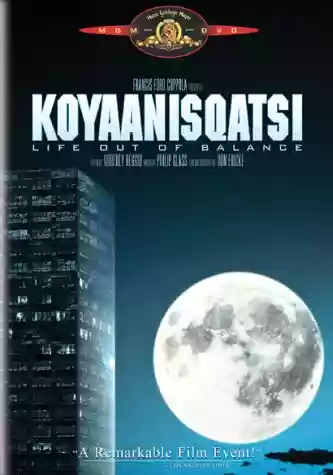
Honestly, I do not know. Certainly, Koyaanisqatsi comes to mind, where it becomes irrelevant whether the images were created for the music or the music for the images.
Surely it would be far less pleasant to watch this film without the music than to listen to this music without the images, especially because the music was composed by none other than Philip Glass.
And who better than him to comment on the frenzy of contemporary human life, the central theme of this visual composition. Often fast-forwarded frames, to show us how our race toward illusions can steal our individuality. We are like mass-produced products, our civilization like a giant assembly line.
And then panoramic views of the world, without humans, without romance, to remind us that the earth is much older than us. And also portraits of people, slow-motion glimpses of moments of life to make us feel that we are still ourselves, unique individuals, each with their own inner universe.
Koyaanisqatsi, eighty-seven minutes without words, dialogues, opinions, conjectures, ideas. A small pause, a solitary journey into man, into cities, into deserts, into space.
Loading comments slowly
Summary by Bot
Koyaanisqatsi is praised for its perfect fusion of Philip Glass's music and breathtaking imagery. The film explores modern civilization’s speed and loss of individuality through innovative cinematic techniques without dialogue. It offers a contemplative journey into humanity’s relationship with nature and technology. Ultimately, it’s an 87-minute wordless masterpiece.
Godfrey Reggio
American filmmaker best known for non-narrative, experimental films and the Qatsi trilogy; frequent collaborator with composer Philip Glass.01 Reviews
