
 •
Rating:
•
Rating:
THE REVIEW
An entire decade in one breath, treading the boards of crowded theaters, gave Giorgio Gaber the opportunity to meticulously analyze every aspect and flaw, both those more introspective and those more evident, but above all the human ones of the Italian thinking creature, who in the '70s communicated, confronted, then fought and cursed, and often dreamed.
But what did that creature really dream of and what concrete achievements had it obtained by the end of that tormented decade? Why every time, month after month, year after year with the wind in its sails, did that stubborn conviction emerge of almost having managed to change the world? Why did that extraordinary project of common consciousness lead millions of young people to the most Copperfieldian illusion of the '900?
Fear? Shame of ostentation? Or was someone exaggerating and starting to evaluate history with more sense? Was it really time to stop? As if to say, "OK, we played until now, but now enough." Gaber was quite impassioned when two years earlier, in the previous "Polli d'allevamento," he accused the masses, especially the pseudo-revolutionary youth, of laxity, lack of "guts," and little coherence with what '68, a source of global renewal of every perspective, had entrusted them.
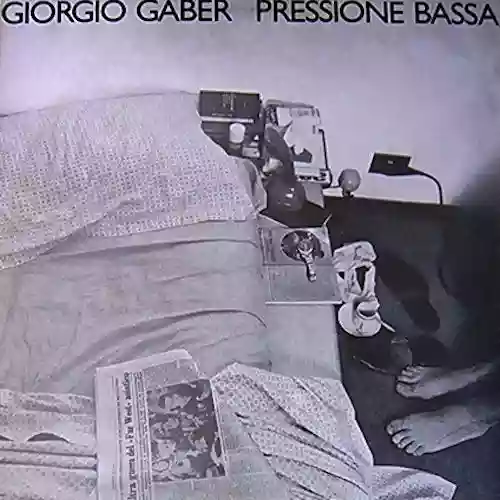
And here is "Mister G" in 1980 debuting the newborn decade with "Pressione bassa," the first studio work 10 years after "Sexus et politica," after the "zingarate" (as Monicelli would say) face to face with the live and carefully attentive flesh to every provocation of the Milanese showman.
After the renunciation of change, it is the moment of dismay, low pressure, or of the pressing depression and turmoil that went to fill that void left by the failed realization of utopia. With a choked harmonica and a reluctant guitar, one resigns to the forced return to monotonous normality, "lying I feel heavy and think of people, who buy pastries, who listen to Mass, even the world has low pressure." Echoing is the song "It's No Longer the Time" in which Gaber definitively buries the season of ideas and confrontation "To stay alive it was enough for us with a bullshit, no one knows why suddenly it's no longer the time for nothing", and prepares to gently annihilate the generation of eternal dreamers: "A breed already over without even beginning, a boneless breed already waiting to die."
Joking with saints, it is the turn of a contemporary counter-current preacher, lashing out against today's stereotypes and consequently locked up in a cell, guilty of annoying the "normal" common thinking shared by all, declaring that even Jesus, if he were to catapult among us, would be misunderstood and would risk ending up in jail too.
Sometimes entering in flashes, in a dreamy context, parallel to the broken and reference-less present, "L'illogica allegria" that Gaber cannot explain, but realizes in all that void, he can have the right to be nourished in some fluctuating moments by a slice of serenity, peacefully pervaded by a sense of blessed solitude.
Gaber still analyzes human and interpersonal relationships as he has always accustomed us, still posing questions, but in a more thoughtful and never turbulent manner, as in the pleasant and slow ballad, where he observes the fascist uncle busy with small daily gestures, like caressing the nephews or watering the roses, and he can't explain why a man so sweet had so much meanness in his youth, committing with arrogance certain inexplicable atrocities, thus coming to the conclusion of facing a man with "too tender a heart and too hard a head", or narrating the tortuous man-woman relationship in previous generations, of that "dilemma" (as the title cites) and that sense of an archaic togetherness, overcoming with sacrifices every difficulty and continuing, despite the mutual death of the feeling, to build a tomorrow for the good of the family. Finally, he illustrates "A Woman" in her most natural and spontaneous being, in the essentiality of making the man lively and still being able to get emotional, placing also the other side of the coin and explaining to us that if her inhibitions were to fail, we would live inside "a world of women so beautiful they don't need to get attached to the lie of our dream".
There is also time to laugh at oneself in a funny metropolitan skit, in which a mild and kind man is forced to gamble on a romantic appointment. "The Hiccup" is due to a nasty street attack, but in the end, the victim, despite the beating, takes pride in his "unsporting" reaction against the brutes, inconsistent with the peaceful side of his character.
The music, at times composed of delicate melodies, flows calmly and serenely throughout the album, creating an atmosphere of relaxation and at times carefree.
A less pretentious Gaber in "Pressione bassa," a point of reflective and calm detachment, the brief calm after the long storm and before the imminent judgment day of "Io se fossi Dio" and the chaotic "Anni affollati" at the door.
Accustomed to the biting and provocative tenacity in live performances, one remains a bit disoriented to hear him tackling a reasonably calm evaluation of the surrounding world. In its complexity, it remains an excellent work to re-evaluate.
I take the liberty to list the tracks, as this album is now almost impossible to find and unfortunately out of catalogue for some time; exceptionally, it can be listened to in snippets in various subsequent theatrical shows or in some collections.
Gaber is Gaber, take it or leave it.
SIDE A:
Low Pressure
The Ballad of Imaginary R.M., P.B. and others
Portrait of the Uncle
It's No Longer the Time
SIDE B:
Illogical Joy
A Woman
The Hiccup
The Dilemma
Loading comments slowly
Summary by Bot
Giorgio Gaber's 'Pressione bassa' offers a thoughtful, calm reflection on Italy's turbulent 1970s and the disillusionment of youthful ideals. Combining gentle melodies with poignant storytelling, the album explores themes of societal change, human complexity, and lost utopias. This less provocative yet deeply insightful work showcases Gaber’s maturity and artistic evolution. Despite being out of print, it remains a valuable piece for those seeking to understand the era's emotional and cultural landscape.Tracklist Lyrics Videos
Giorgio Gaber
Italian singer-songwriter and theatre author, pioneer of teatro-canzone, active from the 1950s until 2003.28 Reviews
