
 •
Rating:
•
Rating:
THE REVIEW
Art is that abstract entity whose veins become material thanks to human experimentation. Consequently, the artist "would be" an assiduous seeker of beauty, a stubborn builder of works endowed with the typical prerogatives that seek the constant emotion of the audience. Here, in this case, the use of the conditional in quotes is more than deliberate, precisely because today, the word artist does not deserve to be associated with all the interpreters of today's entertainment works in cinema, TV, theater, and music, as many of them seek monetary profit and not the quality and beauty sought by every self-respecting artist.
When talking about Giorgio Gaber, the word “art” becomes truly appropriate. Guitarist, singer-songwriter, presenter, comedian, actor, playwright…practically six artists in one! He was credited with bringing "metropolitan rock and roll" to our country (along with Enzo Iannacci and Adriano Celentano); perhaps not doing it with the same grace and technique as the American style, but at least for Italianizing a genre that was not deeply explored in our country before. He was among the first presenters on Italian television, and naturally (his greatest merit) he was the founding father of teatro-canzone, thanks to which cabaret now circumnavigates Italian broadcasts, and actors can propose one-man-shows in their theatrical tours.
Focusing on the "theatrical" Gaber and the shows the artist created with Sandro Luporini, from 1970 to 2000, we will notice that the performances of “Signor G” in theater are never subdued; they may be liked more or less according to the listener's taste, but it is important to assure that none of these works can be defined as "bad". Here, Anche per oggi non si vola is indeed one of these successful experiments.
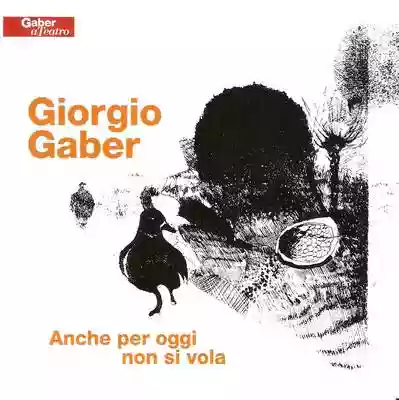
A sincere account flourished during a performance at the Teatro Lirico di Milano, during the 1974/1975 theater season, this album reintroduces the structure of its predecessors and successors, that is, an irregular alternation of prose and song spanning multiple topics conceptually linked to the theme on which the entire work is based. It's an ironic, polemical show, sometimes a bit angry, but never depressing, even though there are melancholic and farcical moments like in the finale C’è solo la strada; a parable on change that denounces individual decay within the walls of the domestic environment and thus invites society to perform collectively in the streets and squares, in the hope that civil commitment can refine the executive power's intervention on man. Among the most comic moments, Il corpo stupido, in which the protagonist narrates an apparently physical sexual impotence, that later turns out to be deeply psychological. Sarcasm and negativity permeate the entire show, even staining seemingly more joyful moments (La leggerezza) and making the gloomy tones of some songs (La ragnatela, La peste) more powerful. Therefore, happiness is unfortunately utopian, as it only lives in the illusions of the characters sung and portrayed by "Signor G", who offers us this setlist populated by individuals afflicted by the weight of everyday life and their unsatisfactory social condition. These frustrations, however, are intertwined with the classic "Gaberian comedy" that manages to lighten the bitter parts with laughter. The ironic and humorous language thus exempts the audience from total despair.
A fun, subtle, critical, and somewhat nostalgic album that, despite its long duration (about 107 minutes), would require an uninterrupted listening: the only way for the audience to grasp the extraordinary depth of this work.
Federico "Dragonstar" Passarella.
Loading comments slowly
Summary by Bot
This review celebrates Giorgio Gaber’s 1974/75 album Anche per oggi non si vola as a significant theatrical and musical work. It highlights Gaber’s role as a pioneer of teatro-canzone, blending humor, irony, and social critique. The album’s structure mixes prose and songs addressing individual and societal struggles. Despite its length, it is praised for its depth and artistic quality, making it a must-listen for those appreciating Italian cultural and musical heritage.Tracklist Videos
Giorgio Gaber
Italian singer-songwriter and theatre author, pioneer of teatro-canzone, active from the 1950s until 2003.28 Reviews
