
 •
Rating:
•
Rating:
THE REVIEW
I have my own idea about why an artist of Gil Scott-Heron's caliber hasn't recorded in a while and, most importantly, has fallen into a "black hole" from which he can't seem to escape. Precisely he, who throughout his exemplary career as a writer, poet, musician, political activist sought to chart a path of proud redemption, of conscious rebellion for the "brothers" against a society, both past and present, hypocritical, racist, and too unjust, he got caught in its traps, seduced by those mirages from which he tried to warn his peers and the younger generations.
I think it has a lot to do with the painful disappointment for what he perceives as the end of his ideals. It must be difficult to accept that those who now point to him as a reference, as a precursor (indeed, Gil was doing "rap" when no one called it that yet...), have raised the white flag, swallowed by the god-dollar and tamed by subsequent rampant consumerism. "My generation has lost," he must have thought; and those that followed, dazzled by the deceitful glitters of Mammon, have gradually become functional to the system that swells the ghettos, prisons, and the bank accounts of a very few, celebrated "Black Stars."
Those who don't know him can get an idea of his multifaceted personality by reading his second and last novel from '72, he hasn't written more, published in Italy only in 2001 by the commendable publisher Shake, "La fabbrica dei negri," a sort of photograph with lights and shadows of the Afro-American student university movement of the seventies; or get hold of his "The Best," which also contains his most famous piece, a sort of political-musical manifesto, "The Revolution Will Not Be Televised," written in '71 at just over twenty years old: more than a proto-rap, a "stream of consciousness" (...The revolution will not go better with Coke / The revolution will not fight the germs that cause bad breath / The revolution WILL put you in the driver's seat / The revolution will not be televised, WILL not be televised, WILL NOT BE TELEVISED / The revolution will be no re-run brothers / The revolution will be live).
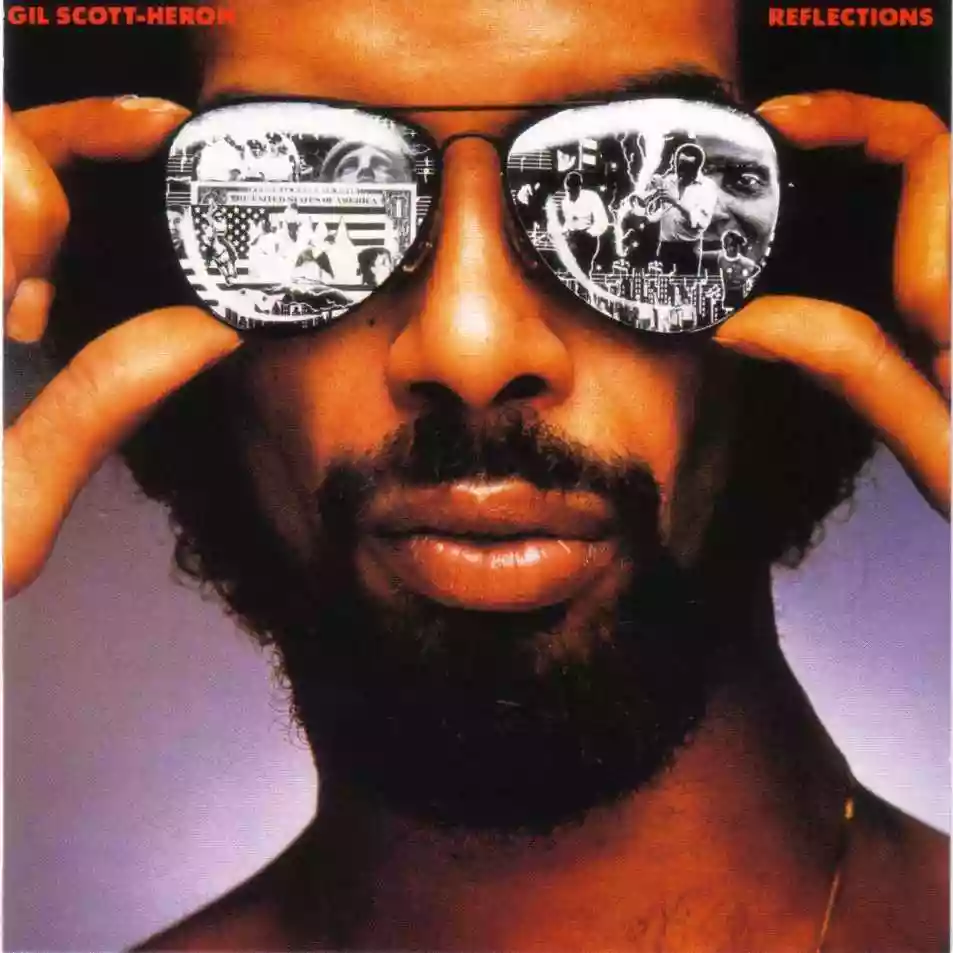
But it's about one of his albums from the '80s that I want to tell you about, my first encounter with him, "Reflections." It is an unparalleled mix of commitment, popular black music, political awareness, intelligent easy listening: body & soul, in short. And if in his previous works a kind of jazz-fusion was "the attire" most often donned by his dense and direct "streams," in the seven tracks of "Reflections" there is much more variety and the "black" music is declined in all its "cases". From the reggae of "Storm Music," a tribute to the King of Kingston whom he considered a master of freedom, to the d.o.c. Soul of "Grandma's Hands," where he seems like an angry Bill Withers. There's even a nod to Latin American rhythms with "Gun," and the classic cool-jazz "carpet" on which to lay his "morning thoughts." "Is The Jazz?" is a continuous succession of images (Bird, Billie, Miles, Prez. . . ) that responds in an unequivocal, yet original way (there are also Stevie Wonder and Bob Marley) to the question.
To seal this ecumenical conception of black sound, a cover of "Inner City Blues" could not be missing, a very personal interpretation, a more canonical first part that grafts onto his typical spoken-word. Closing beautifully with the 12-minute and more "b-movie", an ironic philippic about that mediocre western actor who became a terrible president (we are not much better today: there is a terrible cruise ship pianist at the helm of the ship...).
It's a shame that Gil is not doing well: his mirror glasses, proudly worn on the album cover, would be more useful than ever to help us reflect (with "reflections" in English referring to both reflections and contemplations) on the current desolate reality.
Loading comments slowly
Summary by Bot
The review praises Gil Scott-Heron's 1980s album Reflections as a powerful and versatile musical work blending jazz, reggae, and soul with sharp political awareness. It highlights his role as a precursor to rap and a voice for conscious rebellion. Despite his personal struggles and disillusionment with societal change, the album remains an essential reflection on black music and activism.
