
 •
Rating:
•
Rating:
THE REVIEW
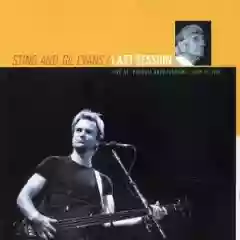
Concerning this album, to begin with, there are a lot of covers. Yes..., since it's a bootleg. For example, the one over here isn't the one that's on my shelves dedicated to the Supreme Art... this is what we find on the web out of laziness. But that's fine: as always, focusing on the substance, we couldn't care less about the cover and focus on the substance, just as we've always cared nothing about clothes, frames, and end credits. Art is always inside, not around. And here, there's an abundance of art, even if the album lends itself to more than one analysis. First of all, it would be nice to try to understand why there has never been an official release of this album, given the extremely high musical quality of the work. Mystery...: recording issues? Little conviction of the living protagonist? Little conviction, then, of the now unfortunately deceased protagonist? We probably will never know, though we know very well that sooner or later a widow or an heir who publishes everything always comes out. And then we'll wait for the proofs, the alternative takes, the backstages, and naturally the accompanying DVD. And we'll wait for it with declared disgust and a very ready wallet. Because, as you know, lovers are always supremely inconsistent.
It was an evening in July of 1987, an important year that marks, perhaps, the true end of the '80s. Prince was releasing a definitive "Sign Of The Times" which would close an extremely important chapter both for him and for music in general, black or white no matter. On the radio and on television, one might stumble into the first "house music" which would mark, with a thousand evolutions, personally one less interesting than the other, the end of the '80s and the beginning of the '90s. From there shortly after, a fake singer-songwriter revival mixed with pseudo-hardness of facade, dressed with plaid shirts à la Neil Young, would mark the nineties as the years of superficial recycling, the years where ideas were no longer there, but there wasn't yet the honesty of the confessed replaying of the past, daughter of an evident acceptance of the lack of ideas and the superiority of what had already been said. The market still followed ideas, and it wasn't the ideas (fake) being fabricated at the market table.
Here there's everything: there's Gil Evans' orchestra, one of the most interesting, innovative, and important in the history of jazz. An orchestra that has recorded and played with the best Miles, which managed to know and exalt the music of Hendrix when many still considered him just a hippie with a guitar. In short, a living monument that would soon leave us, like many others (Dexter Gordon, Stan Getz, and the same Miles, to name three, were still around, then...). And there's Sting, the musician (beloved by musicians around the world because he's good and by girls around the world because he's handsome, just as hated by many men because he's handsome...) who better than perhaps anyone else ferried the '70s into the '80s, with that absolutely fundamental band for the evolution of the sound unjustly defined as "light" which were The Police, and who then alone would traverse the eighties with sophisticated and refined rock-pop-jazz. In the year of Umbria Jazz, Sting had just wrapped up a good album, "Nothing Like The Sun", with some memorable pieces and others, in hindsight, quite negligible. And with some classics like "Fragile" or "Englishman in New York". And above all, with the first encounter with Gil Evans' orchestra, that Hendrixian "Little Wing" so different from the original, but so heartfelt and (it's superfluous to say) wonderfully orchestrated.
This concert is the ideal continuation of that collaboration. A very courageous work, then opposed by many and snubbed by others. But this was a vice of the eighties: to give an apparently impertinent example, then if an Artist gave a song for an advertisement, he was considered an idiot, nowadays he's considered an idiot if he doesn't... And in the eighties, strange years still to be studied and explored without triviality of thought and word, the perception of the "new" was decidedly different from today. Just as the perception of genres and the concept of "purism" was different. The purist of jazz, who today doesn't bat an eye at seeing Irene Grandi duet with Bollani, back then would allow themselves to be annoyed if a giant of pop-rock met, on an indisputable stage, a giant of jazz. And down with criticisms upon criticisms, from those who already took a few years to understand that Gil Evans was paying due and just tributes to another absolute giant like Jimi Hendrix, or from those who turned over and over with Miles' "Tutu" in their hands without understanding what it was. And in this setlist, there's everything: Sting solo in an excellent episode ("Consider Me Gone"), a distinctly jazz-themed piece, already present in "The Dream Of The Blue Turtles", The Police in other thrilling chapters ("Roxanne", "Tea In The Sahara" and the seemingly minor "Shadows In The Rain", already self-coverized even by solo Sting previously, and "Murder By Numbers").
Then a couple of Hendrix episodes and a tribute to Lady Day with the splendid "Strange Fruit", perhaps the most moving moment of the whole evening. Sting, for his part, who in some immediately preceding concerts had appeared slightly off his vocal game, for this very important appointment managed to recover the voice of absolutely the best moments: clear, pure, high, technically impeccable but absolutely expressive. If one wants to frame the moment "historically", it must be said that it is undoubtedly one of the highest encounters between two parallel but often distant worlds, such as jazz and "light music", sometimes strangely lovers, sometimes generators of beautiful children and failures. Here, everything runs smoothly: the orchestra (except for an alto solo of confessed modesty) is perfect, Sting, as said, is impeccable, the trusty Branford Marsalis was already the monster of skill he would later confirm to be in his subsequent records. And on top of everything, the added value of the bootleg must be evaluated, that is the absolute impossibility of post-production, additional recordings, and various corrections. What you hear is exactly what was played. Will they officially release it? Sooner or later, I bet, yes. For now, we make do - and it's a nice making do - with these CDs that circulate with a thousand covers and the same, beautiful, setlist.
Loading comments slowly
Summary by Bot
This review highlights the rare and extraordinary 1987 live collaboration between Sting and jazz legend Gil Evans. Despite being a bootleg with various covers, the musical quality and emotional depth shine through. The album blends jazz and rock, featuring a Hendrix tribute and flawlessly executed performances by Sting and Evans' orchestra. The review also reflects on the cultural and musical climate of the '80s, praising the courage and innovation behind this unique project. Enthusiasts await an official release with anticipation.Tracklist Lyrics
Sting
Sting (Gordon Matthew Thomas Sumner) is a British singer-songwriter and bassist, best known as the frontman of The Police and for a long solo career blending pop/rock songwriting with jazz and other influences.23 Reviews
