
 •
Rating:
•
Rating:
THE REVIEW
A wave that gradually forms on the horizon, conspicuous, large ("Destinazione Paradiso"), crashes with force, power, and beauty on the shore of a barren and deserted beach ("La fabbrica di plastica"), foams and gently approaches the sand near the seafront ("Campi di pop corn"), and then slowly, gradually, retreats without leaving (or almost) a trace ("Sdraiato su una nuvola" and related sequels).
This is how I express the rise of "Grigna" and its slow descent. From the glories of a good pop album like "Destinazione Paradiso", to the accelerations and harsh sounds of that beautiful work which is "La fabbrica di plastica" (still, in my opinion, his best album), passing through this strange but nonetheless good "Campi di pop corn". Then "everything else - as Califfo said - is boredom".
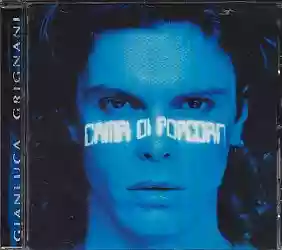
The album I am writing about is different, both thematically and musically, from the previous one. If the scruffy Grignani of 1996 was a boy who wanted to smash the window of his toy store, the result of a "Plastic Factory" of which he did not feel a part, the one in 1998 is once again a long-haired dreamer, a singer-songwriter who seems to be asking for an armistice with the masses who frowned upon his sudden deviation after "Destinazione Paradiso". This seems evident already from the cover and the booklet (laminated, glossy, with intense colors, different from the simplicity, from that intentional poverty of details and that wonderful recycled paper of the previous album, which had surprised even me), or from how the work is structured, which starts strong to please the fans and gradually calms down. Like a thunderstorm. Just listen to realize it.
"Baby revolution", hit single as well as the album's launch song, at first seems to recall "La fabbrica di plastica", but already in the chorus, it's sweeter and less rough. With "Campi di pop corn" and especially with "La Canzone", we return a bit to the Grignani of his beginnings, with that melancholy that had characterized him in the Italian scene. But it's still a dreamy Gianluca, who speaks almost crying with the ideal girl, fallen asleep next to him, or dreams of walking through fields white with popcorn carried by the wind "that helps him bring back the sun". A desire for normality after the previous musical detour?. After the brief but intense "grunge" phase of "Dalla cucina al soggiorno", we return to the sadness of "Marce 1/2", a beautiful and melancholic ballad that greatly recalls "Sally" by Vasco Rossi, the idol of a lifetime (by his own admission). We return again to the pop music "style Destinazione Paradiso" with "Scusami se ti amo" and then to rock with "Dio privato".
The new image of Jocker between reality and fantasy is seen again in "Jocker" and especially in "Candyman", in which the references to the more melancholic Radiohead are evident. In this second part, the album suffers from a sharp creative slowdown, a painful note felt in songs like "Mi piacerebbe sapere" (anyway very catchy) "Little man" and "Buongiorno guerra". It almost seems, at this moment, that the ideas of the Milanese singer-songwriter have diminished. Perhaps stifled? Mystery. Beyond all this, remains a good work, well played and well sung, even if less inspired than the exuberant second album. Indeed, those who expected from Grignani a sort of hyperbole towards experimentation will be disappointed. As mentioned above, with and especially after this "Campi di pop corn", the wave gradually retreats. Anonymous participations will follow in the meager San Remo Festivals and bland albums. What remains is only regret. Regret for what might have been but turned out to be just a runaway chromosome.
Loading comments slowly
Summary by Bot
Campi Di Pop Corn by Gianluca Grignani marks a stylistic shift from his more aggressive previous album La fabbrica di plastica to a softer, melancholic pop rock. The album starts strong but suffers from a creative slowdown in its latter half. While not as groundbreaking as his earlier work, it remains well performed and emotionally evocative, reflecting Grignani’s complex journey. The review expresses regret for the artist’s fading inspiration after this release.Tracklist Lyrics Videos
Gianluca Grignani
Italian singer-songwriter from Milan (born 1972). Broke through with Destinazione paradiso (1995), then swerved into more distorted, psychedelic textures with La fabbrica di plastica (1996) and Campi di popcorn (1998). Known for oscillating between experimental rock edges and pop ballads, with several Sanremo appearances.08 Reviews
