
 •
Rating:
•
Rating:
THE REVIEW
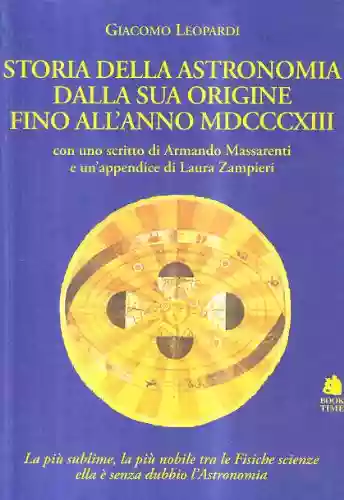
"The most sublime, the most noble among the Physical sciences is undoubtedly Astronomy."Thus begins the Great Marchigiano Poet in this youthful work where, unlike the usual scientific and sterile astronomy treatises, it is undoubtedly a work of flowing literature where Leopardi traces a historical and popular path where traditions merge with astronomical science and vice versa.
Past civilizations imagined Gods and Heroes in the night sky, cosmic powers, or simply tools and signs of divine will.
So it happened in Mesopotamia where the Sumerians began to study the sky inventing constellations that would later be adopted in the West and that have still reached us: everything derives from the Sumerians.
The Sumerians were convinced that the planets known at the time were manifestations of the main deities of the Sumerian Pantheon.
And to this day, these popular traditions remain with astrology, which in Galileo's era split from astronomy that followed a rigorous and scientific path, leaving astrology which after the Enlightenment flourished up to today.
All inventions, Leopardi too was against the daily horoscope and all those charlatans who took the astrological scene, Besides, Leopardi discovered that the zodiac signs derived from popular culture: Aries is the robustness of the lambs following the ram in spring, Taurus nourishes the twins, Cancer represents the retrograde motion of the sun, the ferocity of the lion corresponds to the ferocity of the summer heat, Virgo the harvest, Libra the equinoxes, the poison of the scorpion to denote autumn diseases, the hunt for wild beasts that the ancients carried out at the beginning of winter the Sagittarius, and Capricorn symbolizing the ascent of the sun after the solstice, Aquarius the abundant winter rains, and Pisces the abundant fishing in the seas.
Leopardi hits the target with this complete work on the remote human culture that developed around the stars and at the same time, a practical guide to observing the sky with the naked eye as the Sumerians did, to capture the eternal and cosmic suggestions always under continuous cluster bombings of psychotropic substances et al.
Loading comments slowly
Summary by Bot
Leopardi’s youthful work presents astronomy not as a sterile science but as a poetic and cultural journey. He traces the origins of constellations to the Sumerians and links star lore to ancient myths and zodiac signs. The review highlights Leopardi’s rejection of astrology superstitions while appreciating its cultural roots. This book offers both historical insights and practical tips for stargazing with the naked eye.
Giacomo Leopardi
Giacomo Leopardi (1798–1837) was an Italian poet, philosopher, essayist and philologist, author of the lyric collection Canti and of prose works including a history of astronomy. He is a central figure in 19th-century Italian literature.02 Reviews
